On this page
- Quick Takeaways
- Introduction
- Why Traditional Hazard Management Systems Fail Modern Mining Operations
- What Mine Hazard Management Software Actually Does
- Digital vs Paper: The Productivity Impact You Can’t Ignore
- Key Features of Effective Mine Hazard Management Software
- Meeting Australian Mining Compliance Requirements
- How Real-Time Hazard Tracking Transforms Safety Outcomes
- Surface and Underground Applications
- Conclusion
Quick Takeaways
- Mine hazard management software eliminates paper-based tracking delays, reducing hazard reporting communications from hours to minutes.
- Real-time visibility systems show hazards on interactive maps, giving crews instant access to critical safety information before they start work
- Digital hazard tracking enables proactive safety management instead of reactive responses
- Offline capability ensures remote mine sites maintain full hazard tracking functionality without network connectivity
- Integration with compliance frameworks like PHMPs and dynamic risk assessments keeps you audit-ready without duplicating work
Introduction
You know the scenario. A dozer operator receives a paper hazard report at shift start, but the geotechnical zone marked on the map doesn’t match what they’re seeing on site. They radio back. The supervisor checks old reports. Production stops while everyone waits for clarity.
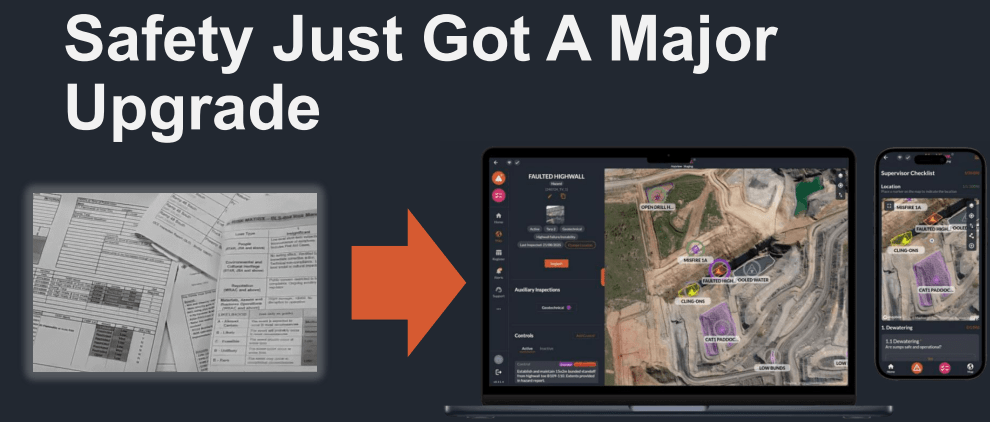
Mine hazard management software fixes this visibility problem. It replaces paper chaos with real-time control, showing every hazard on interactive maps that crews can access from any device. When a geotechnical engineer marks an unstable highwall at 10am, every operator sees it by 10:01.
This isn’t about digitising paperwork. It’s about giving your people the information they need to work safely and productively. Real-time hazard visibility means faster decisions, fewer delays, and the kind of proactive safety management that actually prevents incidents instead of just documenting them.
Modern mining operations generate hundreds of hazards across multiple work areas. Managing them effectively requires systems that match the speed and complexity of your operation.
Why Traditional Hazard Management Systems Fail Modern Mining Operations
Paper-based hazard management creates a dangerous gap between when hazards exist and when crews know about them. That gap costs you time, money, and safety outcomes.
Traditional systems rely on manual processes that can’t keep pace with dynamic mine sites. A geotechnical hazard identified during the day shift might not reach night shift operators until their pre-start meeting, hours after the hazard was logged. By then, work plans have already been made based on incomplete information.
The consequences show up in your incident reports and production schedules. Crews encounter unexpected hazards. Supervisors make decisions without complete data. Work gets delayed while people track down current information.
The Hidden Costs of Paper-Based Hazard Tracking
Paper creates friction at every step of the hazard management process. Engineers spend 3-4 hours compiling hazard reports that could be generated in minutes with digital systems. That’s 3-4 hours of high-value technical expertise wasted on administrative work instead of solving safety problems.
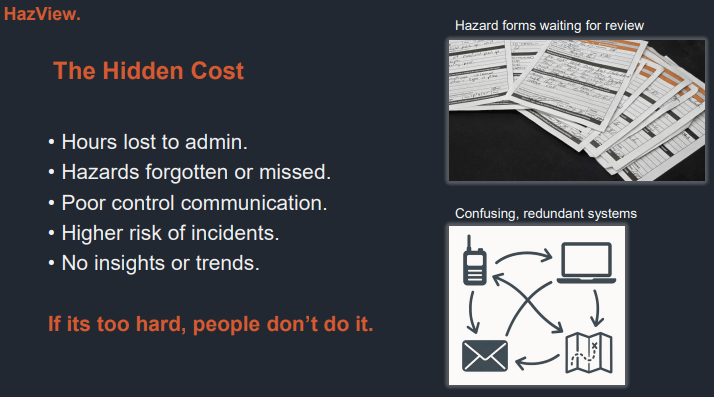
The costs multiply across your operation. Superintendents re-key data from paper forms into spreadsheets for management reporting. Operators wait at pre-start meetings while supervisors distribute printed updates. Compliance teams manually collate information for Queensland OCE shift report requirements.
Version control becomes impossible with paper. Which hazard map is current? Is the copy in the crib room the same as the one the supervisor has? When updates happen, who needs to receive new copies?
These aren’t minor inefficiencies. They’re structural problems that prevent you from managing hazards effectively. Mining operations using digital systems reduce hazard reporting time from 3-4 hours to minutes, freeing technical staff to focus on hazard analysis instead of paperwork.
The Visibility Problem: When Crews Can’t See What They’re Working Around
“What’s the point of a hazard report if I don’t know where the block lines are?” That question from a mine superintendent captures the core failure of traditional hazard management. Information exists, but it’s not accessible where and when decisions happen.
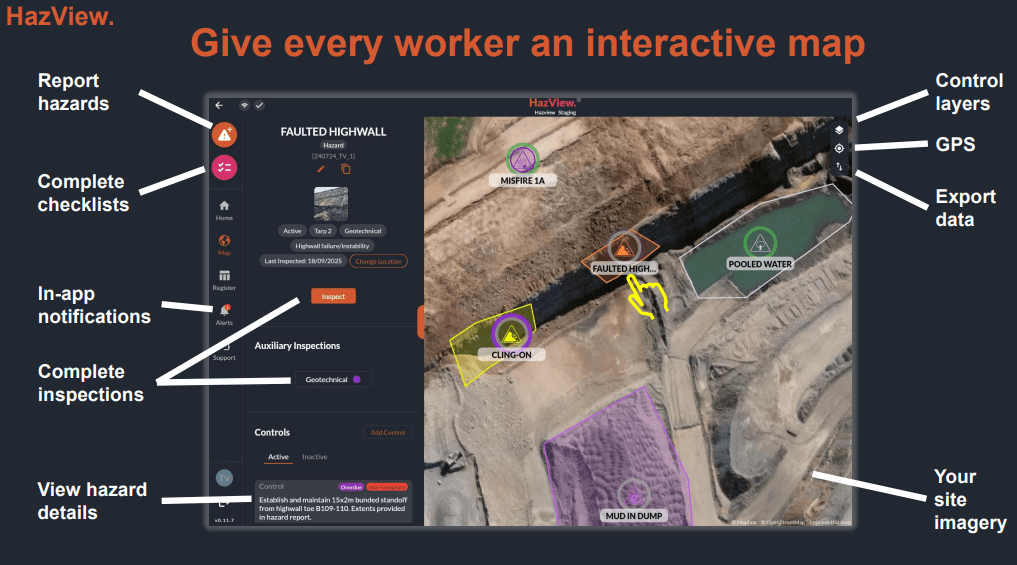
Operators need to know what hazards exist in their work area before they move equipment. Supervisors need complete hazard visibility when planning the day’s activities. Engineers need current data when conducting risk assessments.
Paper can’t deliver this visibility. A printed map becomes outdated the moment a new hazard is identified. Distributing updates to everyone who needs them is logistically impossible in real-time. The result is crews working with incomplete information and making decisions based on assumptions about what might be current.
This visibility gap creates the conditions for incidents. When operators don’t know a geotechnical hazard exists, they can’t avoid it. When supervisors don’t have complete data, they can’t plan work effectively. When engineers don’t see patterns across multiple hazards, they can’t identify systemic issues.
Modern mining operations need visual hazard mapping that shows current conditions in real-time, accessible from any location on site.
What Mine Hazard Management Software Actually Does
Mine hazard management software transforms how you identify, track, and control hazards across your operation. Instead of managing hazards through disconnected paper processes, you get a single system that handles everything from initial reporting to compliance documentation.
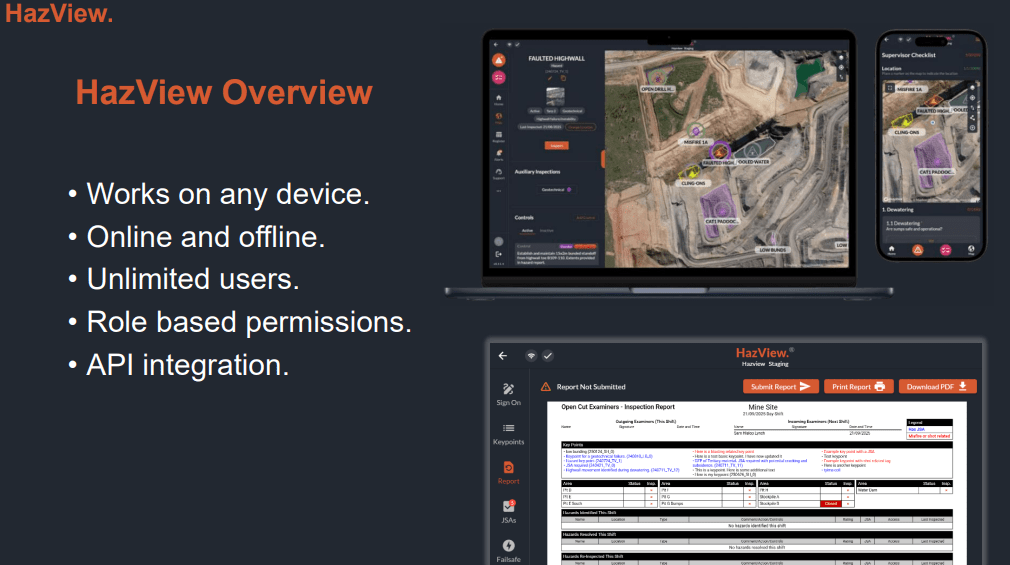
The software creates a live hazard database that updates in real-time as conditions change. When a geotechnical engineer identifies an unstable highwall, they log it directly from their mobile device. The system immediately plots the hazard on your mine map, assigns it to the relevant work area, and notifies everyone who needs to know.
This happens automatically, without manual data entry or administrative overhead. The information flows from the person who identified the hazard to every crew member who might encounter it, creating the visibility that paper systems can’t deliver.
Real-Time Hazard Visibility on Interactive Maps
Interactive hazard maps show you exactly what’s happening across your site right now. Every logged hazard appears on your mine plan with precise location data, status information, and associated control measures.
Operators check the map before starting work and see every active hazard in their area. Red zones mark geotechnical hazards. Orange markers show equipment isolation points. Blue areas indicate environmental controls. Everything they need to work safely is visible at a glance.
The maps update automatically as conditions change. Close out a hazard and it disappears from the active view. Identify a new one and it appears immediately. You’re always working with current information, not yesterday’s data.
Supervisors use the same maps to plan work activities and allocate resources. They can see which areas are clear, which have active hazards, and what controls are in place. This visibility enables better decision-making and more efficient operations.
Automated Compliance and Reporting
Compliance reporting transforms from a time-consuming manual process to an automated output. The system tracks every hazard from identification through to closeout, creating a complete audit trail without additional administrative work.
Generate Principal Mining Hazard Management Plan reports with a few clicks. Pull OCE shift reports that show all hazards identified and controlled during the period. Create executive summaries that show trends across hazard types, locations, and timeframes.
The data is already in the system because it’s captured as part of normal hazard management workflows. You’re not duplicating work or compiling information from multiple sources. The compliance reporting happens automatically using the same data that drives daily operations.
Safety management systems designed for mining integrate regulatory requirements directly into workflows, ensuring compliance happens as a natural part of your process rather than as a separate administrative burden.
Offline Capability for Remote Sites
Remote mine sites can’t rely on consistent network connectivity, but hazard management can’t wait for reception. Effective mine hazard software works offline, allowing crews to log hazards, access maps, and review controls without internet access.
The software syncs data automatically when connectivity is available, ensuring everyone has access to the latest information even when working in areas with no coverage. An operator in the pit can check hazard status offline. A geotechnical engineer can log a new hazard from an area with no signal. The information flows to the central database when they return to range.
This offline hazard mapping in the Bowen Basin approach ensures safety systems work everywhere on site, not just in areas with good connectivity. Your hazard management capability doesn’t degrade in remote areas where you need it most.
Integration with Existing Safety Frameworks
Mine hazard management software doesn’t replace your safety systems. It integrates with them, creating a connected environment where information flows between systems without manual data entry.
Link hazards to your risk register so every identified hazard automatically connects to relevant risk assessments. Integrate with permit-to-work systems so operators see active hazards when planning high-risk activities. Connect to your incident management system so investigations can reference all hazards present at the time of an incident.
These integrations eliminate data silos and ensure consistency across your safety management approach. You maintain one source of truth for hazard information that feeds every system that needs it.
Digital vs Paper: The Productivity Impact You Can’t Ignore
The shift from paper to digital hazard management delivers measurable productivity gains that directly impact your operation’s efficiency and profitability. These aren’t theoretical improvements. They’re documented outcomes from mining operations that have made the transition.
Digital systems eliminate the friction that slows down paper-based processes. Information moves at the speed of your network instead of the speed of physical distribution. Updates happen instantly instead of requiring printed redistributions. Data becomes accessible to everyone who needs it instead of living in filing cabinets.
Time Savings: From Hours to Minutes
The time savings start with hazard reporting. Engineers who previously spent 3-4 hours compiling shift reports now generate them in minutes. That’s not because they work faster. It’s because the system automates the compilation, formatting, and distribution that used to happen manually.
Supervisors save time at pre-start meetings. Instead of distributing printed hazard updates and walking through each one, they pull up the interactive map and show crews exactly what’s active in their work areas. A process that took 20 minutes (or that was never fully completed) now takes 5.
Operators save time accessing information. Instead of checking multiple paper sources to understand hazards in their area, they check one digital map that shows everything. Instead of radioing supervisors for clarification, they access detailed hazard information directly from their device.
Multiply these time savings across your operation and the impact becomes significant. A 500-person mine site saving 30 minutes per person per week recovers 250 hours weekly, over 13,000 hours annually. That’s productive time returned to actual work instead of administrative processes.
Improved Decision-Making Through Data
Better data enables better decisions at every level of your operation. Superintendents planning the week’s activities can see hazard trends and allocate resources accordingly. Supervisors assigning work can route crews away from high-hazard areas when possible. Operators can adjust their approach based on specific hazard details.
The data also reveals patterns that aren’t visible in paper systems. You can identify areas that consistently generate certain hazard types and address root causes. You can track how quickly hazards get closed out and improve response processes. You can measure the effectiveness of control measures and refine your approach.
Research shows that digital control-of-work systems, including hazard management, boost both safety and productivity by giving people the information they need to work effectively. The productivity gains aren’t separate from safety improvements. They’re the same thing viewed from different angles.
Key Features of Effective Mine Hazard Management Software
Not all hazard management software delivers the same value. Effective systems share specific features that make them practical for mining operations rather than generic safety platforms adapted for mining use.
When evaluating software, focus on capabilities that address mining-specific challenges: remote locations, offline requirements, integration with mine planning systems, and compliance with Australian regulatory frameworks.
Mobile-First, Works Everywhere
Mining happens in the field, not in offices. Your hazard management system needs to work on the devices people actually carry, in the locations where hazards actually exist.
Mobile-first design means the software is built for phones and tablets, not desktop computers with mobile versions as an afterthought. Engineers log hazards from the pit floor using their phones. Operators check hazard status from their tablets in equipment cabs. Supervisors review controls from their devices during site inspections.
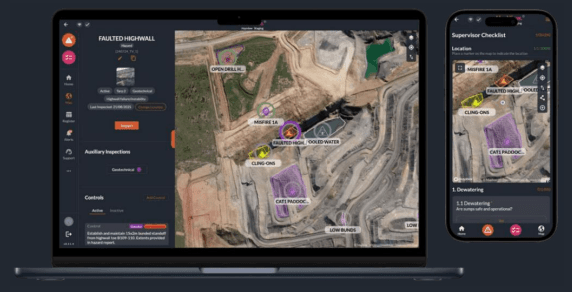
The interface should be intuitive enough to use with gloves on. Data entry should be quick enough to complete in the field without significant interruption to work. Map navigation should be smooth even when displaying hundreds of hazards across large mine areas.
Works-everywhere means offline capability that doesn’t degrade functionality. You should be able to access all hazard data, log new hazards, and update existing ones without connectivity, with automatic syncing when back in range.
Live Hazard Database with Inspection Tracking
A live hazard database maintains current status on every hazard across your operation. You can see at a glance how many hazards are active, what types they are, where they’re located, and what controls are in place.
The database tracks complete hazard lifecycle information: who identified it, when it was logged, what assessment was conducted, what controls were implemented, inspection history, and closeout details. This creates the audit trail you need for compliance and the operational visibility you need for management.
Inspection tracking integrated with the hazard database ensures controls remain effective over time. Schedule recurring inspections for long-term hazards. Track completion status. Receive alerts when inspections are overdue. Link inspection findings back to the hazard record to maintain complete history.
Customizable Reporting Templates
Your operation has specific reporting requirements that generic templates don’t address. Effective hazard management software lets you create custom reports that match your internal processes and regulatory obligations.
Build templates for daily hazard summaries, weekly trend analyses, monthly management reviews, and annual compliance reports. Define exactly what data appears, how it’s formatted, and who receives it. Set up automated distribution so reports generate and send on schedule without manual intervention.
The customization should extend to data fields and hazard categories. Configure the system to track the hazard types relevant to your operation, capture the information your processes require, and align with your existing safety frameworks.
Integration Capabilities
Your hazard management system needs to connect with other operational systems: mine planning software, permit-to-work systems, risk registers, incident management platforms, and training databases.
API access enables these integrations without manual data transfer. Hazards logged in your hazard management system can automatically update your risk register. Permit applications can pull current hazard data for the work area. Incident investigations can reference all hazards present at the incident location and time.
Integration eliminates duplicate data entry and ensures consistency across systems. You maintain one authoritative source for hazard information that feeds every platform that needs it.
Meeting Australian Mining Compliance Requirements
Australian mining operations face specific regulatory requirements for hazard management. Effective software supports compliance with these frameworks without creating additional administrative burden.
The key is building compliance into normal workflows rather than treating it as separate documentation. When you log hazards, conduct inspections, and implement controls through your software, you’re simultaneously creating the records regulators expect to see.
Principal Mining Hazard Management Plans (PMHMPs)
Principal Mining Hazard Management Plans require systematic approaches to identifying, assessing, and controlling significant hazards. Your hazard management software should directly support PMHMP requirements by documenting these processes.
Link hazards to relevant PMHMPs so you can demonstrate how identified hazards connect to your management plans. Track control implementation to show how you’re managing principal hazards in practice. Generate reports that demonstrate compliance with plan requirements.
The software creates evidence that your PMHMPs are living documents guiding actual work, not just paper exercises that sit on shelves. Auditors can see how hazards are identified, what assessments are conducted, what controls are implemented, and how effectiveness is verified.
Queensland OCE Report Requirements
Queensland operations need to document hazards and controls in OCE reports submitted to Resources Safety and Health Queensland. Generating these reports manually from paper records is time-consuming and error-prone.
Hazard management software automates OCE reporting by maintaining complete records of all hazards identified, assessed, and controlled during the reporting period. Generate compliant reports with a few clicks instead of hours of manual compilation.
The system ensures you’re capturing all required information as hazards are logged, so nothing is missing when report time comes. Date stamps, location data, hazard descriptions, risk assessments, and control measures are all recorded in formats that translate directly into OCE report requirements.
Dynamic Risk Assessment Mandates (2025)
Recent updates to Australian mining safety regulations emphasise dynamic risk assessment capabilities. Operations need to adapt quickly to changing conditions and ensure crews have current information about hazards and controls.
Real-time hazard management software enables the dynamic assessment approach regulators expect. Conditions change and hazards are logged immediately. Risk assessments are conducted and documented in the field. Controls are implemented and visible to all crews instantly.
This responsiveness demonstrates the proactive safety management that regulation requires. You’re not documenting what happened after the fact. You’re managing hazards as they emerge and ensuring everyone has current information to work safely.
How Real-Time Hazard Tracking Transforms Safety Outcomes
Real-time hazard tracking fundamentally changes how safety works on your site. Instead of reacting to incidents, you prevent them by giving people the information they need before exposure occurs.
The transformation shows up in measurable outcomes. Operations implementing real-time hazard systems report up to 48% reduction in incidents. That’s not because the systems prevent hazards from existing. It’s because they prevent people from being exposed to hazards they don’t know about.
Proactive vs Reactive Safety Management
Reactive safety waits for incidents to happen, then investigates and implements controls. Proactive safety identifies hazards before exposure, implements controls immediately, and adjusts as conditions change.
Real-time systems enable proactive management by closing the gap between hazard identification and crew awareness. A geotechnical hazard identified at 10am is visible to all crews by 10:01. Controls implemented at 11am are documented and accessible site-wide by 11:01.
This speed prevents the scenarios where crews encounter hazards they weren’t aware of. It enables effective hazard reporting improves safety visibility across your entire operation, creating shared awareness that keeps people safe.
The proactive approach also improves hazard quality. When reporting is quick and easy, people report more hazards. You get better coverage of actual site conditions instead of only the most serious issues making it into the system. More data enables better risk management.
Critical Controls That Actually Work
Critical controls fail when people don’t know about them, can’t access them, or implement them inconsistently. Real-time hazard tracking addresses all three failure modes.
Visibility ensures people know what controls are required. Link critical controls to hazards on your interactive map so operators see exactly what controls apply in their work area. Document control requirements clearly so there’s no ambiguity about what’s needed.
Accessibility means control information is available where work happens. An operator planning to work near a geotechnical hazard can pull up the specific controls on their mobile device before starting. They don’t need to remember from a pre-start meeting or track down a supervisor for clarification.
Consistency comes from documentation and verification. Record when controls are implemented, who implemented them, and verification that they’re effective. Track control effectiveness over time and adjust when needed.
Understanding why critical controls fail without real-time visibility helps you appreciate why digital systems deliver better safety outcomes than paper processes.
Surface and Underground Applications
Mine hazard management software works across different mining methods, though the specific hazards and workflows vary between surface and underground operations.
The core functionality remains the same: identify hazards, document them on interactive maps, implement controls, and maintain visibility for all crews. The application details adapt to operational context.
Open Cut Operations
Surface operations spread across large geographic areas with hazards distributed throughout: geotechnical zones on highwalls, blast areas with restricted access, heavy vehicle interaction points, stockpile management areas, and infrastructure hazards.
Interactive maps for open cut mines display hazards across the entire pit, waste dumps, and infrastructure areas. Operators can zoom to their specific work location and see relevant hazards without filtering through irrelevant information from other areas.
Common open cut hazard types tracked in the system include ground instability, blast exclusion zones, mobile equipment interaction areas, overhead powerlines, edge protection requirements, and environmental controls.
Large-scale open cut operations often manage 3,000+ hazards over a 12-month period, demonstrating the data management capability required from effective software.
Underground Mining
Underground operations face different challenges: confined spaces, ground control requirements, ventilation hazards, and access restrictions. The interactive maps adapt to underground plans showing stopes, development headings, and infrastructure.
Hazard tracking in underground environments focuses on ground conditions, ventilation adequacy, escape routes, refuge chambers, and isolation points. The software needs to handle complex three-dimensional underground workings, not just surface maps.
Offline capability becomes even more critical underground where network coverage is limited or non-existent. Crews need full hazard access without requiring constant connectivity to surface systems.
Guides in this series
Each guide below covers one part of this topic in depth.
- Principal Hazard Management Plans Explained (NSW & WA)
- Digital Hazard Map Mining: Why Visual Maps Outperform Text-Based Systems
- Mine Site Hazard Reporting
- Visual Hazard Mapping Software
- Why Critical Controls Fail — and How to Fix It with Real-Time Visibility
- What’s an “Acceptable Level of Risk” in Mining? It Depends on What You Can Prove
- Offline Hazard Mapping in the Bowen Basin: When Reception Fails, Safety Shouldn’t
- Why ‘We’ve Always Done It This Way’ Is Failing Mining Safety
- Why General Checklists Create a False Sense of Safety in Mining
- How One Client Request Improved JSA Visibility for Everyone
- Proactive Hazard Management: Insights for GMs, OCEs, and Supervisors in Open-Cut Mining
- Enhancing Safety in Australian Open-Cut Mines: Lessons Learned and How HazView™ Could Have Made a Difference
- Meeting Legal Requirements for Hazard Management in Open Cut Coal Mines: The Importance of a Comprehensive Database
- Managing Hazards in Open Cut Coal Mining: The Importance of a Comprehensive Database like HazView
HazView keeps this detail live on a site map rather than in a folder. Book a demo to see it against your own site.
FAQ: Common Questions About Mine Hazard Management Software
Can hazard management software work offline in remote mine sites?
Yes. Effective mine hazard management software is designed for offline operation, recognising that remote mine sites often have limited or no network connectivity in working areas.
The software stores complete hazard data locally on mobile devices, allowing full access to hazard maps, control information, and reporting capability without internet connection. You can log new hazards, update existing ones, and review all current information offline.
When connectivity becomes available, the system automatically syncs changes to the central database and downloads any updates made by others. This ensures everyone eventually has the same current information while allowing continuous operation in areas without coverage.
How does mine hazard software integrate with existing safety systems?
Integration happens through APIs (application programming interfaces) that connect different software platforms and enable data exchange without manual entry.
Your hazard management system can connect to mine planning software to automatically import updated mine plans, integrate with permit-to-work systems to show hazards relevant to planned activities, link to your risk register so hazards connect to formal risk assessments, and sync with incident management platforms to provide hazard context for investigations.
The specific integrations available depend on your software platforms. When evaluating hazard management systems, confirm they offer integration options compatible with your existing technology stack.
What’s the typical implementation timeline for mine hazard management software?
Implementation timelines vary based on operation size and complexity, but typical deployments follow a 4-8 week process from contract signing to full operation.
Week 1-2 involves system configuration: uploading mine plans, setting up hazard categories, creating user accounts, and configuring workflows to match your processes. Week 3-4 covers user training and pilot deployment with a limited group. Week 5-6 expands to full site deployment with ongoing support. Week 7-8 focuses on optimization based on user feedback and operational experience.
Larger operations or those with complex integration requirements may extend timelines to 10-12 weeks. The key is thorough configuration and training upfront to ensure successful adoption across your workforce.
Conclusion
Mine hazard management software transforms paper chaos into real-time control, giving your people the visibility they need to work safely and productively. The technology exists. The results are proven. The question is how long you’ll continue managing hazards with systems that can’t keep pace with your operation.
Reducing hazard reporting from hours to minutes and freeing your technical staff to focus on safety instead of paperwork aren’t future possibilities. They’re current realities for operations using effective digital systems.
Your crews deserve real-time information about the hazards they’re working around. Your supervisors need complete visibility to make good decisions. Your operation needs the efficiency that comes from eliminating manual processes.
Ready to see what real-time hazard management looks like for your operation? Book a demo or start a trial to experience the difference digital visibility makes.