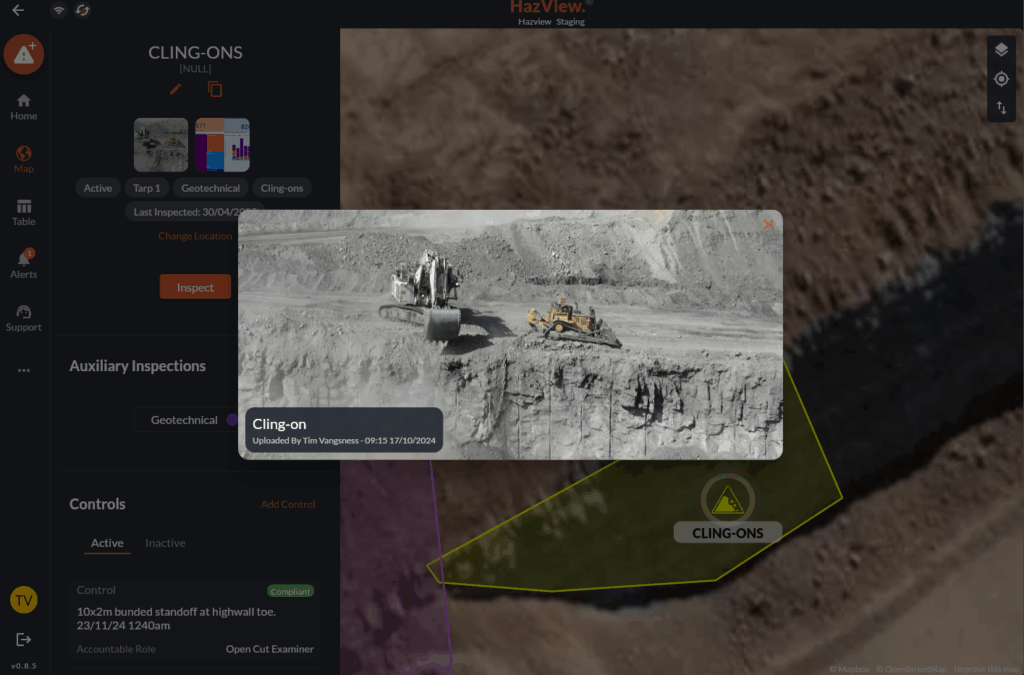
The general checklists mining crews complete every shift feel like compliance, but they rarely deliver clarity or control. A tick against a whole dig block tells you someone looked. It does not tell you where the problem is, how bad it is, or what was done about it, and in open cut mining those are the details that decide whether anyone gets hurt.
This guide explains why area-wide checklists create a false sense of safety, what Queensland law actually expects an inspection to produce, how to make checklists site specific, and what a record looks like when it drives action instead of filing.
The problem with generalised hazard reporting
A typical general checklist carries an entry like this: “Hazard: fresh ravelling in Block X.” It looks like risk being managed: the hazard was seen, written down and signed off.
Now read it as the next shift will. That one line leaves every important question open:
- Where exactly is the ravelling?
- How far is it from the bund line or the active work area?
- Has it been photographed, or rated for severity?
- What controls have been applied, and has anything been escalated?
- Has it got worse since the last inspection, or is this the first time anyone noticed it?
Multiply that uncertainty across a highwall two kilometres long and the risk compounds fast. Writing “cling-on identified” somewhere along that wall is not just vague. It is dangerous, because the record says the hazard is known and handled when nobody on the next shift could walk to it.
What the law expects an inspection to produce
In Queensland coal, the law is specific about outcomes, not tick boxes. Section 141 of the Coal Mining Safety and Health Regulation 2017 requires a surface mine to have a standard operating procedure for safety inspections of workplaces, including the open-cut examiner’s inspection. That procedure must require an inspection before an on-site activity starts and periodically while it continues, and it must make the results, including details of hazards and recommended corrective action, available to the mine’s coal mine workers.
“Details of hazards” is the phrase that matters. A tick against a block is a result, but it is not a detail. Section 107 of the same regulation goes further when an open-cut examiner finds an unacceptable level of risk: the examiner must make the thing safe if practicable, otherwise warn exposed persons, erect a barrier to stop people unknowingly entering the part of the mine where the risk exists, and stop mining in and withdraw everyone from that part until it is safe. You cannot barricade “somewhere in Block X”. The obligation assumes you know where the hazard is.
Those inspection reports and their findings also belong in the mine record. Section 68 of the Coal Mining Safety and Health Act 1999 requires the coal mine operator to keep a mine record that includes all reports of, and findings and recommendations from, inspections carried out at the mine under the Act, and to keep each matter for at least seven years. A vague entry kept for seven years is still a vague entry. Our guide to what Queensland requires of the mine record covers that obligation in full.
Why general checklists feel safe when they are not
General checklists persist because they are easy to write, easy to audit and easy to complete. Those same qualities are what make them misleading.
They measure completion, not condition
A completed checklist proves an inspection happened. Management reports then count completed checklists, and a high completion rate starts to stand in for a safe site. The number that matters, which hazards are open and where, is not in the report at all.
Checklist fatigue turns questions into habits
Checklist fatigue in mining sets in quickly. When the same forty generic questions appear every shift, and most of them never apply to the ground in front of you, people learn to move down the page quickly. The one question that did matter today gets the same tick as the thirty-nine that did not.
Text loses location
Mine sites describe place in local shorthand: block numbers, ramp names, strip and bench. That shorthand drifts as the pit advances, and it means nothing to a contractor on their second swing. A hazard described only in words is a hazard only some people can find.
A clear box hides the trend
Ground conditions rarely fail without warning. Tension cracks widen, ravelling increases, water appears on a face. A checklist that records “OK” or “not OK” for an area on each shift cannot show that the same crack has been noted, a little larger each time, for a week.
The case for mapped, site specific checks
The fix is not a longer checklist. It is a checklist written for the ground being inspected, whose findings are tied to an exact place. Site specific checklists in mining share a few traits:
- Exact location. Each finding is pinned to a point or zone on the site map, not a block name.
- Evidence. A photo of the defect, taken at the time, beats any description.
- Severity. A rating, ideally tied to the site’s TARP, so the response is decided by the finding rather than by who happened to read it.
- Controls. What was applied, who owns it, and when it will be checked again.
- Escalation. A non-conforming answer should open the next steps, not leave them to memory.
Our checklist templates for the highwall inspection, the spoil dump inspection and the haul road inspection are written this way: grouped by the actual features being inspected, with a clear trigger for escalation on each check, and in the dump template the site TARP levels built into the table. The critical control verification checklist applies the same idea to controls instead of ground.
Location is what turns a finding into a target. When something is wrong you do not get a vague line in a spreadsheet, you get a point on a map that someone can drive to, look at and act on. That is the argument behind putting inspections on the mine site map, and the reason visual hazard maps outperform text-based systems.
How to fix a general checklist without starting again
Most sites do not need to throw their forms away. They need to change what the forms ask for.
- Split by area type. A highwall, a spoil dump and a haul road fail in different ways. One generic “pit inspection” form serves none of them well.
- Replace yes or no with what you saw. “Face condition acceptable?” invites a tick. “Signs of ravelling, cracking or water on the face?” invites a look.
- Make location mandatory for any defect. If the answer is not conforming, the inspector marks where.
- Require a photo for anything above a set severity. It settles arguments later and shows change over time.
- Tie ratings to the TARP. Let the finding determine the response level.
- Close the loop. Each defect gets a control, an owner and a due date, and the next inspection checks it.
Our mine site inspection checklist guide for Australian operations sets out how these inspection types fit together, and who is required to do which. Outside Queensland coal the legal wording differs; for New South Wales see NSW mine workplace inspection requirements.
Where general checklists in mining go wrong in practice
- The handover gap. The night shift OCE notes a crack. The day shift reads “crack noted, Block X” and cannot find it before work starts nearby.
- The duplicate hazard. Three inspectors record the same defect three different ways, and nobody can tell whether it is one hazard or three.
- The orphaned control. A bund is recommended on the form, but no one owns it, so it never appears on anyone’s list.
- The paper trail that stops at the office. The sheet is filed, the scan is saved, and the finding never reaches the people working near it. Moving to paperless inspections on the mine site only helps if the digital record carries location and follow-up too.
Turning inspections into ground truth
The operational problem is simple to state. Inspection findings live in forms, hazards live in someone’s head or on a whiteboard, and controls live in a spreadsheet. Nobody can see all three for the same piece of ground at once, and no amount of ticking fixes that.
HazView puts them in one place: a single interactive map of the site that every role uses. A checklist can be pinned to a location on the map or attached to a specific hazard, so the finding sits where the ground is. Each question can carry photos and comments, and a non-conforming answer can open a follow-up section so escalation is part of the form. TARP levels can sit in the answer options, so the response level comes straight from the inspection, and controls carry an owner, a due date and a status. Checklists work offline in the pit and sync once the device is back in reception.
Sites usually start by converting their existing forms like for like, then tightening them once the team can see the results on the map. If you run a site and want to see what that looks like for your managers, read how HazView supports mine managers or book a HazView demo.
General checklist versus site specific check
| Question | General checklist | Site specific, mapped check |
|---|---|---|
| Where is the hazard? | “Block X” | Pinned point or zone on the site map |
| How bad is it? | Tick or cross | Severity rating tied to the TARP |
| What does it look like? | Free text, if anything | Photo taken at the time |
| What was done? | “Noted” | Control with owner, due date and status |
| Is it getting worse? | Not visible | History on the same hazard |
| Can the next shift find it? | Only if they know the shorthand | Yes, on the map |
| What does the report show? | Checklists completed | Open hazards and where they are |
Related guides
- Mine Hazard Management Software: From Paper Chaos to Real-Time Control
- How One Client Request Improved JSA Visibility for Everyone
- Proactive Hazard Management: Insights for GMs, OCEs, and Supervisors in Open-Cut Mining
- Enhancing Safety in Australian Open-Cut Mines: Lessons Learned and How HazView™ Could Have Made a Difference
- All Hazard Management guides
Frequently asked questions
Are general checklists illegal in mining?
No. The law does not prescribe or ban any particular form. At a Queensland surface coal mine, section 141 of the regulation requires that inspection results, including details of hazards and recommended corrective action, are made available to workers. A general checklist can technically be completed and still fail to give those details, which is the problem.
What are the main mining checklist limitations?
They record completion rather than condition, lose location in text, hide trends between shifts, and leave controls without an owner. Each gets worse as the site grows.
How do you reduce checklist fatigue on a mine site?
Ask fewer, sharper questions that match the area being inspected, and use conditional follow-ups so detail is only requested when something is wrong. A short form that always applies gets more attention than a long one that mostly does not.
What makes a checklist site specific?
It is written for the features actually present, such as a particular highwall, dump or road, and it records findings against an exact location with evidence, a severity and a control. The site’s own TARPs and escalation paths are built into it.
Do we have to rewrite all our forms to fix this?
Usually not. Start with the existing form, add a mandatory location and photo for any defect, link ratings to the TARP and give every defect an owner. Then remove questions that never apply to the area the form covers.