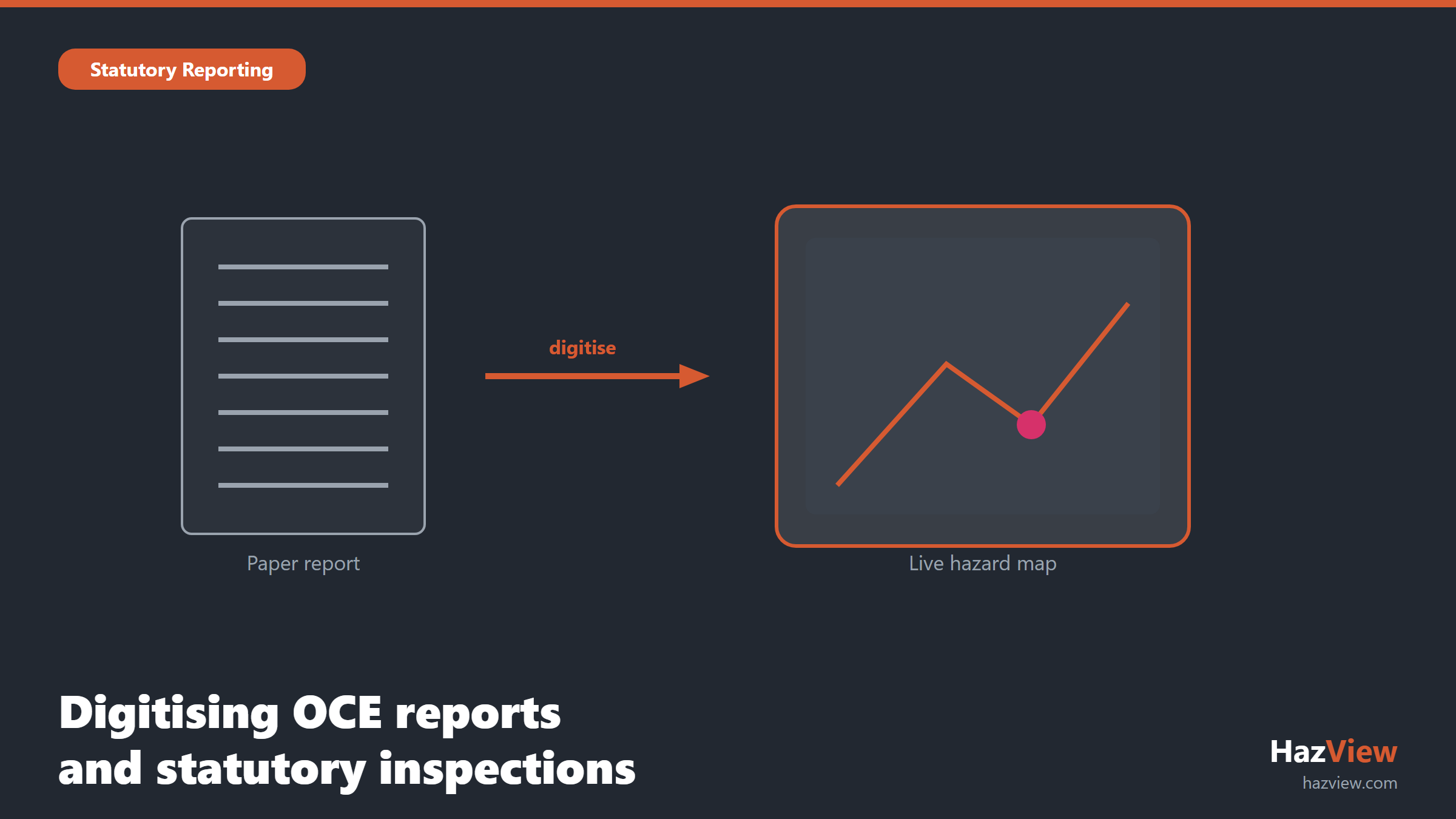
Good OCE report software lets an Open Cut Examiner record a statutory inspection digitally, then produce a report that meets the same content, record-keeping and availability obligations as a paper one. At Queensland surface coal mines the law does not require paper. It requires that the inspection is done, that the report contains the right information, that it is kept, and that it can be produced when needed. A well-built digital OCE report satisfies those obligations while adding a timestamped, georeferenced and permanent record that paper cannot match. This article explains what to look for, and where digital genuinely helps.
The problem with paper OCE reports
Paper has served statutory reporting for decades, but its weaknesses are well known to anyone who has run a shift. Handwriting is misread. Pages go missing from the book. A hazard described in words (“windrow low near the northern ramp”) is open to interpretation by the next crew. Photographs live on a phone and never make it into the record. When an inspector or an incident review asks for the report from a shift three months ago, someone spends an afternoon in a filing cabinet.
None of this changes the legal validity of a paper report. It does, however, make the report harder to trust, slower to act on and weaker as evidence. The point of digitising is not novelty. It is to remove the friction and the gaps that paper introduces, while keeping every obligation intact.
What an OCE report must contain
The Open Cut Examiner is a statutory position. During a shift the OCE inspects the mine and produces a report on the state of the mine, the hazards present and the actions taken or required. Those obligations sit under the Coal Mining Safety and Health Act 1999 and the Coal Mining Safety and Health Regulation 2017. In practice, a complete report captures:
- The mine, the area or areas examined, and the shift and date.
- The examiner’s identity and the time of the examination.
- The condition of the workings and any hazards observed, described clearly enough for the next crew to locate and understand them.
- Actions taken during the shift and actions required, with responsibility and any relevant conditions on continuing work.
- A record that can be kept and produced, and made available to the people who rely on it.
The obligation is about content, retention and availability, not about the medium. For the specific detail, see our guide to Queensland OCE report requirements. Whether you work from a printed open cut examiner report template or an on-screen form, the same fields have to be there.
Does digital reporting meet Queensland requirements
Yes, provided the digital report does what the law asks of any report. It must contain the required information, it must be kept for the required period, and it must be available to the people entitled to see it, including inspectors from the Resources Safety and Health Queensland regulator. A digital OCE report that meets those three tests carries the same weight as a paper one.
Be careful with claims you may hear from vendors. No software is “approved” or “certified” by the regulator as a statutory report. Regulators set the obligations; the mine is responsible for meeting them. What good statutory report software mining teams should look for is a system that is designed around those obligations and makes them easy to satisfy, not a badge that promises the decision has been made for you. The responsibility to get the content, retention and availability right stays with the mine and its statutory officials.
The digital chain of evidence
This is where digital moves ahead of paper. A statutory report is not only a shift tool. It is a record that may be read months later during an audit, an investigation or a court process. The quality of that record is the quality of your evidence.
An electronic mine inspection can attach metadata to every entry that paper simply cannot hold:
- Georeferencing. A hazard is pinned to a coordinate on the mine, not described in prose. The next OCE, the mine manager or an inspector sees exactly where it is on a map. Our note on why a digital hazard map outperforms text-based systems covers this in depth.
- Timestamping. Each observation and action carries the time it was recorded, so the sequence of events is unambiguous.
- Photographs and media. Images are captured against the hazard in place, not lost on a personal device.
- A permanent, tamper-evident record. Entries are retained and any changes are logged, so the report cannot be quietly rewritten after the fact.
When something goes wrong, this chain of evidence is what lets the mine show what was known, when it was known, and what was done about it. It also feeds directly into high potential incident reporting in Queensland, because the hazard record and the incident record share the same underlying data instead of being reconciled by hand.
Faster, clearer handover
Handover is where the daily value shows up. At the change of shift the incoming OCE and crew need to know the state of the mine and the live hazards in minutes, not by deciphering a page of notes. A digital report presents open hazards on a map, sorted by area and severity, with the actions still outstanding. Nothing carries over by being forgotten, because open items stay open until they are closed and signed off.
The gain compounds over time. Because every shift’s report is structured data, patterns become visible: a hazard that keeps recurring at the same location, an action type that is consistently slow to close. That is the material behind our piece on lessons from OCE shift reports. Paper gives you a shift record. Structured digital reporting gives you a trend.
Audit and inspector readiness
When an inspector visits or an internal audit runs, retrieval speed and completeness matter. With paper, producing a specific shift’s report, its photographs and the follow-up actions can take real effort, and gaps are common. With digital reporting, any report is searchable by date, shift, area or examiner, and it comes with its media and action history attached. You can display the current state of the mine on a screen and show the trail behind any single hazard in seconds.
Availability is a legal obligation, not just a convenience. Being able to produce a complete, legible, timestamped record on request is exactly what the availability requirement is about, and it is far easier to meet from a well-organised system than from a shelf of report books.
What to look for in OCE report software
If you are assessing options, judge them against the obligations and the practical realities of a shift rather than the sales sheet. Use this checklist:
- Content coverage. Does the report capture every field your statutory obligations require, and can the template be configured to your mine’s needs?
- Retention and integrity. Are records kept for the required period, tamper-evident, and is every change logged with who and when?
- Availability and retrieval. Can any past report be produced quickly, in full, including photographs and action history?
- Georeferencing and mapping. Are hazards pinned to locations on a live mine map, not just described in text?
- Offline capability. Does it work in areas with no signal and sync reliably later? Mines are not fully connected.
- Handover workflow. Do open hazards and outstanding actions carry across shifts automatically until closed?
- Photographs and media. Can images be attached to a hazard in the field and stay with the record?
- Sign-off and accountability. Is there a clear, attributable record of who examined, who reviewed and who actioned?
- Integration. Does the hazard and inspection data feed incident reporting and other safety systems without re-keying?
- Ease of use on shift. Can an OCE complete a report on a tablet quickly, in the field, with gloves on, without a manual?
- Honest compliance claims. Does the vendor explain how the tool helps you meet your obligations, rather than claiming it is “approved” by the regulator?
HazView is one option built around these points: a live, georeferenced hazard map, digital statutory reporting, offline field capture and shift handover designed for surface coal operations. You can see how it fits the OCE role on the HazView for OCEs page. Whichever system you choose, hold it to the checklist above.
Related guides
- Queensland OCE Report Requirements
- Same Role, Different Output: How OCE Reports Vary by Site and State
- The Future of Open-Cut Mining Safety: Lessons from OCE Shift Reports
- High Potential Incident (HPI) Reporting in Queensland: Duties and Timeframes
- All Statutory Reporting guides
Frequently Asked Questions
Can OCE reports be digital?
Yes. The law governing OCE reports at Queensland surface coal mines does not mandate paper. A digital report that contains the required information, is kept for the required period and is available to those entitled to see it, including regulators, meets the same obligations as a paper report.
What must an OCE report include?
At a minimum, the mine and areas examined, the shift and date, the examiner and time, the condition of the workings, the hazards observed, and the actions taken or required. The report must be recorded, kept and made available. See our Queensland OCE report requirements guide for the detail.
Does digital reporting meet Queensland requirements?
It can, when the system is designed around the content, retention and availability obligations set under the Coal Mining Safety and Health Act 1999 and Regulation 2017. No software is “approved” by the regulator; the responsibility to meet the obligations stays with the mine, so choose a tool that makes that straightforward.
How does software help at handover?
It presents open hazards on a live map with outstanding actions, so the incoming crew sees the state of the mine in minutes. Open items carry across shifts until closed, nothing is lost in translation from handwriting, and photographs stay attached to each hazard.
See it on your own mine
If you are weighing up how to move OCE reports and statutory inspections off paper, the fastest way to judge the fit is to see it running against your workflow. Book a HazView demo and we will walk through digital OCE reporting, the live hazard map and shift handover for your operation.