High potential incident reporting in Queensland is a legal duty, not a matter of judgement. A high potential incident, or HPI, is an event, or series of events, that causes or has the potential to cause a significant adverse effect on the safety or health of a person. On a Queensland mine or quarry, HPIs must be recorded, investigated and reported to the inspectorate under the state’s mining safety and health legislation. This guide sets out what counts as an HPI, who carries the reporting duty, the notification process, and where reporting most often falls down.
What a high potential incident is
The definition turns on potential, not just outcome. An event does not need to injure anyone to be an HPI. If it caused, or had the potential to cause, a significant adverse effect on a person’s safety or health, it qualifies. That distinction is the whole point of the concept. It captures the near miss with serious consequences that did not happen this time but easily could have next time.
Two words carry the weight. “Potential” means you assess the credible worst realistic outcome of the event, not only what actually occurred. “Significant” means the effect on safety or health would be material, not trivial. A tyre that deflates slowly in the workshop is unlikely to meet the threshold. A haul truck that loses braking on a decline does, regardless of whether it reached the bottom without contact. When you are weighing an event, ask what a reasonable person would conclude the event could have done, and rate it against the potential, not the luck.
This is closely tied to how a site frames its exposure more generally. If you want to understand how sites justify where they draw these lines, our note on the acceptable level of risk and what you can prove is a useful companion read.
Examples of HPIs on a mine site
Categories help crews recognise an HPI in the moment, when it matters most. The following are the kinds of events that commonly meet the threshold on Queensland operations. This list is illustrative, not exhaustive, and each event still needs to be assessed on its own facts against the potential-effect test.
- Uncontrolled movement of mobile plant, such as a haul truck runaway, brake failure or loss of steering on a ramp.
- Loss of control of a load, including dropped objects from cranes, excavators or elevated work.
- Highwall, lowwall or spoil pile instability, slumping or unexpected ground movement.
- Inrush or unplanned water ingress into a pit or underground workings.
- Exceedance of a gas threshold, an ignition source in a hazardous zone, or any potential for a methane or coal dust event.
- Contact or near contact between mobile plant and light vehicles, pedestrians or fixed infrastructure.
- Electrical events including flashover, contact with overhead lines or unexpected energisation.
- Fire or the potential for fire on plant, conveyors or in fuel and storage areas.
- Failure of a critical control that a site relies on to keep a principal hazard within an acceptable level of risk.
- Uncontrolled release of energy, including stored pressure, suspended loads or unexpected start-up.
The pattern across these is the same. Something that a site depends on to keep people safe did not perform as intended, and the consequence could have been serious. When a critical control fails and only circumstance prevents harm, treat it as an HPI and record it.
The legal basis for HPI reporting in Queensland
Queensland runs two parallel mining safety statutes. Coal mines sit under the Coal Mining Safety and Health Act 1999. Mineral mines and quarries sit under the equivalent Mining and Quarrying Safety and Health Act 1999. Both Acts define the high potential incident and both create duties to record and report it. The regulator that receives these reports is Resources Safety and Health Queensland (RSHQ), working through its mines inspectorate.
The reporting duty is a statutory obligation. It is not discretionary, and it does not depend on whether anyone was hurt or whether the site considers the matter closed. Because section references and the fine detail of the obligation can change with amendments, always confirm the current wording directly in the relevant Act and against current RSHQ guidance rather than relying on a summary. The principle, however, is stable: HPIs are reportable, and the obligation to report them sits with defined people at the mine.
Who reports, and to whom
The Site Senior Executive (SSE) carries the central reporting duty. The SSE is the person with overall control of the mine’s operations, and the safety and health management system runs under their authority. When an HPI occurs, the SSE is responsible for ensuring it is reported to an inspector at RSHQ. In practice the SSE will have delegated the mechanics of notification to nominated people, but the accountability remains with the role.
SSE notification duties do not sit in isolation. Site safety and health representatives, and the Industry Safety and Health Representatives (ISHRs) who operate across the sector, also have a role in the flow of incident information. Supervisors and coordinators, including those completing statutory inspections, are usually the first to identify an HPI and are the people who feed it into the reporting chain. A well run site makes that chain explicit, so an operator who sees a reportable event knows exactly who to tell and how quickly.
This connects directly to statutory inspection reporting more broadly. The same discipline that keeps Queensland OCE report requirements in order is what keeps HPIs from slipping through, because the open cut examiner report is often where a reportable event first surfaces in writing.
Timeframes and the notification process
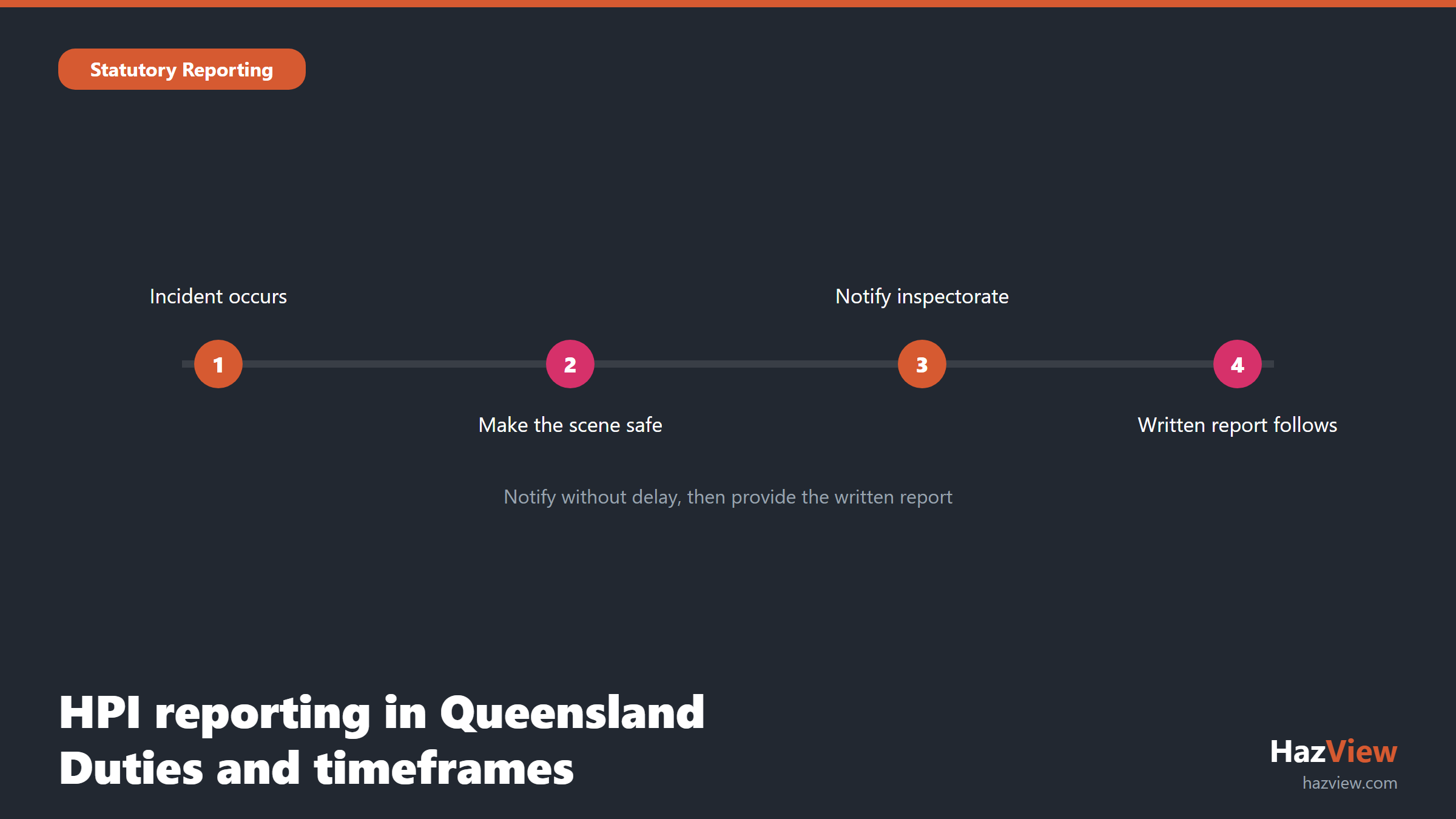
HPI notification in Queensland typically runs in two stages. The first is a prompt oral notification to an inspector, made without delay once the site is aware of the event. The second is a written report that follows, providing the detail of what happened, the potential consequence and the site’s response. The urgency of the first stage reflects the purpose of the system, which is to let the inspectorate know quickly that something with serious potential has occurred.
Because exact timeframes and the required content of a written report are set by the legislation and current RSHQ practice, and because they differ in detail between the coal and the mineral and quarrying frameworks, do not work from memory or a rule of thumb. Confirm the applicable timeframe against the relevant Act and the current guidance published by RSHQ for your operation. As a working principle, treat oral notification as something to be done without delay and the written report as something to be completed as soon as practicable, and build your site procedure around the specific requirements that apply to you.
The practical failure mode is delay caused by internal handoffs. An event is identified on shift, the information moves by word of mouth or a paper form, and hours pass before the person responsible for notification even learns of it. The tighter the path from identification to the SSE’s nominated notifier, the more defensible the site’s compliance. This is one of the strongest arguments for digitising OCE reports and statutory inspections, so a reportable event raises a flag the moment it is captured rather than sitting in a notebook until the end of shift.
What a good HPI record contains
A report to the inspectorate is only as good as the underlying record. Weak records slow investigations, invite follow up questions and undermine the site’s credibility. A strong HPI record is specific, timestamped and tied to a location. Use the following as a checklist when capturing an HPI.
- What happened, in plain factual terms, without speculation about blame.
- The date and time the event occurred and the date and time it was identified.
- The precise location on the mine, ideally tied to a mapped point rather than a vague area name.
- The potential consequence, and why the event met the significant adverse effect threshold.
- The principal hazard involved and which critical control failed or was challenged.
- The people, plant and equipment involved, and the conditions at the time.
- Immediate actions taken to make the area safe and prevent recurrence.
- Who was notified, at what time, and the reference for the notification to the inspector.
- Supporting evidence, including photographs, readings and any relevant inspection records.
- The person recording the event and their role.
The location detail matters more than sites often realise. An HPI tied to an exact point on the mine can be cross referenced against inspection history, prior hazards at the same location and the controls that were meant to be in place. An HPI logged as “the pit” cannot.
The under-reporting problem
RSHQ has repeatedly flagged under-reporting of HPIs as a concern across the Queensland sector. The reasons are rarely deliberate concealment. More often it is genuine uncertainty about whether an event crosses the threshold, a culture that treats near misses as non events because no one was hurt, or a reporting process so slow and manual that events are quietly dropped rather than pursued.
Under-reporting is a safety problem before it is a compliance problem. Every HPI that goes unreported is a warning the industry does not get to learn from. The value of the system is that it surfaces the events where a critical control failed but harm did not follow, which are exactly the events that let a site fix a weakness before it produces a fatality. When those events stay on site, the same failure can play out somewhere else with a worse outcome. The lessons from serious incidents at open cut operations, explored in our piece on enhancing safety in Australian open cut mines, repeatedly trace back to signals that were available but not acted on.
The practical fix has two parts. First, make the threshold clear to the workforce so people err towards reporting when in doubt. Second, make reporting so quick and low friction that raising an HPI is easier than not raising it. When those two conditions hold, reporting rates climb because the barriers that suppressed them are gone.
Capturing HPIs digitally
This is where a purpose built system changes the picture. With HazView, a person on the ground captures an HPI against an exact location on the mine, the right people are notified instantly, and the event becomes a permanent, timestamped record that cannot be lost or quietly forgotten. The delay between identification and notification, which is the single biggest weakness in most HPI processes, effectively disappears, and the SSE has visibility of reportable events as they arise rather than at the end of shift.
Just as importantly, a digital record ties the HPI to the site’s wider picture: the hazards already logged at that location, the inspection history, and the critical controls that were meant to hold. That context is what turns a compliance obligation into genuine learning, and it is what an inspector expects to see when they ask how the event was managed.
Related guides
- Queensland OCE Report Requirements
- Digitising OCE Reports and Statutory Inspections
- Same Role, Different Output: How OCE Reports Vary by Site and State
- The Future of Open-Cut Mining Safety: Lessons from OCE Shift Reports
- All Statutory Reporting guides
Frequently Asked Questions
What is a high potential incident?
A high potential incident is an event, or series of events, that causes or has the potential to cause a significant adverse effect on the safety or health of a person. The key feature is potential: an event can be an HPI even if no one was injured, provided the credible potential consequence was serious. It is defined under Queensland’s mining safety and health legislation for both coal and mineral mines and quarries.
When must an HPI be reported in QLD?
Reporting is typically done in two stages: a prompt oral notification to an inspector made without delay once the site is aware of the event, followed by a written report. The exact timeframes are set by the relevant Act and current RSHQ guidance and differ between the coal and the mineral and quarrying frameworks, so confirm the specific requirement that applies to your operation rather than relying on a general figure. As a rule, notify without delay and complete the written report as soon as practicable.
Who must the SSE notify?
The Site Senior Executive is responsible for ensuring an HPI is reported to an inspector at Resources Safety and Health Queensland. On site, the SSE typically delegates the mechanics of notification to nominated people, while retaining accountability for the duty. Site safety and health representatives and Industry Safety and Health Representatives also have a role in the flow of incident information.
Why is HPI under-reporting a problem?
RSHQ has repeatedly raised under-reporting as a concern. Every unreported HPI is a lost warning: it is an event where a critical control failed but harm did not follow, which is exactly the kind of signal that lets a site fix a weakness before it causes a fatality. Under-reporting keeps those lessons on site instead of sharing them across the industry, so the same failure can recur elsewhere with a worse outcome.
Where can I find the exact legal requirements?
Start with the primary legislation and the regulator. Coal mines are covered by the Coal Mining Safety and Health Act 1999 and mineral mines and quarries by the Mining and Quarrying Safety and Health Act 1999. For current guidance, forms and notification detail, refer to Resources Safety and Health Queensland.
Reliable HPI reporting comes down to speed, location and a record that holds up. If your current process still runs on paper forms and word of mouth, see how HazView captures reportable events against an exact location and notifies the right people instantly. Book a demo to see it on your own operation.