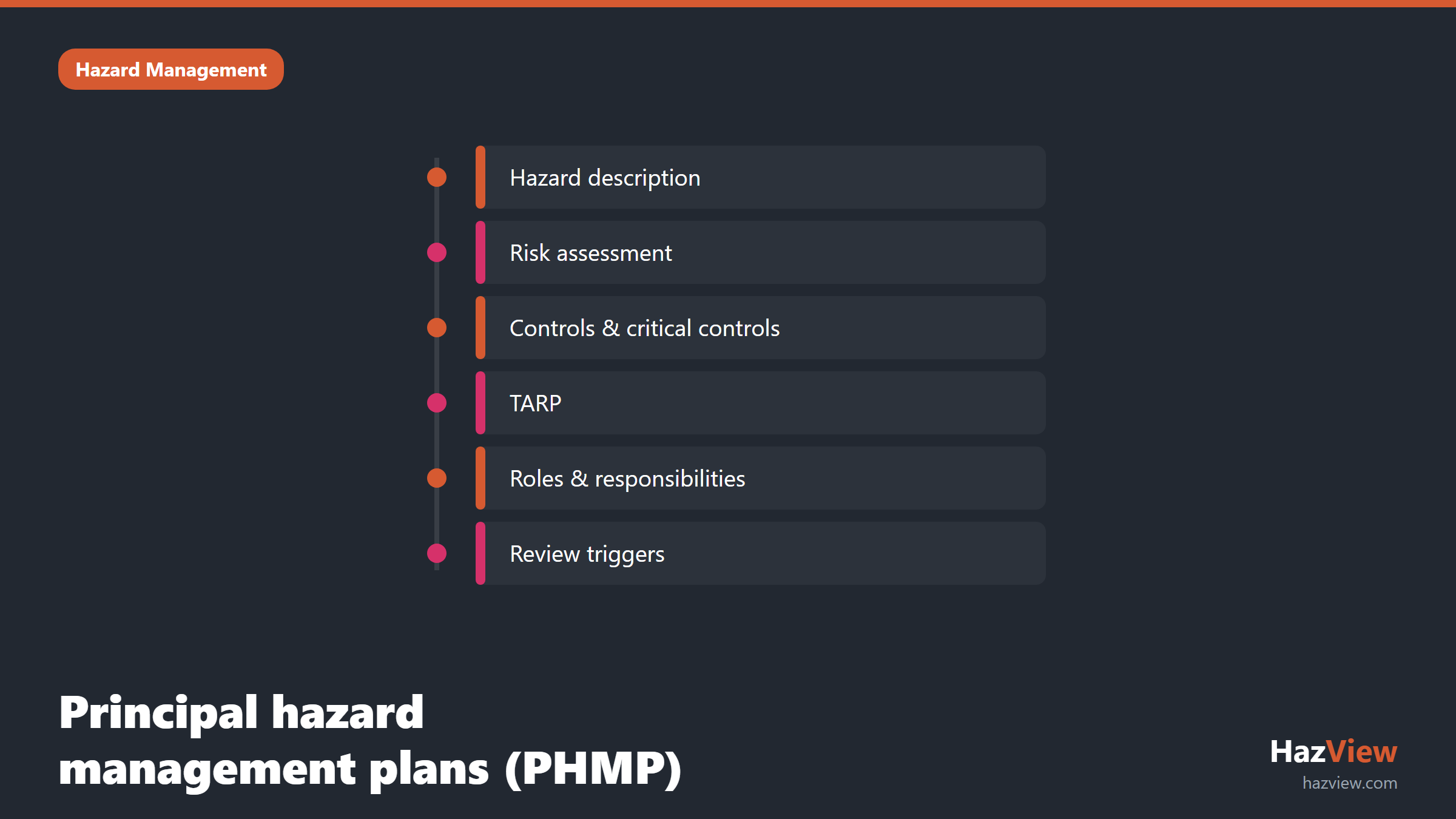
A principal hazard management plan (PHMP) is the document a mine operator uses to show how it manages a hazard with the potential to cause multiple deaths or serious injury in a single event. It describes the hazard, sets out the risk assessment, defines the controls including the critical controls, and states how those controls are monitored, triggered and reviewed. In New South Wales a separate plan is required for each principal hazard at a mine. In Western Australia the equivalent sits inside the mine safety management system. This guide walks through what a PHMP is, when it is required, how the NSW and WA rules differ, and what a strong plan actually contains.
What a principal hazard is
A principal hazard is not just any workplace hazard. It is a hazard that, on its own, has the potential to cause multiple fatalities or serious injuries from a single incident. That distinction matters, because it sets the bar for the level of planning, control and assurance the regulator expects. A trip hazard in the crib room is a hazard. A strata failure that could bury a face crew is a principal hazard, and it demands a documented, structured management approach.
The common principal hazards recognised across Australian mining are broadly consistent, even where the terminology differs between jurisdictions. They typically include:
- Ground or strata failure
- Inrush of water, gas or other material
- Gas outbursts and hazardous gas accumulation
- Fire or explosion
- Spontaneous combustion
- Air quality, dust and airborne contaminants
- Mine roads, vehicle operating areas and vehicle interaction
- Mine shafts, winding systems and roadways where relevant to the operation
Not every hazard on this list applies to every mine. An open cut coal operation carries a very different principal hazard profile to an underground metalliferous mine. The first job of any operator is to identify which principal hazards are genuinely present, and then to plan for each of them properly.
When a principal hazard management plan is required
The short answer: a PHMP is required whenever a principal hazard exists at your mine. The obligation is not triggered by an incident or by a regulator’s request. It is a standing duty that flows from the presence of the hazard itself. If your operation has a principal hazard, you must have a plan that manages it, and that plan must be in place before the associated work proceeds.
This is where operators sometimes come unstuck. A PHMP is not a one-off compliance artefact you write once to satisfy an assessor and then file away. It is a working control document. If the hazard is live at your site, the plan needs to be current, accurate and reflected in what actually happens on the ground. A plan that describes controls no longer in use, or that omits a hazard the operation has since introduced, is a plan that fails when it is tested.
New South Wales requirements
In NSW, principal hazards are governed by the Work Health and Safety (Mines and Petroleum Sites) Regulation 2022. Under that regulation, a mine operator must manage principal hazards, and a principal hazard management plan is required for each principal hazard identified at the mine. NSW uses the term “principal hazard” specifically, and the expectation is a discrete, documented plan per hazard rather than a single catch-all document.
The NSW Resources Regulator publishes a practical guide to preparing a principal hazard management plan, and it is the reference every NSW operator should keep close. It sets out the regulator’s expectations for structure, risk assessment method, control selection and review. Rather than reproducing schedule numbers here that you should confirm directly, treat the regulation as the source of the legal obligation and the regulator’s guide as the source of the practical “how”.
NSW also provides hazard-specific technical reference material that feeds directly into a PHMP. For vehicle-related principal hazards, the NSW vehicle interaction technical reference guide is essential reading, because it details the control expectations that a vehicle interaction PHMP is measured against.
Western Australia requirements
WA takes a structurally different route to the same outcome. Under the Work Health and Safety (Mines) Regulations 2022, an operator must have a mine safety management system (MSMS). Within that system, the operator must prepare management plans for principal mining hazards. WA uses the term “principal mining hazard”, and the specific hazards are listed in the regulations. The concepts map closely to the NSW principal hazards, even though the wording and the framing differ.
The key practical difference is one of architecture. In NSW you tend to think in terms of standalone principal hazard management plans. In WA you think in terms of the overarching MSMS, with a principal mining hazard management plan sitting inside it for each relevant hazard. The content of a strong plan is largely the same in both states: hazard description, risk assessment, controls, critical controls, trigger action response plans and review. What changes is where the plan lives and how it connects to the broader safety management framework.
WA operators managing vehicle and traffic hazards should also work to the WA road and traffic management code for mines, which sets out the controls a principal mining hazard management plan for vehicle interaction should reflect.
What a strong PHMP contains
Regardless of jurisdiction, a strong principal hazard management plan is built from the same core elements. Each one earns its place.
- Hazard description. A clear statement of the hazard, where it occurs, what the credible worst-case event looks like and who is exposed.
- Risk assessment. A documented assessment of the hazard using a recognised method, showing how the risk was evaluated and what informed the control decisions.
- Controls. The full set of controls applied to the hazard, mapped to the risk and ideally ordered by the hierarchy of control.
- Critical controls. The subset of controls that must not fail, called out explicitly, with the performance standard each one has to meet.
- Trigger action response plans (TARPs). Defined trigger levels and the graded actions that follow when a trigger is reached, so the response is decided in advance, not improvised under pressure.
- Roles and responsibilities. Named accountabilities for owning, implementing, verifying and reviewing each control.
- Monitoring and verification. How the operator confirms controls are in place and working, including inspection, sensor data and assurance activities.
- Review triggers. The events that force a review of the plan, such as an incident, a change to the operation, a control failure or a set time interval.
Critical controls and TARPs are where plans most often fall down. It is easy to list a control. It is harder to define the performance standard it must meet, to name who verifies it, and to prove it was in place when it mattered. That gap between the written control and the verified control is exactly where serious events find room to occur, a pattern explored in more detail in why critical controls fail and how to fix it with real-time visibility.
Keeping a PHMP live, not a shelf document
The single biggest failure mode for a principal hazard management plan is that it becomes a shelf document. It is written to a high standard, approved, and then it stops moving while the mine keeps changing. Twelve months later the plan describes a pit layout that no longer exists, controls that have been superseded, and TARPs nobody has looked at since the last audit.
A live PHMP is one where the controls, TARPs and evidence are connected to what is actually happening on site. When a control changes, the plan changes. When a trigger is reached, the response is logged. When a supervisor verifies a critical control, that verification is captured against the location and the hazard, not lost in a paper pad. This is where connecting the plan to a spatial view of the operation pays off. Platforms such as HazView let you hold controls, TARPs and verification evidence live against the mine map, so the plan reflects the ground rather than drifting away from it.
The test is simple. If an inspector asked today whether a given critical control was in place and verified last shift, could you answer with evidence in minutes? If the honest answer is that you would have to go hunting through folders, the plan is closer to a shelf document than a living one.
PHMP checklist
Use this checklist to sense-check a principal hazard management plan before it goes to approval or into a regulator’s hands.
- Every principal hazard present at the mine has a plan.
- The hazard description states the credible worst-case event and who is exposed.
- The risk assessment uses a recognised method and its reasoning is documented.
- Controls are mapped to the risk and ordered by the hierarchy of control.
- Critical controls are named explicitly, each with a performance standard.
- TARPs define trigger levels and the graded actions for each level.
- Every control and TARP has a named accountable owner.
- Monitoring and verification methods are defined and actually used.
- Review triggers are stated, including incidents, change and set intervals.
- The plan matches the current operation, not last year’s.
- Verification evidence can be produced quickly on request.
- The plan aligns with the relevant regulation and the regulator’s guide.
Related guides
- Mine Hazard Management Software: From Paper Chaos to Real-Time Control
- Digital Hazard Map Mining: Why Visual Maps Outperform Text-Based Systems
- Mine Site Hazard Reporting
- Visual Hazard Mapping Software
- All Hazard Management guides
Frequently Asked Questions
What is a principal hazard management plan?
A principal hazard management plan is a documented plan that sets out how a mine operator manages a hazard with the potential to cause multiple deaths or serious injuries in a single event. It covers the hazard description, risk assessment, controls, critical controls, TARPs, roles and responsibilities, monitoring and review triggers.
When is a PHMP required?
A PHMP is required whenever a principal hazard is present at a mine. In NSW a plan is required for each principal hazard under the WHS (Mines and Petroleum Sites) Regulation 2022. In WA, principal mining hazard management plans sit within the mine safety management system under the WHS (Mines) Regulations 2022. The plan must be in place before the associated work proceeds.
What is the difference between NSW and WA?
NSW uses the term “principal hazard” and expects a discrete plan for each one. WA uses the term “principal mining hazard” and requires plans within an overarching mine safety management system. The hazards themselves are conceptually similar and the content of a strong plan is largely the same. The main difference is structural: where the plan sits and how it connects to the wider safety framework.
How often should a PHMP be reviewed?
A PHMP should be reviewed whenever a review trigger occurs, not only on a calendar. Common triggers include an incident or near miss involving the hazard, a change to the mine or its operations, a control failure, new information about the hazard, and a set maximum interval defined in the plan. The point is to keep the plan aligned with the real operation at all times.
See your principal hazard controls live
A principal hazard management plan is only as good as the controls behind it, and controls are only as good as your ability to prove they are in place. If your PHMPs are drifting towards shelf documents, it is time to bring them to life against the mine map. Book a HazView demo to see how operators hold controls, TARPs and verification evidence live where the hazard actually is.