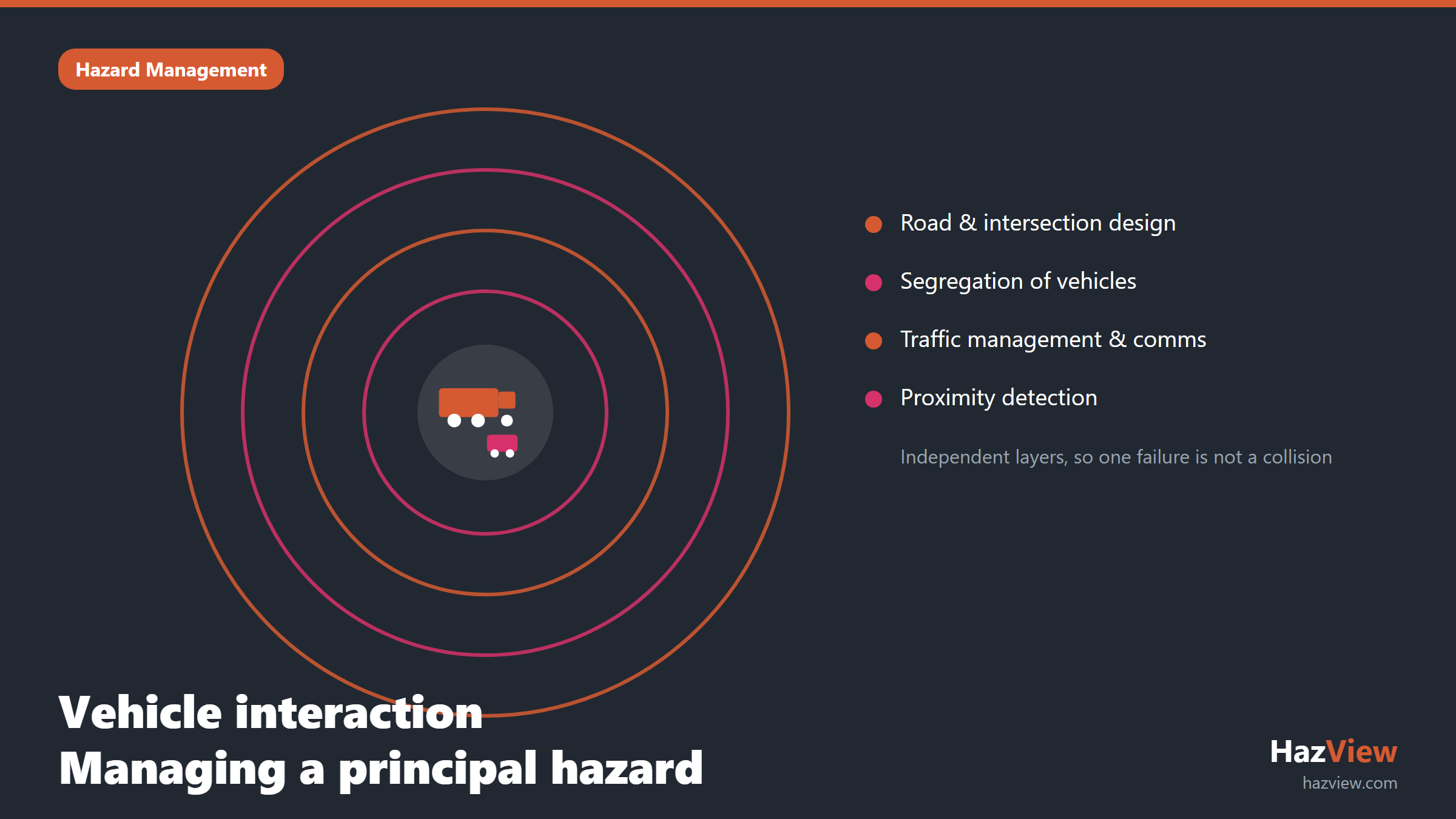
The vehicle interaction principal hazard is one of the most consistently fatal risks on Australian mine sites, and every jurisdiction now treats it as a hazard that can cause multiple fatalities from a single event. A light vehicle sitting in a haul truck operator’s blind spot, an unplanned movement on a grade, or two machines converging at an unmarked intersection can each end a life in seconds. This article compares how Queensland, New South Wales and Western Australia require you to manage vehicle interaction, and sets out the layered defence controls that actually reduce the risk rather than simply documenting it.
What a principal hazard means and why vehicle interaction qualifies
A principal hazard is a hazard that has the reasonable potential to cause multiple fatalities or a single fatality from a single event or a series of related events. It is a step up from an ordinary hazard because the consequence is catastrophic, not because the likelihood is high. That distinction matters: a control failure around vehicles rarely results in a minor injury. It results in a fatality or several.
Vehicle interaction qualifies on every count. The mass and momentum of a loaded haul truck, restricted operator visibility, mixed traffic of light vehicles and heavy mobile plant, night operations, dust, grades, and the potential for unplanned movement all combine to produce a hazard where a single mistake is unforgiving. Because of this, the three major mining states each require vehicle interaction to be managed through a formal, documented, and audited system rather than left to general duty of care. What differs between the states is the legal architecture and the terminology, not the underlying expectation that you identify the hazard, apply multiple controls, and verify they work.
The layered defence model
Layered defence, sometimes called defence in depth, is the principle that no single control should be relied on to prevent a catastrophic event. Instead you build multiple independent controls so that if one fails, others remain in place to catch the error. It is the same logic behind the Swiss cheese model: individual layers have holes, but the holes rarely line up when the layers are independent and well maintained.
For vehicle interaction, a robust layered defence typically includes:
- Road design and segregation: separating light vehicles from heavy mobile plant by distance, time, or physical barriers such as windrows.
- Traffic management: rules, signage, give-way priorities, parking protocols, and controlled intersections.
- Positive communications: two-way radio call-ups, positive acknowledgement before approaching or passing heavy plant.
- Speed and fatigue controls: speed limits matched to road geometry, fatigue management, and journey management.
- Proximity detection and collision avoidance: technology that warns operators or intervenes when vehicles converge.
- Trigger Action Response Plans (TARPs): pre-agreed triggers and responses that move the operation to a safer state as conditions deteriorate.
The order matters. Higher-order controls that eliminate or physically separate the interaction are more reliable than administrative controls that depend on human behaviour. A windrow does not get tired at the end of a night shift; a give-way rule can be forgotten. All three states, in different words, push operators up the hierarchy of controls and warn against over-reliance on a single administrative layer. You can see how the individual layers fit together in our guide to TARPs for mine roads and vehicle interaction.
How Queensland manages vehicle interaction
In Queensland, vehicle interaction is a declared principal hazard at surface coal mines. It is managed under the Coal Mining Safety and Health Act 1999 and the Coal Mining Safety and Health Regulation 2017, which require the site’s safety and health management system to identify principal hazards and apply controls to an acceptable level of risk. The regulator is Resources Safety and Health Queensland (RSHQ).
The key technical document is Recognised Standard 19: Mine roads. Recognised standards state ways to achieve an acceptable level of risk, and while a site can choose an alternative approach, it must then demonstrate that its approach achieves at least the same outcome. RS19 covers road design, geometry, sight distances, intersections, signage, segregation, and the management of interactions between light vehicles and heavy mobile plant. It is the practical benchmark Queensland inspectors work from when they assess a site’s mine roads.
Queensland also runs a High Potential Incident (HPI) reporting regime. Vehicle interaction events, including near misses where a collision was narrowly avoided, are reported and analysed, and the data feeds directly back into safety alerts and site-level review. If your HPI trend shows repeated light vehicle and haul truck interaction events at particular intersections or during particular shifts, that is a signal your controls are not holding, and it should trigger a review of the relevant part of your management system. Intersection geometry is a recurring theme in these events, which is why we cover mine road intersection design as a topic in its own right.
How New South Wales manages vehicle interaction
New South Wales manages vehicle interaction under the Work Health and Safety (Mines and Petroleum Sites) Act 2013 and the associated Regulation 2022. The central mechanism is the Principal Hazard Management Plan (PHMP). Where a mine has a principal hazard, the operator must prepare and implement a PHMP that documents the hazard, the risk assessment, the controls selected, and how those controls are monitored and maintained. Roads and vehicle operating areas, and the interactions that occur on them, sit squarely within this framework.
In 2025 the NSW Resources Regulator finalised a Technical Reference Guide on roads or other vehicle operating areas. The guide sets out a layered-defence model and gives operators a structured way to assess whether their controls across road design, traffic management, communications, speed and fatigue, and collision-avoidance technology are adequate and independent. It is deliberately built around the idea that no single layer is sufficient, and it gives inspectors and operators a common reference point for what good looks like.
For NSW operators, the practical task is to map the guide’s layers against your existing PHMP and identify where you are relying on a single control. If light vehicle and haul truck segregation depends entirely on a traffic rule with no physical or technological backup, the layered-defence lens will expose that gap. We break the document down in detail in our NSW vehicle interaction Technical Reference Guide summary, and the broader plan structure in our overview of the principal hazard management plan.
How Western Australia manages vehicle interaction
Western Australia manages vehicle interaction under the Work Health and Safety (Mines) Regulations 2022. These regulations require mining operations to have a Mine Safety Management System (MSMS) and, where principal mining hazards are present, principal mining hazard management plans. Vehicle and mobile plant interaction is a principal mining hazard that must be assessed and managed within that system, with controls documented and reviewed rather than assumed.
WA has also released a draft code of practice on road and traffic management for mines. As of 2026 it remains in draft, but it signals the regulator’s direction and is worth reviewing now so your controls align before it is finalised. A code of practice, once approved, is admissible in proceedings as evidence of what is reasonably practicable, so operators who get ahead of it reduce their exposure later. We track the detail in our summary of the WA road and traffic management code for mines.
One administrative point for WA operators: the state’s mines safety regulator moved into the Department of Mines, Petroleum and Exploration from 1 July 2025. If your management system documents reference the previous departmental name, update those references so your regulatory contacts and reporting pathways remain correct.
Practical controls that work
Across all three states, the same controls consistently prove their worth. The difference between a plan that protects people and one that only satisfies an auditor is whether these controls are genuinely independent, maintained, and verified in the field:
- Physical segregation: windrows, bunds, dedicated light vehicle roads, and separate parking bays that remove the interaction rather than manage it.
- Positive communications protocols: mandatory radio call-ups and acknowledgement before a light vehicle approaches or passes heavy mobile plant, so the truck operator knows exactly where the smaller vehicle is.
- Exclusion zones and park-up rules: defined safe distances and procedures for approaching stationary or operating machines, addressing the blind-spot risk that drives so many light vehicle haul truck interaction events.
- Speed management: limits set to road geometry, sight distance, and conditions, not a single site-wide number that is too fast for the worst corner.
- Controls against unplanned movement: park brake protocols, wheel chocks, and parking on grade rules to prevent unplanned movement in mining operations where a vehicle rolls or runs away.
- Proximity detection and collision avoidance systems: technology that provides an independent warning or intervention layer, particularly valuable at night and in dust where line of sight fails.
- TARPs: triggers tied to weather, visibility, road condition, or incident frequency that move the operation to a safer state before an event occurs.
No single item on this list is sufficient alone. That is the whole point of layered defence for vehicle interaction: each control is chosen and maintained on the assumption that another will occasionally fail.
Mapping and monitoring vehicle interaction
Layered defence only works if you can see where your interactions actually occur and whether your controls are still in place. This is where a spatial, evidence-based approach earns its keep. Plotting interaction hotspots, intersections, segregation boundaries, and control locations on a live site map turns an abstract PHMP into something a supervisor can act on during a shift. Monitoring HPI and near-miss trends against those locations tells you whether the controls are holding or quietly degrading.
HazView is built for exactly this: mapping vehicle interactions against site geography, recording the segregation and controls that apply at each location, and monitoring incidents and inspections so a weakening control shows up before it becomes an event rather than after. It gives QLD, NSW and WA operators a single place to hold the layered-defence picture that their respective frameworks demand. Explore the hazard management tools to see how the pieces connect.
Related guides
- NSW Vehicle Interaction on Mine Roads: The 2025 Technical Reference Guide
- WA’s Road and Traffic Management Code for Mines: What It Requires
- Mine Road Intersection Design: RS19 Rules for Safer Haul Road Junctions
- All Mine Roads & RS19 guides
Frequently Asked Questions
What is a principal hazard?
A principal hazard is a hazard with the reasonable potential to cause multiple fatalities, or a single fatality, from a single event or a series of related events. It is defined by the severity of its potential consequence rather than by how often it occurs, which is why it must be managed through a formal, documented management plan rather than routine hazard controls.
Is vehicle interaction a principal hazard in every state?
Vehicle and mobile plant interaction is treated as a principal hazard, or principal mining hazard, in each of the major mining states, though the exact legal term and framework differ. Queensland declares it a principal hazard at surface coal mines under the Coal Mining Safety and Health legislation, New South Wales manages it through principal hazard management plans, and Western Australia treats it as a principal mining hazard under the WHS (Mines) Regulations 2022. The common thread is that all three require multiple documented controls and ongoing verification.
What is layered defence?
Layered defence, or defence in depth, means using multiple independent controls so that if one control fails, others remain in place to prevent a catastrophic event. For vehicle interaction this typically spans road design and segregation, traffic management, positive communications, speed and fatigue controls, proximity detection or collision avoidance, and TARPs. The controls are chosen to be independent, so a single failure does not remove all protection.
What controls reduce vehicle interaction?
The most effective controls physically separate light vehicles from heavy mobile plant through segregated roads, windrows, and parking bays. These are backed by positive radio communications, exclusion zones around operating machines, speed limits matched to road geometry, park brake and chock protocols against unplanned movement, proximity detection and collision avoidance technology, and TARPs that respond to deteriorating conditions. Higher-order controls that eliminate or physically separate the interaction are more reliable than administrative rules alone.
See how HazView helps you map, control and monitor vehicle interaction across your site. Book a demo to walk through your own layered-defence picture with our team.