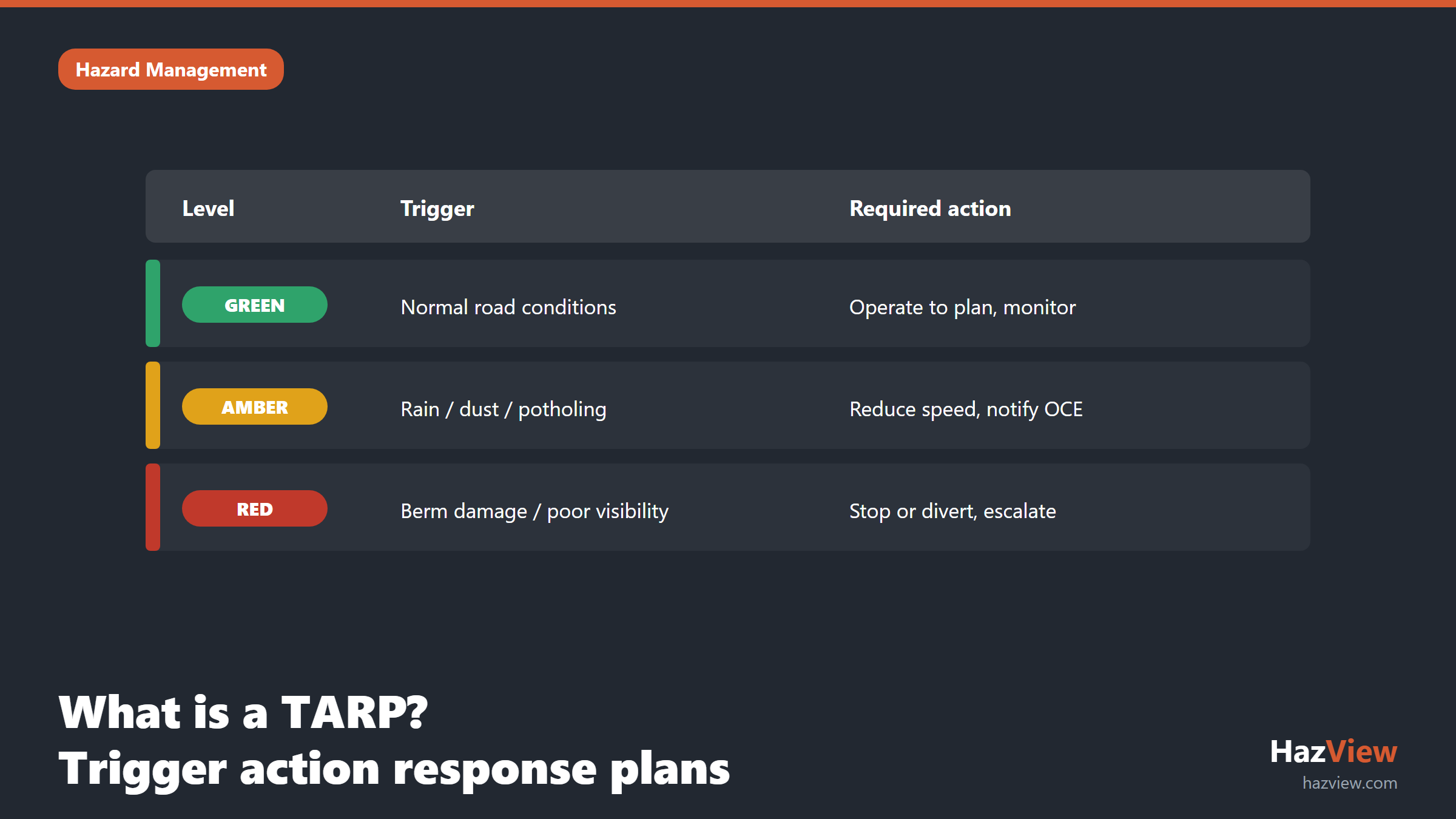
A TARP in mining is a Trigger Action Response Plan: a simple document that defines escalating trigger levels for a changing hazard, and states in advance what action must be taken at each level and who is responsible for taking it. Instead of deciding what to do about deteriorating conditions in the heat of the moment, a TARP lets a site agree the response beforehand. If you have ever asked what is a TARP in mining, the short answer is that it turns “we should probably do something” into a defined, accountable action tied to a measurable trigger.
TARPs are used across Australian mines to manage conditions that can shift quickly, from ground movement and gas readings through to weather effects on haul roads. This article focuses on one of the highest-consequence applications: mine roads and vehicle interaction. We will cover what a TARP is, how one is structured, a worked example you can adapt, how TARPs connect to critical controls, and the mistakes that quietly undermine them.
What a TARP is and why mines use them
A Trigger Action Response Plan exists because conditions on a mine site are not static. A haul road that is safe at the start of a shift can become genuinely dangerous after two hours of rain. Visibility that is fine at dawn can drop as dust builds through the day. The risk profile changes, but the people working in it are busy, under production pressure, and not always the best placed to judge when “a bit greasy” has become “unsafe to operate”.
A TARP removes that ambiguity. It sets out observable, and ideally measurable, triggers that mark the boundary between one level of response and the next. When a trigger is reached, the response is not up for debate: it has already been agreed, documented and signed off. This matters most for hazards where hesitation costs lives, and vehicle interaction is exactly that kind of hazard. A loaded haul truck cannot stop or steer like a light vehicle, and a wet or rutted road removes the margin that keeps them apart.
Regulators actively encourage this approach. Both Resources Safety and Health Queensland (RSHQ) and the NSW Resources Regulator promote TARPs as a practical tool for managing principal hazards and keeping response decisions consistent across crews and shifts. A TARP is not a substitute for engineering the hazard out, but it is a strong administrative layer that keeps a site inside its acceptable level of risk as conditions move.
The anatomy of a TARP: levels, triggers, actions, responsibility
Every effective TARP is built from the same four elements. Get these right and the plan works. Get them vague and it becomes shelfware.
- Trigger levels. Most TARPs use three escalating levels, commonly shown as green, amber and red, or Level 1, 2 and 3. Three levels is usually enough to separate “monitor”, “act” and “stop” without overcomplicating the decision. Some hazards justify more, but each extra level adds judgement calls, so add them only when they earn their place.
- Triggers. The condition that puts you at a given level. A good trigger is observable and, where possible, measurable: “standing water deeper than 100 mm across a traffic lane” beats “road looks wet”. The less interpretation required, the more consistently the TARP is applied.
- Required actions. What must happen at that level. Actions should be specific and verifiable: reduce speed to a stated limit, grade a section, close a road, escalate to the shift supervisor. “Exercise caution” is not an action.
- Responsible person. The named role accountable for acting on the trigger and, at higher levels, authorising escalation. Every level needs an owner, or the trigger fires and nobody moves.
The logic runs left to right: a person observes a trigger, matches it to a level, and the responsible person ensures the required action happens. When those four columns are clear, anyone from a new operator to a mine manager can read the same plan and reach the same decision.
A worked TARP example for mine road conditions
Below is a realistic TARP mining example for deteriorating haul road conditions where light vehicles and heavy vehicles share the road. It is written to be adapted, not copied: your triggers should reflect your own road design, vehicle mix, speed limits and site standards. Treat it as a template for a vehicle interaction principal hazard plan rather than a finished control.
| Level | Trigger | Required Action | Responsible Person |
|---|---|---|---|
| Green (Level 1) Normal, monitor | Road surface firm and well drained. Light rain with no ponding. Dust intermittent and visibility clear beyond 100 m. | Operate to standard speed limits. Report changing conditions over the radio. Continue routine road inspections each shift. | All operators; Road inspector |
| Amber (Level 2) Elevated, act | Road surface greasy or rutted. Standing water up to 100 mm in a lane. Potholing or minor berm damage present. Dust reducing visibility to 50 to 100 m. | Reduce speed to the wet-road limit (for example 40 km/h). Increase following distance. Dispatch a grader or water cart as needed. Restrict light vehicle access to affected sections. Notify the shift supervisor. | Shift supervisor |
| Red (Level 3) Critical, stop | Standing water deeper than 100 mm across a traffic lane. Loss of traction reported. Berm failure or road edge collapse. Visibility below 50 m from dust or fog. Any near miss between vehicles. | Stop haulage on the affected road. Close the road and isolate with signage or a physical barrier. Complete repairs and a documented reinspection before reopening. Record the event and review the trigger. | Mine manager or delegated authority |
Notice how the triggers sharpen as the level rises. Green tolerates minor imperfection, amber demands active intervention while keeping the road open under tighter rules, and red stops the activity outright. The responsible person also escalates with the level, so the decision to close a road sits with someone who has the authority to carry the production consequences. This is deliberate: the harder the decision, the more senior the owner.
How TARPs link to critical controls and principal hazards
A TARP is not a control in its own right. It is a mechanism that protects the controls you already rely on. Vehicle interaction is a principal hazard on almost every surface mine, and it is managed through critical controls such as segregation, road design, speed management, positive communication and, increasingly, collision awareness technology. A TARP sits alongside those controls and tells the site what to do when conditions start to erode their effectiveness.
Consider road design as a critical control. Good mine road intersection design keeps vehicles apart through sight lines, geometry and priority rules. Rain does not change the design, but it changes how well that design performs: braking distances lengthen, and a driver who could safely judge a gap in the dry no longer can. The TARP is what recognises that degradation and pulls the speed limit down, or closes the intersection, before the control fails silently.
That link matters because critical controls fail more often through gradual erosion than sudden collapse. A control can look present on paper while being quietly undermined by conditions, workload or drift. This is one of the main reasons critical controls fail, and a well-run TARP is a direct countermeasure: it forces a visible, accountable response the moment a defined threshold is crossed, rather than trusting that someone will notice the control weakening.
Common TARP mistakes
Most TARP failures are not exotic. They come from a handful of recurring problems that are easy to spot once you know to look for them.
- Vague triggers. “Heavy rain” or “poor visibility” force each person to interpret the threshold differently, so the same conditions get different responses. Make triggers observable and, where you can, measurable.
- Weak actions. “Take care” and “monitor closely” are not actions. If an action cannot be verified after the fact, it will not drive behaviour under pressure.
- No named owner. When responsibility reads “the crew” or is left blank, the trigger fires and everyone assumes someone else has it. Every level needs a specific role.
- Too many levels. Five or six levels blur the boundaries and slow the decision. Three clear levels usually beat six fuzzy ones.
- Set and forget. A TARP written once and never reviewed drifts out of step with the site. Triggers should be revisited after incidents, near misses and changes to roads or fleet.
- Buried in a binder. A TARP the crew cannot see at the moment conditions change is not a plan, it is a record. Accessibility at the point of decision is the whole game.
Running TARPs digitally
The last two mistakes above, drift and inaccessibility, are exactly where paper TARPs struggle most. A printed plan cannot tell you when a trigger has been reached, cannot show which road it applies to, and cannot prove that the required action was taken. This is where running TARPs digitally changes the picture. With HazView, trigger levels can be linked directly to the hazard map, so a road TARP is tied to the actual section of road it governs, and the response actions flow into the checklists and tasks the responsible person already works from. When conditions change, the trigger, the location and the required action sit together in one place instead of three.
That connection also builds the evidence trail. Every trigger, action and sign-off is recorded, so a supervisor can see at a glance which roads are at amber, who is acting, and whether a red-level closure has actually been completed and reinspected. Instead of hoping the TARP was followed, you can show it was. That kind of proof is increasingly what separates a control that exists on paper from one that demonstrably works.
Related guides
- Managing Vehicle Interaction as a Principal Hazard (QLD, NSW & WA)
- NSW Vehicle Interaction on Mine Roads: The 2025 Technical Reference Guide
- WA’s Road and Traffic Management Code for Mines: What It Requires
- All Mine Roads & RS19 guides
Frequently Asked Questions
What does TARP stand for?
TARP stands for Trigger Action Response Plan. It is a document that sets escalating trigger levels for a hazard and defines, in advance, the action required at each level and the person responsible for taking it.
What is the difference between a TARP and a control?
A control reduces risk directly, such as road segregation or a speed limit. A TARP does not reduce risk on its own: it monitors changing conditions and triggers a response when a control’s effectiveness is threatened. Think of the control as the barrier and the TARP as the plan that keeps that barrier working as conditions shift.
How many trigger levels should a TARP have?
Three levels is the common and usually sensible choice, often shown green, amber and red or Level 1, 2 and 3. Three levels cleanly separate monitoring, active intervention and stopping the activity. Add more only when a hazard genuinely needs finer steps, because each extra level adds a judgement call.
Who acts on a TARP trigger?
The named responsible person for that level. Lower levels often sit with operators and road inspectors, while higher levels escalate to the shift supervisor and, for a stop or road closure, the mine manager or a delegated authority. Naming the role for every level is what makes sure a trigger actually leads to action.
Turn your TARPs into live controls
A TARP is only as good as the site’s ability to see the trigger, act on it and prove the action happened. HazView links your trigger levels to the hazard map and to the checklists your crews already use, so mine road and vehicle interaction TARPs stay visible, accountable and current. Book a demo to see how HazView runs TARPs digitally on your site.