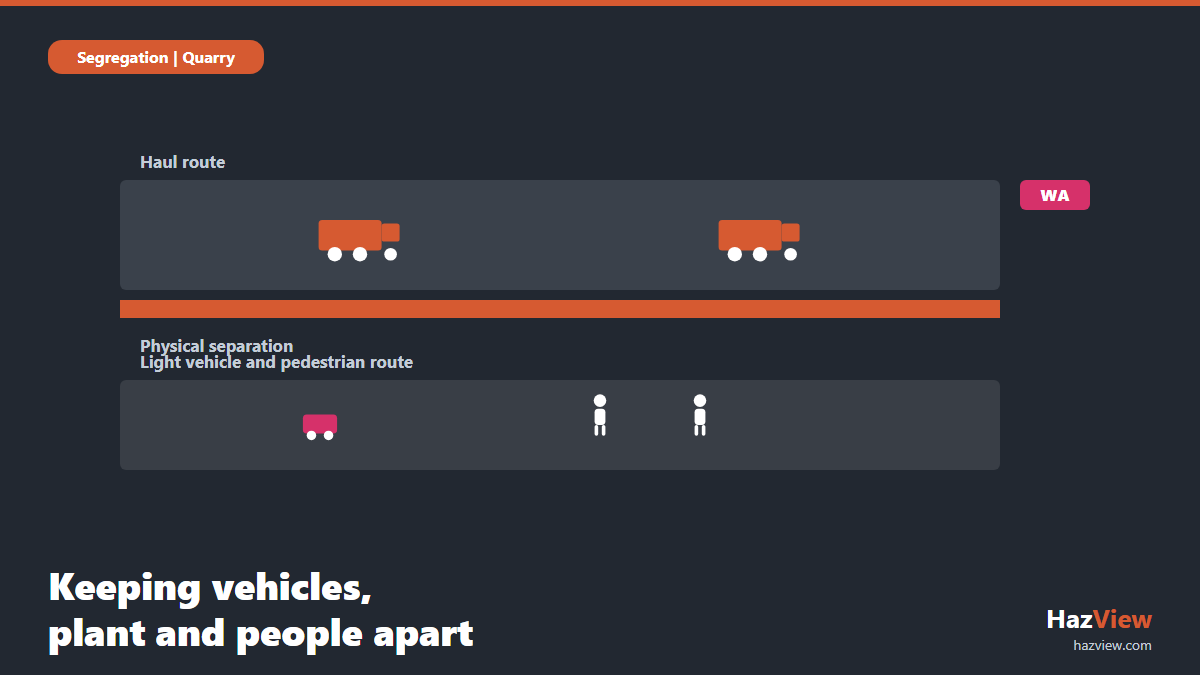
Vehicle and pedestrian segregation at a quarry is the control that does the most work and gets the least attention. Almost every serious vehicle interaction incident on a quarry comes down to a person or a light vehicle being somewhere a plant operator did not expect. Road geometry matters, signage matters, but separation is the control that removes the interaction rather than managing it.
The Code of practice: Road and traffic management at Western Australian mines, published on 4 August 2026, deals with separation across every pairing: heavy vehicles and light vehicles, mobile plant and pedestrians, plant and infrastructure, and different classes of equipment. This article works through where it breaks down on a real quarry.
The hierarchy, applied properly
The order is not negotiable and it is easy to get lazy about.
- Eliminate the interaction. Does the light vehicle need to go there at all? Can the task be done from a fixed position, remotely, or at a time when plant is not operating?
- Separate in space. Dedicated light vehicle routes, physical barriers, bunded walkways, separate entries, parking well clear of operating areas.
- Separate in time. Plant shut down or parked up before a person approaches. Loading stopped before a customer truck is loaded. Scheduled windows for maintenance access.
- Control the interaction. Positive communication, right of way rules, exclusion zones, park-up positions, proximity detection.
- Rely on behaviour. Awareness, training, signage, high-visibility clothing. Necessary, but never the primary control.
Most quarry traffic management plans jump straight to level four and describe radio protocols in detail. That is the weakest position you can take in an investigation, because it means your defence rests on two people doing the right thing at the right moment.
Where segregation fails on a quarry
The weighbridge and customer truck queue
Drivers get out to sign dockets, stretch their legs, check loads and talk to the weighbridge operator. Meanwhile loaders shuttle, other trucks queue and reverse, and someone walks between them. This is the highest-frequency pedestrian and plant interaction on most quarries, and it is often outside the plan entirely because it does not feel like the pit.
Fixes that work: a marked and physically defined pedestrian path from parking to the office, a “stay in cab” rule with an intercom or camera at the bridge, and a queue layout that does not require reversing across the walkway.
The loading area
An excavator or loader working a face or stockpile has a blind zone that most people underestimate. A light vehicle sitting in it is invisible. The control is a defined exclusion zone with positive communication to enter, and a park-up position in the operator’s line of sight where the vehicle waits until acknowledged.
The test is simple: can the operator confirm, out loud, that they know where the light vehicle is before it moves? If the answer relies on the light vehicle driver assuming they were seen, the control has failed.
The workshop apron and fuel bay
Plant is moving slowly, people are walking with tools, and everyone treats it as a low-risk area because the speeds are low. Low speed does not help when a 40-tonne loader articulates. Mark walkways, control plant movement into the apron, and require a spotter or positive communication for plant movement while people are on foot.
The crib room walk
The route people actually take at smoko is rarely the route on the plan. Watch it for a shift. If people cross a haul route to save two minutes, they will keep doing it, and the answer is to change the route or the layout, not to write a procedure telling them not to.
Contractor and visitor movements
Drill and blast crews, fitters, surveyors, sales reps and auditors all move around a quarry with varying levels of site knowledge. The visitor who follows the site vehicle in and then parks wherever there is room is a recurring problem. Escort protocols and a defined visitor parking area, enforced, remove most of it.
Proving segregation works
Under the WHS (Mines) Regulations 2022, roads and areas where mobile plant operate is a listed principal mining hazard, so your controls need performance standards and evidence, not just a description. That means being able to show:
- Where the segregation is, on a map that reflects the site as it is now.
- What physical controls exist, and when they were last checked. Bunds get flattened, bollards get knocked over, line marking wears off.
- That people have been inducted into the rules, including contractors and regular carters.
- That supervisors verify compliance, with a record of what was checked and what was found.
- What happens when a control is out of service, and who authorises the alternative.
This is the same evidence problem described in why critical controls fail. The control usually exists. What is missing is proof that it was in place at the time it mattered.
Exclusion zones that people can actually see
An exclusion zone described in a document is a zone nobody can find the edge of. A blast exclusion, a zone around a working face, a no-go area under a highwall or a closed ramp all have precise boundaries that matter, and those boundaries move.
Putting them on a shared live map that every operator, supervisor and contractor can see on a phone removes the guesswork entirely. It also removes the constant radio traffic of people asking whether they are inside or outside. That is the practical case for visual hazard mapping over text-based systems, and it is what HazView was built for.
To see it on your site layout, book a demo.
Where this fits in your documentation
Segregation belongs in your quarry traffic management plan, which in WA is the principal mining hazard management plan for roads and mobile plant areas. The plan sits inside your mine safety management system. For the wider jurisdictional picture, see managing vehicle interaction as a principal hazard across QLD, NSW and WA.
Related guides
- Quarry Safety in Western Australia: A Compliance Guide for Quarry Managers
- Quarry Haul Road and Access Road Design: WA Standards Explained
- Speed Limits, Signage and Delineation at a Quarry
- WA’s Road and Traffic Management Code for Mines: What It Requires
- All WA Quarries & Mines guides
Frequently asked questions
What is positive communication?
A two-way exchange where the operator of the plant acknowledges the other party before movement occurs. A call that is transmitted but not acknowledged is not positive communication. Line of sight plus a hand signal can qualify if both parties confirm.
Do we need proximity detection at a quarry?
Not necessarily. Proximity detection is one control among several and it sits low in the hierarchy because it manages the interaction rather than removing it. Physical separation, exclusion zones and park-up rules usually deliver more risk reduction for less money at quarry scale.
How wide should a pedestrian walkway be?
The regulations do not prescribe a width for a mine site walkway. Size it for the traffic it carries and the plant it passes, make the boundary physically obvious, and keep it clear. Being able to justify the design is what matters.
Does segregation apply to customer truck drivers?
Yes. Anyone on site is inside the hazard. Carters and customers are often the least familiar with your layout and the most exposed at the weighbridge and loading area, so they need explicit routes, rules and induction.