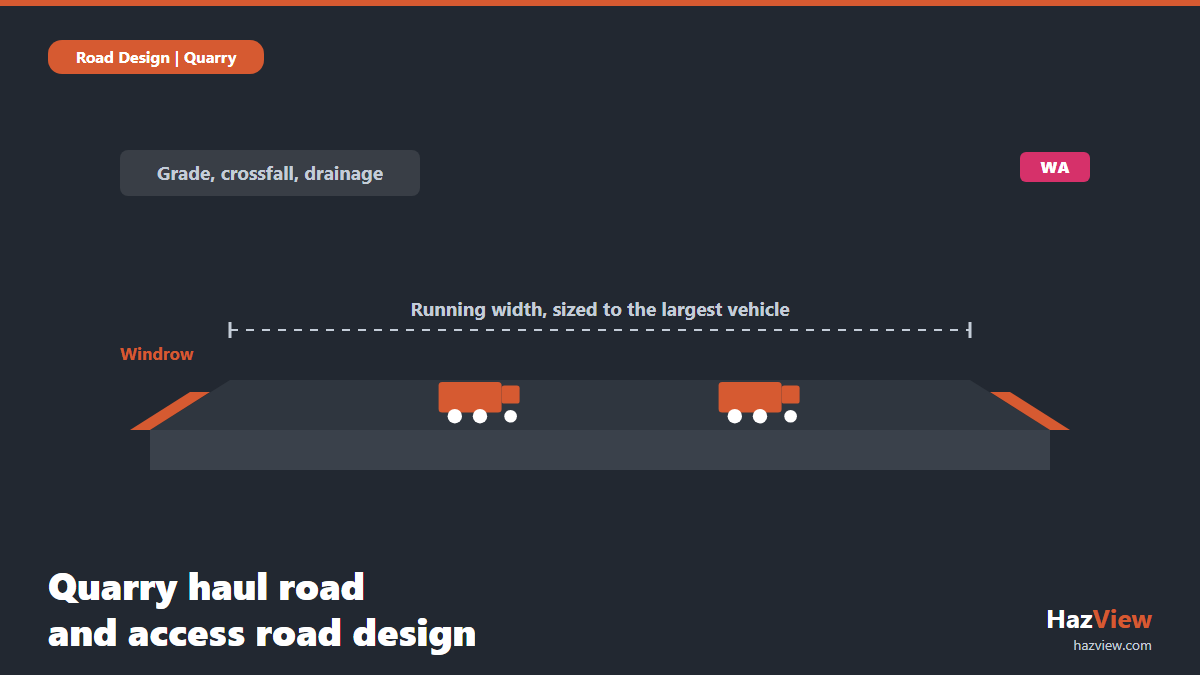
Quarry haul road design comes down to one rule: build the road for the largest vehicle that uses it, then maintain it to that standard. Everything else, running width, grade, sight distance, windrow height, crossfall and drainage, follows from that. In Western Australia the expectation is now anchored by the Code of practice: Road and traffic management at Western Australian mines, published on 4 August 2026 as an approved code under the Work Health and Safety Act 2020.
Quarry roads get less engineering attention than large open pit haul roads, usually because the trucks are smaller and the hauls are shorter. The physics does not care. A rigid body truck rolling off a ramp edge kills the same way a 240-tonne unit does.
Start with the design vehicle
Write down the largest vehicle that uses each road. On a quarry that is often not your own truck. It may be a customer’s triple road train, a low loader bringing in a crusher, or a water cart. Roads sized for an articulated dump truck and then used by a road train are a design failure waiting to be discovered.
Record the design vehicle in the traffic management plan and treat any change as a trigger to review the road. If a new customer starts running larger combinations, that is a change to the hazard.
Running width
The long-standing engineering convention across Australian mining is that a two-lane haul road provides roughly three and a half times the width of the widest vehicle, and a single-lane road roughly two times. Those multiples come from the mining engineering literature rather than from WA regulation, so treat them as a design starting point that you justify, not as a legal number.
The running width is the trafficable surface. It sits between the windrows and does not include them, and it does not include the drainage table drain. Plenty of quarry roads measure fine on paper and fail in practice because the windrow has crept in over months of grading.
Single-lane sections need managed access: signage, right of way, and where traffic is frequent, positive communication or a passing bay schedule. A single-lane ramp with two-way traffic and no protocol is a common quarry finding.
Grade and ramps
Ten percent, or one in ten, remains the common design maximum for sustained haulage grade in Australian surface mining, with steeper short pinches sometimes accepted where the risk is assessed and the vehicles can handle it. Grade drives braking demand, retarder duty, tyre wear and runaway risk, so it is not a number to inherit from whoever built the ramp.
Flat zones at the top and bottom of a ramp matter more than most quarry operators expect. A truck cresting a ramp onto an immediate intersection has no room to stop and no sight distance. The detail is in our guide to haul road grades and ramps, written against Queensland’s Recognised Standard 19 but engineered on the same principles.
Windrows and edge protection
Where a road runs beside a drop-off, a windrow is the last line of defence. The widely used benchmark across Australian mining is a windrow at least as high as the rolling radius of the largest wheel using the road, built as a continuous, competent, trapezoidal bund rather than a line of loose spoil.
Three failure modes recur on quarries. The windrow is built from oversize rock that a truck would ride over rather than be stopped by. It is broken at the exact points where trucks turn in, because that is where it gets knocked out. Or it has been progressively bladed down by grading until it is decorative. A windrow that has not been inspected is not a control. Our guide to safety berm heights and profiles covers the geometry in detail.
Sight distance and intersections
Stopping sight distance has to suit the vehicle, the grade and the surface. On a downgrade with a loaded truck, that distance is much longer than instinct suggests. Intersections are where quarry roads concentrate risk, and the usual quarry problems are stockpiles or vegetation blocking the approach view, and junctions that meet at an acute angle because the road grew organically.
Aim for junctions close to 90 degrees, clear sight triangles, defined priority, and a flat approach. The full treatment is in mine road intersection design.
Surface, crossfall and drainage
Water destroys quarry roads faster than traffic does. Crossfall sheds water to a table drain, the table drain has somewhere to go, and the surface material holds together when wet. A road with no crossfall becomes a linear pond, then a rutted trap, then a corrugated surface that shakes fasteners loose and fatigues operators.
Dust is the other half of the problem. Untreated quarry roads in a WA summer generate visibility loss and respirable dust in one hit. Water carts, chemical suppression or sealing on high-traffic sections are traffic controls as much as health controls. See silica dust at WA quarries.
The maintenance standard is the real standard
A road built to specification and left alone for six months is not a road built to specification. What an inspector wants to see is a maintenance regime with:
- A defined inspection frequency and who does it.
- Recorded findings, including “no defects”, not just the days something was wrong.
- Defect triggers that specify when a road is repaired, restricted or closed.
- Close-out evidence with dates.
- A grader and water cart schedule that matches the traffic and the weather.
Condition triggers work well as a trigger action response plan: green for normal operation, amber for reduced speed or restricted access, red for closure. The structure is in building a TARP for mine roads.
Keeping the road network current
Quarry road networks change constantly as faces advance and stockpiles move. If the only record of the current layout is in a supervisor’s head, then road defects, closures and new routes never reach the people who need them, and the traffic management plan drifts out of date.
Mapping the network live, with defects and closures marked where they physically are, keeps the plan honest and gives you a dated record of every change. That is how HazView is used on active pits. Book a demo to see it on your layout.
Related guides
- Quarry Safety in Western Australia: A Compliance Guide for Quarry Managers
- Speed Limits, Signage and Delineation at a Quarry
- WA’s Road and Traffic Management Code for Mines: What It Requires
- The Quarry Manager in WA: Duties, Appointment and When One Is Required
- All WA Quarries & Mines guides
Frequently asked questions
How wide should a quarry haul road be?
Size it from the widest vehicle using it. The common engineering convention is around three and a half vehicle widths for two-way traffic and around two for single lane, measured across the trafficable surface between windrows. WA regulation does not prescribe a figure, so document the basis for the width you choose.
How high does a quarry windrow need to be?
The widely accepted benchmark is at least the rolling radius of the largest wheel using the road, built as a continuous competent bund. The point is to redirect a vehicle, not to mark an edge.
What grade is acceptable for a quarry ramp?
Ten percent is the common design maximum for sustained haulage in Australian surface mining. Steeper short sections can be justified with a risk assessment and suitable vehicles, but grade drives braking demand and runaway risk so the justification needs to be genuine.
Does the WA code prescribe road dimensions?
The code provides guidance on haul road design and maintenance standards rather than acting as a dimension table. Read the code itself before adopting numbers from any summary, including this one, and record the engineering basis for your own design.
Who is responsible for quarry road standards?
The mine operator holds the duty. In practice the quarry manager or SSE owns the design and maintenance standard, with supervisors accountable for inspection and defect reporting. See the quarry manager’s duties.