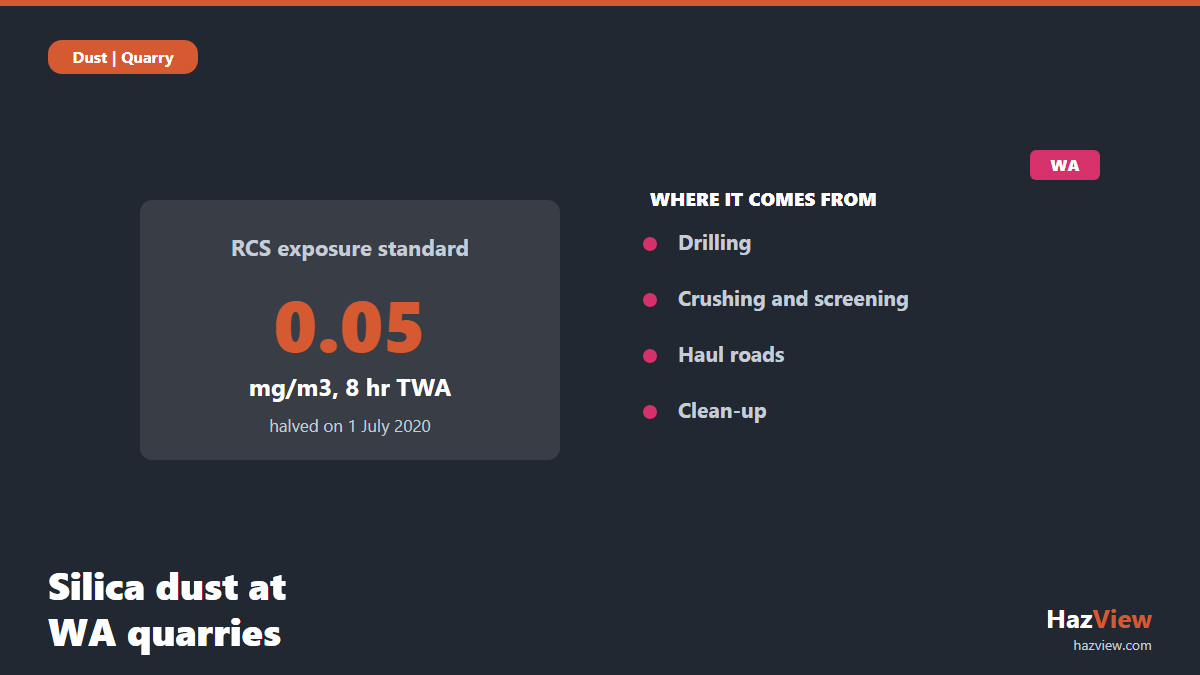
Silica dust at a quarry is a fatality risk that arrives slowly. Respirable crystalline silica, or RCS, is generated whenever silica-bearing rock is drilled, blasted, crushed, screened, loaded or driven over. In Western Australia the workplace exposure standard has been 0.05 mg/m3 as an eight-hour time-weighted average since 1 July 2020, half what it was before. This guide covers what a WA quarry has to do about it.
Why this is a principal mining hazard question
A principal mining hazard is anything with a reasonable potential to result in fatalities, either in a single event or through recurring incidents. Silicosis and silica-related lung cancer are the textbook example of the second limb. Daily exposure that harms nobody on any given shift produces disease over a working life.
Quarries that treat dust purely as an occupational health matter and leave it out of the principal mining hazard assessment are making a defensible-looking decision that is hard to justify at a hard rock operation with crushing and screening. Work through identifying principal mining hazards at a quarry and record the reasoning either way.
The exposure standards
- Respirable crystalline silica: 0.05 mg/m3 as an eight-hour time-weighted average. This halved from 0.1 mg/m3 on 1 July 2020.
- Inhalable dust: 10 mg/m3.
Two things to be clear about. The standard is a ceiling, not a target: the duty is to keep exposure as low as reasonably practicable, not merely below the number. And there is real evidence of harm below the standard. Published risk estimates put silicosis risk at around seven percent at a lifetime average exposure of 0.06 mg/m3, and increased lung cancer risk above roughly 0.065 mg/m3. Sitting at 0.045 is compliance, not safety.
If monitoring shows the airborne concentration of RCS has exceeded the exposure standard, the result must be reported to the WorkSafe Commissioner.
Where the exposure comes from at a quarry
- Drilling. Dry drilling without collection is the highest single-source exposure on most quarries.
- Crushing and screening. Transfer points, screen decks and enclosed areas around the plant.
- Conveyor transfer and stockpiling. Particularly in wind.
- Loading and haulage. Cab-in exposure where filtration is poor or doors are left open.
- Haul roads. Untreated roads in dry conditions produce respirable fractions continuously, not just visible dust.
- Maintenance and clean-up. Blowing down plant with compressed air and dry sweeping are two of the worst practices still common at quarry scale.
Note that the silica content varies enormously by material. Granite and quartzite are high, limestone is generally low, and sand can be very high. Know the crystalline silica content of what you are working, because it drives everything downstream.
The mine air quality officer
Under Schedule 26 of the Work Health and Safety (Mines) Regulations 2022, a mine air quality officer must be appointed if a hazard identified at the mine includes exposing workers to airborne contaminants, heat or humidity. At most hard rock quarries, that condition is met.
The MAQO’s role includes advising the mine operator on the status of air quality and the steps needed to reduce exposures, and planning and carrying out monitoring to verify control effectiveness and report the results. WorkSafe WA publishes course criteria for mine air quality sampling and assessment.
Small quarries commonly miss this appointment entirely, because dust does not feel like a statutory position trigger the way ground control or roads do. Check whether the condition applies to your site, and if it does, make and document the appointment the same way you would any other. See how statutory positions work.
Monitoring that tells you something
Personal sampling on workers in similar exposure groups is the basis of a defensible programme. A few principles that make the difference between data and paperwork:
- Sample the worst case, not the average. The driller on a dry day tells you more than the weighbridge operator.
- Build similar exposure groups honestly. If the crusher attendant and the loader operator have different exposures, they are different groups.
- Sample across conditions. A dry season result and a wet season result describe different sites.
- Repeat. One round of sampling three years ago is a snapshot, not a programme.
- Feed results back to the workers sampled. This is both a legal expectation and the fastest way to get behaviour change on cab doors and respirator use.
Controls, in order
Respirators are last. That is not a slogan, it is the hierarchy, and quarry dust programmes that start and end with P2 masks are the ones that produce exceedances.
- Eliminate or substitute. Wet processing instead of dry where the product allows. Avoid handling that is not needed.
- Engineering. Water injection and dust collection on drills, water sprays at transfer points and crushers, enclosure of screens, sealed and pressurised cabs with maintained filtration, and dust extraction in workshops.
- Road treatment. Water carts, chemical suppression or sealing on high-traffic sections. This is a traffic control as well as a health control, since visibility loss is its own hazard. See quarry haul road design.
- Administrative. Restricting who goes where in dusty conditions, rotating exposure, stopping work at defined visibility triggers, banning compressed air blow-down and dry sweeping.
- Respiratory protection. Correctly selected, fit-tested and maintained. A P2 that leaks around a beard is not a control.
Cab integrity deserves special attention because it is the control most quarries rely on without verifying. Filters get neglected, seals perish and doors get propped open in summer. If cab filtration is a critical control, it needs a performance standard and a check, exactly as described in writing a PMHMP.
Health monitoring
Where workers are at risk of exposure to a hazardous chemical with health monitoring requirements, health monitoring is part of the duty. For silica that means the appropriate monitoring for the exposure, arranged by the PCBU at no cost to the worker, with results provided to the worker.
Health monitoring is not a control. It detects harm that has already occurred. Treat an abnormal result as a failure of the control programme, not as the system working.
Recording exposure and controls
Dust exposure records are long-lived documents. A worker who develops silicosis in twenty years will have their exposure history reconstructed from what you kept. Monitoring results, control verification, respirator fit tests and the dates that engineering controls were installed or repaired all matter.
Recording dust conditions and control failures where and when they occur, with the location attached, also makes the pattern visible while you can still act on it. A recurring dust problem at one transfer point is invisible in a folder and obvious on a map. See moving from paper to real-time control, or book a demo.
For the wider picture, see quarry safety in Western Australia.
Related guides
- Quarry Safety in Western Australia: A Compliance Guide for Quarry Managers
- Quarry Inspections That Stand Up: Daily Checks, Records and Evidence
- Quarry Traffic Management Plan: What a WA Site Needs to Include
- Keeping Vehicles, Mobile Plant and People Apart at a Quarry
- All WA Quarries & Mines guides
Frequently asked questions
What is the RCS exposure standard in WA?
0.05 mg/m3 as an eight-hour time-weighted average, in force since 1 July 2020. Exceedances must be reported to the WorkSafe Commissioner.
Does a limestone quarry need to worry about silica?
Crystalline silica content in limestone is generally low, but it is not always negligible and it varies by deposit and by the presence of siliceous bands or sand horizons. Establish the silica content of your material rather than assuming, and monitor to confirm.
When must a mine air quality officer be appointed?
Under Schedule 26, where a hazard identified at the mine includes exposing workers to airborne contaminants, heat or humidity. At most hard rock quarries with drilling, crushing and screening, that condition is met.
How often should dust monitoring be done?
Frequently enough to characterise exposure across your similar exposure groups and across seasonal conditions, and to verify that controls are working. Set the programme in your management plan rather than sampling only when someone asks.
Are P2 masks enough?
No. Respiratory protection sits at the bottom of the hierarchy and only works when correctly selected, fit-tested and maintained. Engineering controls, wet methods and cab integrity do the real work.