A statutory supervisor in WA mining is a prescribed position under the Work Health and Safety (Mines) Regulations 2022, not a company job title. If you supervise a part of a mine or quarry, you may be required to hold the position formally, complete approved training before appointment, and accept the appointment in writing. This guide covers what the role is, the Schedule 26 training, and what the duties mean day to day at a quarry.
What a statutory position actually is
Part 10.7A of the WHS (Mines) Regulations 2022 prescribes positions in relation to mines, and the positions themselves are listed in Schedule 26. They include the site senior executive, exploration manager, quarry manager, underground managers and supervisors, statutory supervisors, authorised mine surveyors, winding engine drivers and the mine air quality officer.
The distinction that matters: some statutory positions require a statutory certificate of competency issued by WorkSafe WA, and some do not. Quarry manager, underground manager and underground supervisor, authorised mine surveyor and winding engine driver require certificates. Statutory supervisor does not require a WorkSafe certificate, but it does require the approved training units before appointment.
The mine operator must ensure sufficient appropriate persons are appointed to the positions listed in Schedule 26. “Sufficient” means the roster is covered, including leave and turnover.
The Schedule 26 training requirement
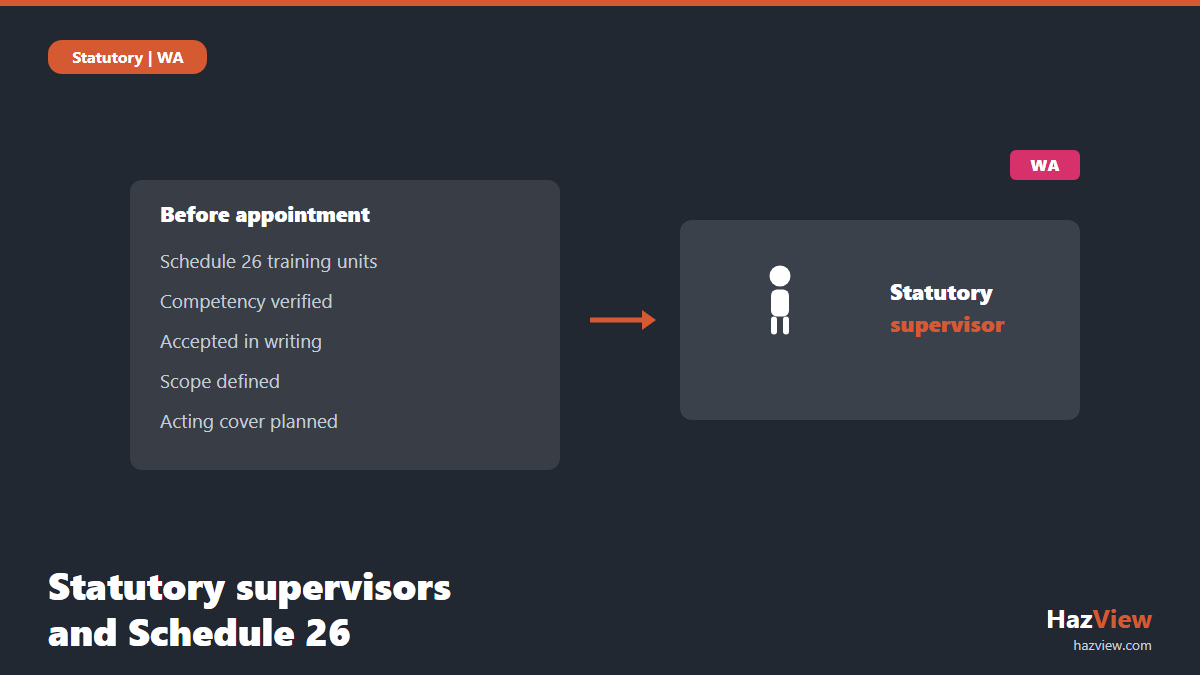
Before appointment to a statutory position, a worker must complete the approved WHS risk management training units in Schedule 26. The units differ depending on whether the position is manager level or supervisor level, so check which tier applies before enrolling.
The training is built around risk management: identifying hazards, assessing risk, selecting and verifying controls, and communicating risk to the people doing the work. That is the point of the requirement. A supervisor who can run a pre-start and a supervisor who can recognise when a control has stopped working are different people, and the regulations are asking for the second one.
Training must be complete before the appointment, not within some grace period after it. Appointing first and training later is a compliance gap that shows up cleanly in an audit of appointment records against training records.
Making and recording the appointment
Three requirements are easy to satisfy and commonly missed.
- The person must accept the appointment in writing. Not a verbal handover, not an entry on a roster.
- The scope must be defined. Which part of the mine, which shifts, which operations. An open-ended appointment is unhelpful for the supervisor and unconvincing to an inspector.
- Acting arrangements must be planned. Your mine safety management system should describe how temporary and permanent vacancies and acting positions are filled. A quarry running for a week with no appointed supervisor on nights is a real exposure.
Note that only the SSE and exploration manager appointments must be notified to the regulator through the Safety Regulation System. Statutory supervisor appointments are documented and held on site.
What the role means on a quarry
On a small quarry, the statutory supervisor is usually the person who opens the gate, runs the pre-start, allocates the crew and walks the pit. The statutory element adds four things to that job.
- Workplace inspection of the area you supervise. Faces and batters, roads, plant, access, housekeeping. See quarry inspections that stand up.
- Verifying controls are in place before work starts, not assuming they are because they were yesterday. Windrows, exclusion zones, isolation, guarding.
- Making sure people understand the duties they are given. This mirrors the quarry manager’s function and pushes down to the supervisor in practice.
- Raising and escalating what you cannot fix. A hazard identified and left unrecorded is the single most common failure point in an incident investigation.
The supervisor sits between the quarry manager’s duty to direct and control operations and the crew doing the work. See the quarry manager’s duties for the layer above.
The evidence problem
Statutory supervisors do a great deal of safety work that leaves no trace. They walk a batter, decide it is safe, and move on. They notice a windrow is low and tell the operator to fix it. They stand a job down until the dust settles.
None of that exists as a record unless someone writes it down, and after an incident the absence of a record reads as an absence of supervision. That is unfair, and it is also avoidable. Capturing inspections, hazards and decisions as they happen, located and timestamped and attributed to the person who made the call, means the supervisor’s judgement is on the record. It also means the next shift inherits the picture rather than rediscovering it.
This is exactly the shift described in why critical controls fail. To see how it works in the field, book a demo.
For the full WA picture, start at quarry safety in Western Australia.
Related guides
- Quarry Safety in Western Australia: A Compliance Guide for Quarry Managers
- Building a Mine Safety Management System for a Small Quarry
- Notifiable vs Reportable Incidents at a WA Quarry
- Principal Mining Hazards at a Quarry: How to Identify Them
- All WA Quarries & Mines guides
Frequently asked questions
Does a statutory supervisor need a certificate of competency?
No WorkSafe-issued certificate is required for the statutory supervisor position, unlike quarry manager or underground supervisor. The approved WHS risk management training units in Schedule 26 must still be completed before appointment.
What training is required before appointment?
Approved WHS risk management units listed in Schedule 26, at the tier applying to the position. Supervisor-level and manager-level requirements differ, so confirm which set applies before enrolling with an RTO.
Can a supervisor be appointed before finishing the training?
The requirement is to complete the approved training before formal appointment. Appointing first and training later is a gap that appears immediately when appointment records are compared with training records.
Do statutory supervisor appointments need to be notified to WorkSafe?
No. Only site senior executive and exploration manager appointments are notified through SRS. Other appointments must be accepted in writing and documented on site.
How many statutory supervisors does a quarry need?
Enough to cover the operation. The duty is to appoint sufficient appropriate persons, which means every shift and area that requires supervision has an appointed person, including during leave and vacancies.