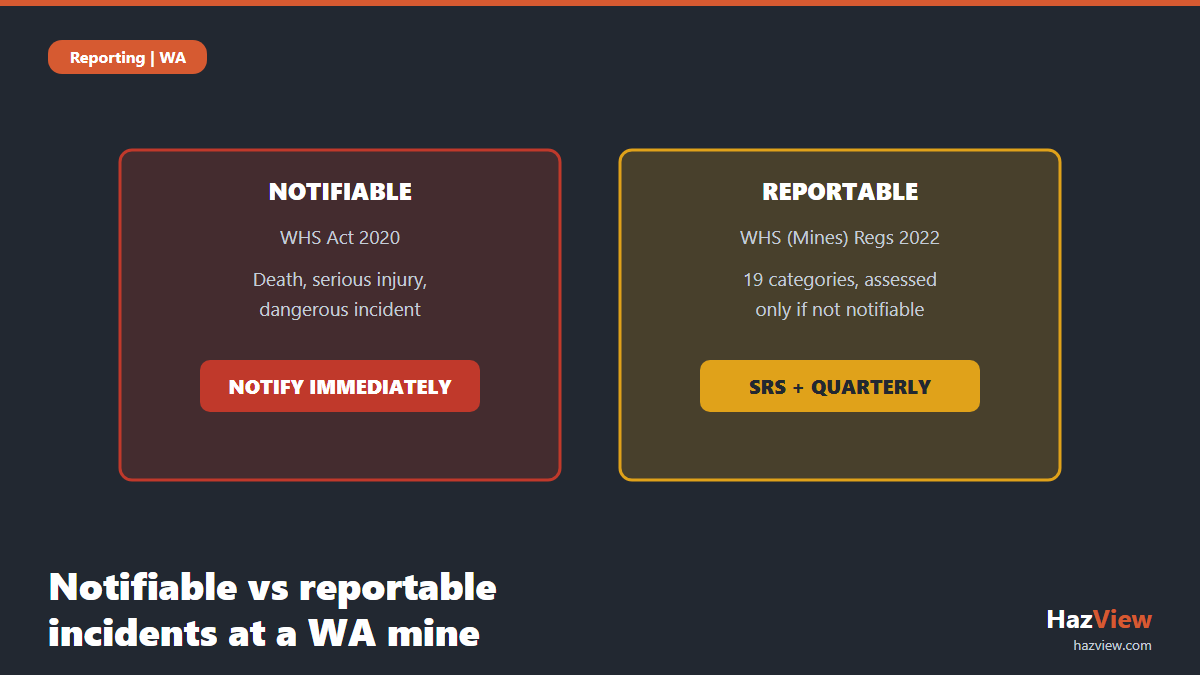
A reportable incident at a WA mine is not the same thing as a notifiable incident, and getting the two confused is one of the most common compliance errors at quarry scale. Western Australia runs two parallel streams under the Work Health and Safety Act 2020 and the Work Health and Safety (Mines) Regulations 2022. This guide sets out how to tell them apart, how each is lodged, and what goes into the quarterly report.
The decision sequence
The order is fixed and it is worth putting on a card in the site office.
- Is it a notifiable incident? Assess this first. Notifiable incidents are death, serious injury or illness, or a dangerous incident, as defined in the WHS Act 2020. If yes, notify WorkSafe immediately.
- If not, is it a reportable incident? Only assess this after ruling out notifiable. Reportable incidents are the categories set out in the WHS (Mines) Regulations 2022 and are lodged through the Safety Regulation System.
- Either way, record it and investigate it. Your obligations under the mine safety management system do not depend on which external stream applies.
The trap is assessing in the wrong order. A crew looks at a list of reportable categories, finds a match, lodges it in SRS and considers the job done, when the incident actually met the notifiable threshold and required immediate notification.
Notifiable incidents
A notifiable incident under the WHS Act 2020 is the death of a person, a serious injury or illness, or a dangerous incident. The duty falls on the PCBU, which at a mine includes the mine operator, and notification must be immediate once you become aware.
Immediate means by the fastest means available, which in practice is a phone call. A written notification follows where required. The site of a notifiable incident must also be preserved until an inspector directs otherwise, which is easy to breach when the instinct after an incident is to clean up and restart.
“Dangerous incident” is deliberately broad. It captures events that exposed someone to a serious risk even where nobody was hurt. On a quarry, an uncontrolled failure of a face, a runaway vehicle, or an unplanned initiation of explosives can all qualify. Do not filter on whether anyone was injured.
Reportable incidents
The WHS (Mines) Regulations set out 19 categories of reportable incident, assessed only after ruling out a notifiable incident. The mine operator must take all reasonable steps to ensure the regulator is notified as soon as possible after becoming aware of a reportable incident arising out of mining operations.
The categories include incidents resulting in illness or injury requiring medical treatment, significant seismic events, extensive subsidence, air blasts in underground mines, single-exit situations underground, plant or structural damage hampering safe operations, winding system or shaft failures, loss of control of a vehicle or plant, high voltage contact, unplanned detonation or ignition of explosives, fly rock incidents, unplanned immersion in liquid, spontaneous combustion in underground mines, exposure to toxic substances, loss of consciousness arising from a workplace incident, suicide or attempted suicide at a mine site, and incidents with the potential to cause serious harm.
Several of those are directly relevant to quarries. Loss of control of a vehicle or plant covers a truck that runs away on a ramp or slides on a wet road, even with no damage. Fly rock covers material leaving the blast exclusion zone. Medical treatment injuries are a far lower bar than a notifiable serious injury, and are the category quarries under-report most.
The quarterly work health and safety report
All data relating to reportable incidents must be included in the quarterly work health and safety report provided to the regulator. The quarterly status report is submitted through the Safety Regulation System no later than 15 days after the end of the quarter it relates to.
Fifteen days is not long if your incident records are scattered across a paper register, a shared drive and someone’s email. Sites that lodge late almost always have the same underlying problem: the incident data does not exist in one place, so the quarterly report is a data-gathering exercise rather than an extract.
Put a recurring diary entry in for quarter end plus a few days, and treat the report as a check on your own records rather than a submission task.
The under-reporting problem
Quarries under-report for understandable reasons. Small crews, a culture of sorting it out, and a genuine uncertainty about whether something crosses the line. The most common misses:
- Near misses treated as non-events because nothing was damaged. Incidents with potential to cause serious harm are a reportable category in their own right.
- Medical treatment injuries recorded as first aid because the worker went to their own GP rather than through the site process.
- Contractor incidents that never reach the mine operator because the contractor handled it internally.
- Loss of control events that resulted in no damage, so nobody logged them.
Under-reporting is not a paperwork issue. It removes the data that would show you a trend before the trend becomes a fatality, which is the whole argument in what shift reports reveal when you actually read them.
Getting the record right at the time
The quality of an incident record is set in the first hour. What was the condition, where exactly, what did it look like, who was there. A photo taken at the scene with the location attached is worth more than a paragraph written in the office three hours later.
Capturing incidents and hazards in the field, geolocated and timestamped with photos attached, gives you a record that stands up in a regulator’s hands and an extract you can run at quarter end. That is what HazView does, and why mine site hazard reporting works better when it happens where the hazard is. Book a demo.
For the wider compliance picture, see quarry safety in Western Australia. For how Queensland handles the equivalent, see high potential incident reporting in Queensland.
Related guides
- Quarry Safety in Western Australia: A Compliance Guide for Quarry Managers
- Principal Mining Hazards at a Quarry: How to Identify Them
- Writing a Principal Mining Hazard Management Plan for a Quarry
- Ground Control at a Quarry: Faces, Batters and the GCMP
- All WA Quarries & Mines guides
Frequently asked questions
What is the difference between a notifiable and a reportable incident in WA?
A notifiable incident is a death, serious injury or illness, or dangerous incident under the WHS Act 2020, and must be notified immediately. A reportable incident is one of the categories in the WHS (Mines) Regulations 2022 that is not a notifiable incident, lodged through SRS and included in the quarterly report.
When is the quarterly WHS report due?
No later than 15 days after the end of the quarter it relates to, submitted through the Safety Regulation System.
Is a near miss reportable at a WA mine?
It can be. Incidents with the potential to cause serious harm are a reportable category, and a dangerous incident that exposed someone to serious risk may be notifiable even where nobody was injured. Assess against the definitions rather than against the outcome.
Do contractor incidents have to be reported?
Yes, where they arise out of mining operations at the mine. The mine operator’s duty is not limited to directly employed workers, so your contractor management arrangements need to bring incidents back to you promptly.
Who reports, the operator or the PCBU?
Notifiable incidents fall on the PCBU under the WHS Act. Reportable incidents place the duty on the mine operator, who must take all reasonable steps to ensure the regulator is notified. At most quarries these overlap, but the roles should be named in your mine safety management system so nobody assumes someone else has done it.