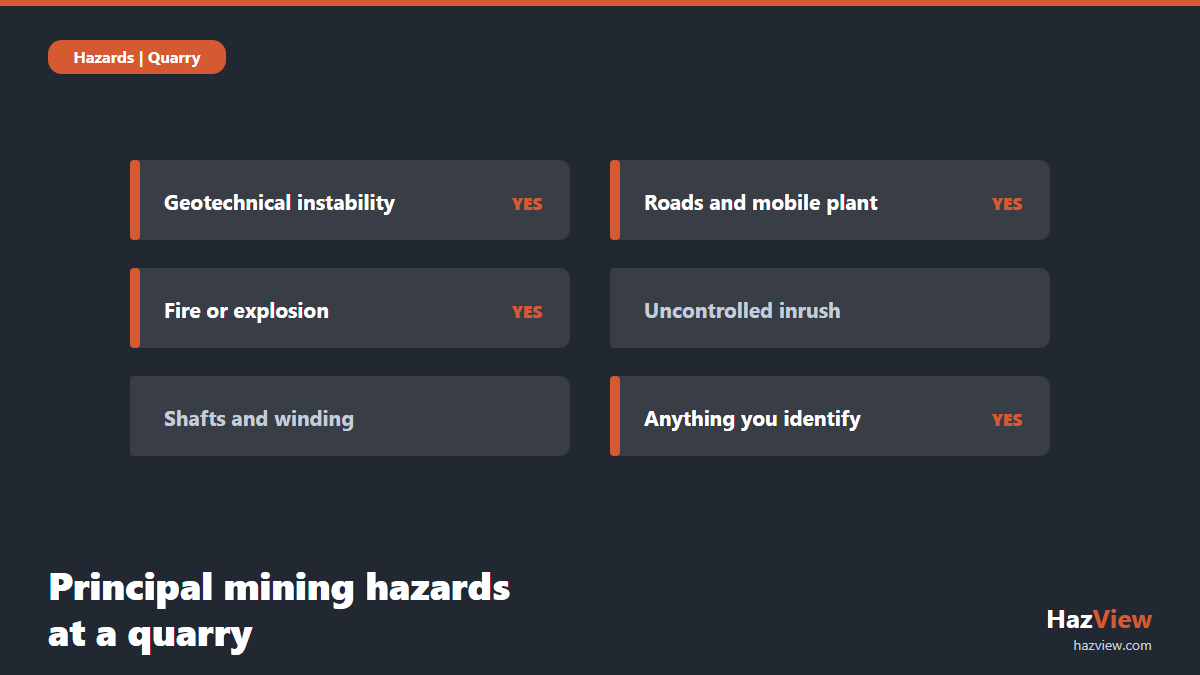
Principal mining hazards at a quarry are the hazards with a reasonable potential to cause fatalities, either in a single event or through recurring incidents. Under regulations 627 to 629 of the Work Health and Safety (Mines) Regulations 2022, the mine operator must identify every principal mining hazard at the mine and prepare a management plan for each one. Getting the identification right is the step that everything else in your safety system depends on.
This guide covers the listed categories, which ones apply to a typical quarry, how to run the identification, and the errors that get assessments sent back.
What counts as a principal mining hazard
A principal mining hazard is any activity, process, procedure, plant, structure, substance, situation or other circumstance in mining operations that has a reasonable potential to result in fatalities, either in a single event or through recurring incidents.
Two parts of that definition do the work. Fatalities, plural. This is not the general hazard register. It is the short list of things that can kill. And through recurring incidents, which captures the slow hazards: dust exposure over a working life is a principal mining hazard even though no single shift kills anyone.
The listed categories
The regulations list principal mining hazard categories, and then require you to identify any others that apply. The listed categories are:
- Geotechnical instability
- Uncontrolled inrush of substances
- Mine shafts and winding systems
- Roads or other areas where mobile plant operate
- Fire or uncontrolled explosions
- Gas outbursts in underground coal mines
- Spontaneous combustion in underground coal mines
- Any other principal mining hazard identified by the mine operator
That last line is not filler. It is where most quarry-specific hazards land, and an assessment that only addresses the named categories has not done the job.
Which apply to a quarry
Geotechnical instability: almost always
Any quarry with a face has this hazard. Face failure, batter instability, undercut faces, loose material on a bench, tip head and stockpile stability, and the edge of an excavation. A sand pit with a four metre unbenched face has a live geotechnical hazard, and so does a hard rock quarry with a twenty metre highwall.
The management plan for this is your ground control management plan. See ground control at a quarry.
Roads or other areas where mobile plant operate: always
If mobile plant moves on your site, this hazard applies. It covers haul roads, access roads, the loading area, stockpile areas, the workshop apron, the weighbridge and anywhere plant and people share ground.
The management plan for this is your traffic management plan, now measured against the Code of practice: Road and traffic management at Western Australian mines published on 4 August 2026. See the new road and traffic code and writing the plan.
Fire or uncontrolled explosions: usually
Two distinct sources at a quarry. Explosives storage, transport and initiation where you drill and blast. And fire on mobile plant, in the workshop, in fuel storage and in conveyor and crushing plant, where hot bearings and accumulated fines are a well-known combination.
Uncontrolled inrush of substances: sometimes
Relevant where a quarry works below a water table, adjacent to a water body, or below tailings, saturated ground or a stockpile that can flow. Quarries that fill with water seasonally and then dewater need to think about this properly rather than dismissing it as an underground hazard.
Mine shafts and winding systems: rarely
Not applicable to surface quarry operations. Record that you considered it and why it does not apply, rather than leaving it off the list silently.
The ones you identify yourself
This is where quarry assessments differentiate themselves. Candidates worth working through:
- Airborne contaminants, particularly respirable crystalline silica. A textbook recurring-incidents hazard. See silica dust at WA quarries.
- Fixed plant: crushing, screening and conveying. Entanglement, engulfment in bins and stockpiles, and stored energy during clearing blockages.
- Working at height on crusher structures, screens and silos.
- Isolation and stored energy across the whole plant.
- Emergency response isolation. A remote quarry a long way from help changes the outcome of any serious injury, which makes response capability a control on every other hazard.
How to run the identification
- Assemble the right people. The quarry manager or SSE, supervisors, experienced operators, a geotechnical practitioner where faces are involved, and any contractor who runs significant plant. Worker consultation is a legal requirement, not a nicety.
- Work through the listed categories first, deciding applies or does not apply, and record the reasoning either way.
- Then work the site systematically. Walk it by area: pit, faces, roads, plant, workshop, stockpiles, offices. Ask at each one what could kill someone here.
- Test against history. Your own incidents and near misses, WorkSafe WA significant incident reports, and industry fatality data. Most quarry fatality mechanisms are well documented and repeat.
- Record the decision for every category, including exclusions. An inspector reading your assessment should be able to see what you considered, not just what you kept.
- Write a management plan for each hazard identified. See writing a PMHMP for a quarry.
The mistakes that get assessments rejected
- Confusing the PMH list with the hazard register. Twenty-five principal mining hazards means you have not distinguished fatality risks from everything else.
- Only addressing the listed categories. The regulation requires you to identify any other principal mining hazard, and a quarry has some.
- No record of exclusions. “Mine shafts and winding systems: not applicable, surface operation only” takes one line and closes a question.
- Copying another site’s list. The assessment is site-specific by definition.
- Doing it once. A new pit, a new plant, a change of method or a change of scale all warrant a fresh look.
- No worker input. The operator who works the face every day knows things the assessment team does not.
From identification to control
Identifying a hazard is the easy half. The hard half is keeping the controls visible and verified once the plan is written, which is where most systems quietly fail. A face flagged as unstable in a plan is only controlled if the people driving past it today know it is there.
Mapping principal hazards and their controls where they physically are, so every worker sees the same current picture, is what turns a plan into a control. See why critical controls fail, or book a demo.
The wider WA picture is in quarry safety in Western Australia. For how NSW handles the same idea, see principal hazard management plans.
Related guides
- Quarry Safety in Western Australia: A Compliance Guide for Quarry Managers
- Writing a Principal Mining Hazard Management Plan for a Quarry
- Ground Control at a Quarry: Faces, Batters and the GCMP
- Silica Dust at WA Quarries: RCS Monitoring and the Air Quality Officer
- All WA Quarries & Mines guides
Frequently asked questions
What is a principal mining hazard?
Any activity, process, procedure, plant, structure, substance, situation or other circumstance in mining operations with a reasonable potential to result in fatalities, either in a single event or through recurring incidents.
How many principal mining hazards should a quarry have?
There is no target number. Most quarries land on a handful: geotechnical instability, roads and mobile plant areas, fire or uncontrolled explosions, and usually airborne contaminants or fixed plant. If your list runs to twenty, you are listing hazards rather than principal mining hazards.
Is dust a principal mining hazard?
It can be. The definition expressly covers fatalities through recurring incidents, and respirable crystalline silica exposure at a hard rock quarry fits that. Assess it rather than assuming it belongs only in the health section.
Who must identify principal mining hazards?
The mine operator, under regulations 627 to 629. In practice the quarry manager or SSE leads it with input from supervisors, workers and specialists.
How often should the identification be reviewed?
On a scheduled cycle and whenever the operation changes materially: a new pit or face, new plant, a change of method or scale, or an incident that reveals a hazard you had not identified.