A principal mining hazard management plan for a quarry is required under regulations 627 to 629 of the Work Health and Safety (Mines) Regulations 2022. You need one for each principal mining hazard identified at the mine. This guide covers the structure that works, how to write controls that can actually be verified, and why the plan needs to be readable by the people who work under it.
If you have not completed the identification step, start with identifying principal mining hazards at a quarry. Writing plans before you know what hazards you have produces a set of documents that do not cover the site.
The one rule about templates
Use a template for structure. Never use one for content.
WorkSafe WA publishes a PMHMP guide and a self-assessment template, and they are worth working through. What does not work is lifting a plan from another operation and changing the site name. The plan must be specific to your site and must include input from relevant workers and stakeholders. A copied plan is affirmative evidence that you did not assess your own operation, which is a worse position than having no plan at all.
Structure that works
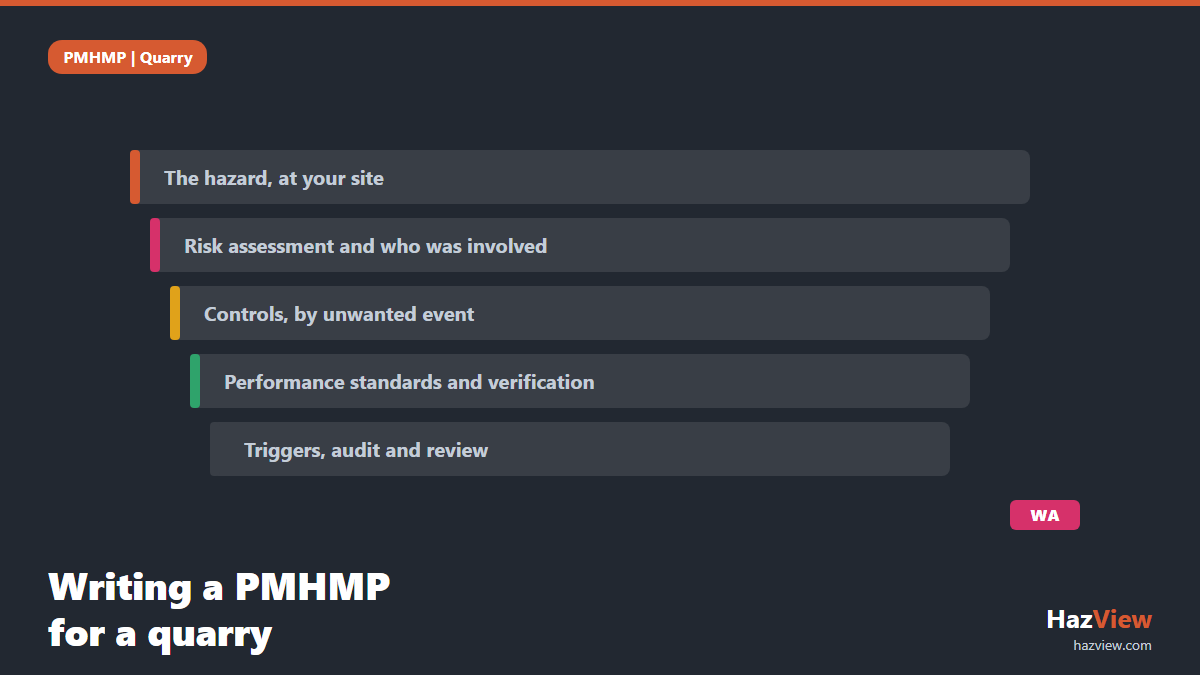
1. Scope and the hazard
Name the principal mining hazard and describe it as it exists at your site, not in the abstract. “Geotechnical instability” is a category. “Face and batter instability in the northern extraction area, where the weathered horizon overlies competent rock at approximately eight metres and undercuts have occurred during wet season extraction” is a hazard.
State what the plan covers and what it does not, and where the boundary sits with your other plans.
2. How the risk was assessed
Describe the process, not just the outcome. Who was involved, when, what method was used, what information was drawn on, and what conclusions were reached. Include the workers who were consulted by role. This section is what an inspector reads to decide whether the rest of the plan is credible.
3. The unwanted events
Set out the specific ways the hazard causes a fatality at your site. For roads and mobile plant areas at a quarry: a light vehicle struck in a loading area blind spot, a truck leaving a ramp edge, a pedestrian struck at the weighbridge, a runaway on a grade. Naming the mechanisms forces the controls to be specific.
4. Controls, by event
For each unwanted event, list the controls in hierarchy order: elimination, substitution, engineering, administrative, PPE. Mark which are critical, meaning the ones whose failure allows the fatality to occur.
Be honest about what you actually have. A plan listing proximity detection you have not installed is a plan that will be tested against equipment that does not exist.
5. Performance standards
This is the section that separates a compliant plan from a description. For each critical control, three answers:
- What must it achieve? Stated so that a person could tell whether it is being achieved.
- How do we verify it? A specific check, at a stated frequency, by a named role.
- What happens when it fails? The trigger and the response.
Example. Control: continuous windrow on all roads with an adjacent drop-off. Standard: continuous, competent, at least the specified height, no gaps except at authorised access points. Verification: recorded road inspection each shift by the statutory supervisor. Trigger and response: any gap or reduced section closes the road or restricts it to one lane at reduced speed until repaired, authorised by the quarry manager.
That is four sentences and it is auditable. A page of prose about the importance of edge protection is not.
6. Roles and accountabilities
Who owns the plan, who implements each control, who verifies, who can authorise a departure. Use statutory positions where they apply so the accountability chain matches your appointments. See the quarry manager’s duties and statutory supervisors.
7. Triggers and escalation
Conditions change and the plan needs to change with them. A trigger action response plan is the cleanest format: defined levels, defined triggers, defined actions, named decision maker. See building a TARP.
8. Training, communication and competency
Who needs to know what, how they are trained, and how you confirm they understood. This connects to the quarry manager’s function of ensuring every person appointed to perform duties understands the nature and scope of that duty.
9. Monitoring, audit and review
How the plan’s effectiveness is measured, how often it is audited, and what triggers a review. Regulation 629 requires the plan to be updated following changes in risk controls caused by incidents or altered hazard conditions, so name those triggers explicitly rather than relying on an annual date.
Readability is a requirement, not a nicety
The regulator’s expectation is that a PMHMP is clear, easy to understand and readily accessible to all personnel. That rules out a 90-page document in a locked folder in the site office.
The practical answer at quarry scale is a plan short enough to read, with a one-page summary of the critical controls and triggers that can go on the wall and into the induction. If a new operator cannot tell you the three things that will kill them here and what stops each one, the plan is not accessible regardless of where the file lives.
How many plans do you need?
One for each principal mining hazard identified. For a typical hard rock quarry that is commonly three or four: geotechnical instability, roads and mobile plant areas, fire or uncontrolled explosions, and airborne contaminants.
They can share appendices and cross-reference each other. What they should not do is merge into one general safety document, because that loses the hazard-by-hazard structure the regulation asks for. All of them sit inside your mine safety management system.
Keeping the plan alive
The failure mode is not writing a bad plan. It is writing a good plan and then letting the site drift away from it. Faces advance, roads move, plant changes, and six months later the plan describes a quarry that no longer exists.
The controls that stay current are the ones tied to a live picture of the site rather than to a document. Hazards, exclusion zones, road conditions and inspection records on a shared map update as the site updates, and produce a dated record of every change. That closes the gap between the plan and the pit, and gives you the verification evidence the performance standards demand.
That is what HazView does. Book a demo to see it on your hazards.
Related guides
- Quarry Safety in Western Australia: A Compliance Guide for Quarry Managers
- Ground Control at a Quarry: Faces, Batters and the GCMP
- Silica Dust at WA Quarries: RCS Monitoring and the Air Quality Officer
- Quarry Inspections That Stand Up: Daily Checks, Records and Evidence
- All WA Quarries & Mines guides
Frequently asked questions
What must a PMHMP contain?
It must describe the hazard, set out the risk assessment, clearly define the control measures and how they are implemented, include performance standards, and provide for auditing and review. It must be clear, easy to understand and readily accessible to personnel.
Can one plan cover several hazards?
The regulation requires a plan for each principal mining hazard identified. Plans can share content and cross-reference, but each hazard needs its own identifiable plan rather than being absorbed into a general document.
Is there a PMHMP template for WA?
WorkSafe WA publishes a principal mining hazard management plan guide and a self-assessment template. Use them for structure. The content must be specific to your site and developed with input from your workers.
How often must a PMHMP be reviewed?
On a scheduled cycle and on trigger. Regulation 629 requires updating following changes in risk controls caused by incidents or altered hazard conditions, so set explicit triggers as well as a review date.
Who signs off a PMHMP?
The mine operator holds the duty. In practice the SSE approves, with the quarry manager owning implementation. Name the accountable roles in the plan itself.