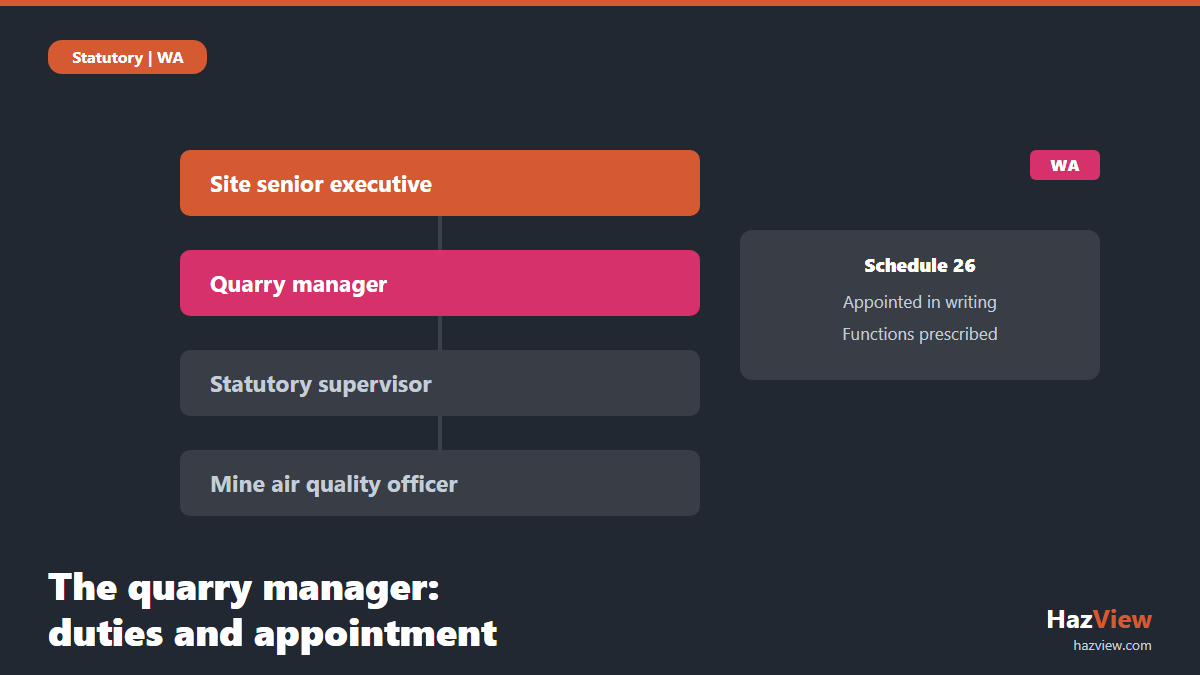
Quarry manager duties in WA are set out in Schedule 26 of the Work Health and Safety (Mines) Regulations 2022. The quarry manager is a statutory position, which means it is a formally prescribed role with defined legal responsibilities, not a job title the business hands out. This guide covers when a quarry manager must be appointed, what the role is legally required to do, what certificate is needed, and what happens when no quarry manager is required at all.
When must a quarry manager be appointed?
A quarry manager must be appointed at a mine where quarry operations are carried out and a levy is payable under the Mines Safety and Inspection Act 1994.
Two conditions, both required. Quarry operations are surface mining operations where mineral, rock or soil is extracted by excavating into a natural surface gradient, expressly including sand, clay and gravel extraction, strip mining, harvesting evaporites and hydraulic mining. The levy test is the second gate and it is the one most people overlook.
If both apply, you appoint a quarry manager. If they do not, you do not, but that does not mean nobody holds the responsibility.
What happens if a quarry manager is not required
Where a quarry manager is not required to be appointed, the site senior executive has the functions of a quarry manager.
This catches people out. A small operator who concludes “we do not need a quarry manager” and stops there has not removed the duty, they have moved it onto the SSE. If you are the SSE at a quarry with no appointed quarry manager, the functions below are yours, and they are the ones an inspector will hold you to.
The statutory functions of a quarry manager
Schedule 26 sets out the functions. In substance, the quarry manager is required to:
- Direct and control the quarry operations at the mine.
- Control and supervise the quarry operations.
- Ensure every person appointed to perform duties understands the nature and scope of that duty.
- Ensure persons engaged in quarry operations perform all duties imposed under the Act.
- Assist the site senior executive in managing emergencies at the part of the mine where quarry operations are carried out.
Read those carefully, because the wording is doing work. “Direct and control” is an operational duty, not an advisory one. “Ensure every person understands the nature and scope of that duty” means a verbal handover of a task is not enough: the person needs to understand what they have been given and how far it extends. That is an evidence obligation as much as a communication one.
What certificate does a quarry manager need?
Quarry manager is one of the certificated statutory positions in WA, alongside underground managers and supervisors, authorised mine surveyors and winding engine drivers. The certificate is issued by WorkSafe WA following approved training, evidenced experience and legislation exams.
There is a size threshold that changes which certificate is acceptable. Where, on average, more than 25 persons per day carry out quarry operations at the mine, the quarry manager must hold either a first class mine manager’s certificate for coal mines or a first class mine manager’s certificate for non-coal mines. Below that threshold, a quarry manager’s certificate is the applicable qualification.
Count the people carrying out quarry operations, not the headcount on the gate register, and check the number as the operation grows. Crossing 25 on average is a change to your statutory obligations. The full pathway is in how to get a WA quarry manager’s certificate of competency.
Making the appointment properly
The mine operator must ensure sufficient appropriate persons are appointed to the statutory positions listed in Schedule 26. Three practical points:
- The person must accept the appointment in writing. A verbal appointment does not meet the requirement, and this is one of the easiest findings for an inspector to make.
- Only SSE and exploration manager appointments must be notified to the regulator through the Safety Regulation System. Quarry manager appointments do not require notification, but they must still be documented and held on site.
- “Sufficient” means cover. Rosters, leave, illness and turnover all need planning. A single quarry manager on a two-week break with nobody appointed to act is a gap, and your mine safety management system should say how vacancies and acting positions are filled.
Before appointment, the person must also complete the approved WHS risk management training units in Schedule 26 that apply to a manager-level position. See statutory supervisors and Schedule 26 training for how the manager and supervisor tiers differ.
How the quarry manager fits with other roles
The site senior executive holds overall accountability for safety at the mine. The quarry manager directs and controls the quarry operations within it and assists the SSE in emergencies. Statutory supervisors supervise defined parts of the operation day to day. A mine air quality officer is appointed where workers may be exposed to airborne contaminants, heat or humidity, which at a hard rock quarry with crushing and screening is a live question. See silica dust at WA quarries.
On a small quarry these roles can overlap in one or two people. That is legal, and it is also how gaps form, because one person holding four sets of duties tends to work to whichever is loudest that week.
Proving you discharged the duty
“Direct and control” and “ensure persons perform their duties” are duties of active management. After an incident, the question is what you knew, when you knew it, and what you did. That is answered by records: inspections completed, hazards raised and closed out, instructions given, and decisions dated.
Most quarry managers do this work and cannot prove it, because it lives in radio calls, a notebook and a whiteboard. Capturing hazards, inspections and actions in one system where each entry is located, timestamped and attributed turns daily management into an evidence trail without adding a second job. That is the case made in why critical controls fail, and what HazView is built to do. Book a demo to see it.
For the wider WA picture, start at quarry safety in Western Australia.
Related guides
- Quarry Safety in Western Australia: A Compliance Guide for Quarry Managers
- How to Get a WA Quarry Manager’s Certificate of Competency
- Statutory Supervisors at a WA Quarry: Schedule 26 Explained
- Building a Mine Safety Management System for a Small Quarry
- All WA Quarries & Mines guides
Frequently asked questions
Does every WA quarry need a quarry manager?
No. A quarry manager is required where quarry operations are carried out and a levy is payable under the Mines Safety and Inspection Act 1994. Where one is not required, the site senior executive holds the quarry manager’s functions.
Can the SSE also be the quarry manager?
Yes, and on small operations it is common. The person still needs to meet the competency requirements for each position they hold, and the workload needs to be realistic enough that both sets of duties are genuinely discharged.
What happens above 25 persons per day?
Where more than 25 persons per day on average carry out quarry operations, the quarry manager must hold a first class mine manager’s certificate, for coal or non-coal mines. Below that, a quarry manager’s certificate applies.
Does a quarry manager appointment need to be reported to WorkSafe?
No. Only site senior executive and exploration manager appointments must be notified to the regulator through SRS. All appointments, including the quarry manager, must be accepted in writing and documented.
What is a statutory position?
A formally prescribed role under the WHS (Mines) Regulations 2022 with defined health and safety responsibilities. The positions are listed in Schedule 26, and Part 10.7A prescribes positions in relation to mines. Some require a statutory certificate of competency.