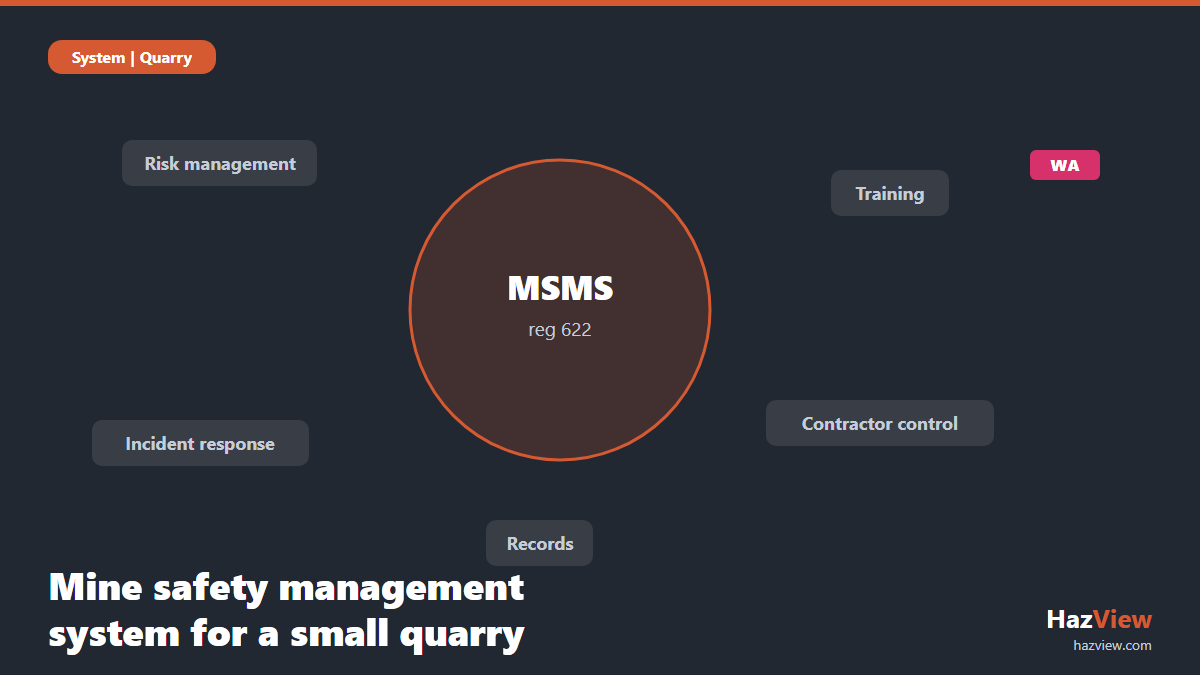
A mine safety management system is required at every Western Australian quarry, no matter how small. Regulation 622 of the Work Health and Safety (Mines) Regulations 2022 puts the duty on the mine operator to establish and implement an MSMS. There is no worker-number threshold and no exemption for sand pits. What does scale is the level of detail, which the regulator accepts should be appropriate to the size, complexity and risk of the operation.
This guide covers what an MSMS has to contain, how to build one that a twelve-person quarry can actually use, and the review obligations that catch operators out.
What an MSMS is, and is not
The MSMS is the framework that brings together your policies, systems, procedures and plans so the mine operator can ensure the safe operation of the mine. It covers the full life cycle: planning, design, construction, commissioning, operation, maintenance and closure.
It is not a manual. It is not a folder of procedures. A collection of documents that nobody references is not an implemented system, and “establish and implement” is the wording in the regulation. The practical test an inspector applies is whether a supervisor standing next to a hazard can find the control that applies to it.
What regulation 622 requires
Regulation 622 sets the content requirements. The core elements are:
- Risk management. How hazards are identified, risks assessed and controls selected and verified.
- Training and competency. Who is competent to do what, and how that is verified and maintained.
- Incident response. How incidents are responded to, investigated, reported and learned from.
- Contractor control. How contractors are engaged, inducted, supervised and held to the same standard.
- Records. What is kept, for how long, and where it can be found.
Beyond those, the system must set out the health and safety policy and the broad aims of the MSMS, the management and supervisory structure including how temporary and permanent vacancies and acting positions are filled, performance standards for measuring the effectiveness of every part of the system, and the process for updating the MSMS when the mine or the operation changes.
Monitoring arrangements for plant, workings and air quality, and control measures for identified hazards, also sit inside it. The MSMS is where your principal mining hazard management plans, traffic management plan and ground control management plan live.
Review obligations
Three timings matter.
- A new mine must review its MSMS within 12 months of commencing operations. This is the one small operators miss most often, because the system was written to get the mine started and then left alone.
- A full review at least every three years. Documented, with findings and actions.
- Trigger-based review following a notifiable incident, deficiencies found in an audit, or significant operational change. A new pit, a new plant type, a change of contractor model or a change in scale all qualify.
Building one for a small quarry
The failure mode at quarry scale is over-building. Someone downloads a tier one miner’s system, spends three months adapting it, and produces 400 pages that nobody opens. That is worse than a thin system, because it proves the operation cannot describe its own risks.
Build it in this order instead.
- Identify your principal mining hazards first. Everything else hangs off them. For most quarries that is geotechnical instability and roads or areas where mobile plant operate, and possibly fire or uncontrolled explosions. See identifying principal mining hazards at a quarry.
- Write a management plan for each. These are the substance of the system.
- Document the structure. Who holds which statutory position, what each is responsible for, and how vacancies and acting arrangements work. See the quarry manager’s duties.
- Set performance standards. For each significant control, state what “working” looks like and how you check it. This is what turns a description into a system.
- Define the routine. Inspections, pre-starts, maintenance, monitoring, reporting. What happens, how often, by whom, recorded where.
- Cover contractors explicitly. Drill and blast crews, crushing contractors, carters and fitters are often the largest exposure on a quarry and the least covered part of the system.
- Then write the policy and the front matter. Last, not first.
Performance standards, in plain terms
Performance standards are where most small-quarry systems fall over, usually because the concept sounds academic. It is not. A performance standard answers three questions about a control: what does it have to achieve, how do we know it is achieving it, and who checks.
Take windrows. The standard might be that a continuous windrow of at least the specified height is maintained on every road with an adjacent drop-off; verification is a documented road inspection each shift by the statutory supervisor; the trigger is that any gap or reduced section is closed or the road restricted until repaired. That is a performance standard, and it is two sentences.
The implementation gap
Almost every WA quarry that gets a finding on its MSMS gets it on implementation rather than content. The document says inspections happen weekly. The records show three in the last quarter. The plan names a control. The pit shows it has not been maintained.
The reason is rarely negligence. It is that recording things properly on paper takes time nobody has at the end of a shift, so it gets deferred and then reconstructed. A system where the inspection is completed on a phone in the field, against the actual location, and the record exists the moment it is done, closes that gap without adding work. It also means the evidence exists before you need it rather than after.
That is the argument in moving hazard management from paper to real-time control, and what HazView does. Book a demo to see it against your operation.
The wider WA compliance picture is in quarry safety in Western Australia.
Related guides
- Quarry Safety in Western Australia: A Compliance Guide for Quarry Managers
- Notifiable vs Reportable Incidents at a WA Quarry
- Principal Mining Hazards at a Quarry: How to Identify Them
- Writing a Principal Mining Hazard Management Plan for a Quarry
- All WA Quarries & Mines guides
Frequently asked questions
Does a small quarry need a mine safety management system?
Yes. Regulation 622 applies to mine operators without a worker-number threshold. The level of detail should be appropriate to the size, complexity and risk of the mine, but the system itself is not optional.
How often must an MSMS be reviewed?
A new mine reviews within 12 months of commencing operations, and every operation completes a full review at least every three years. Reviews are also triggered by notifiable incidents, audit deficiencies and significant operational change.
Can we use an MSMS template?
A template is a useful structure and a poor substitute for content. The system must describe your site, your hazards and your controls. A plan that describes someone else’s operation is evidence that you did not assess your own.
Does the MSMS apply to exploration?
Yes. The requirement extends to mining operators across their sites including exploration operations, with the exploration manager as the relevant statutory position.
What is the difference between an MSMS and a PMHMP?
The MSMS is the overall system covering the whole operation. A principal mining hazard management plan is a specific plan for one identified principal mining hazard, and it sits inside the MSMS.