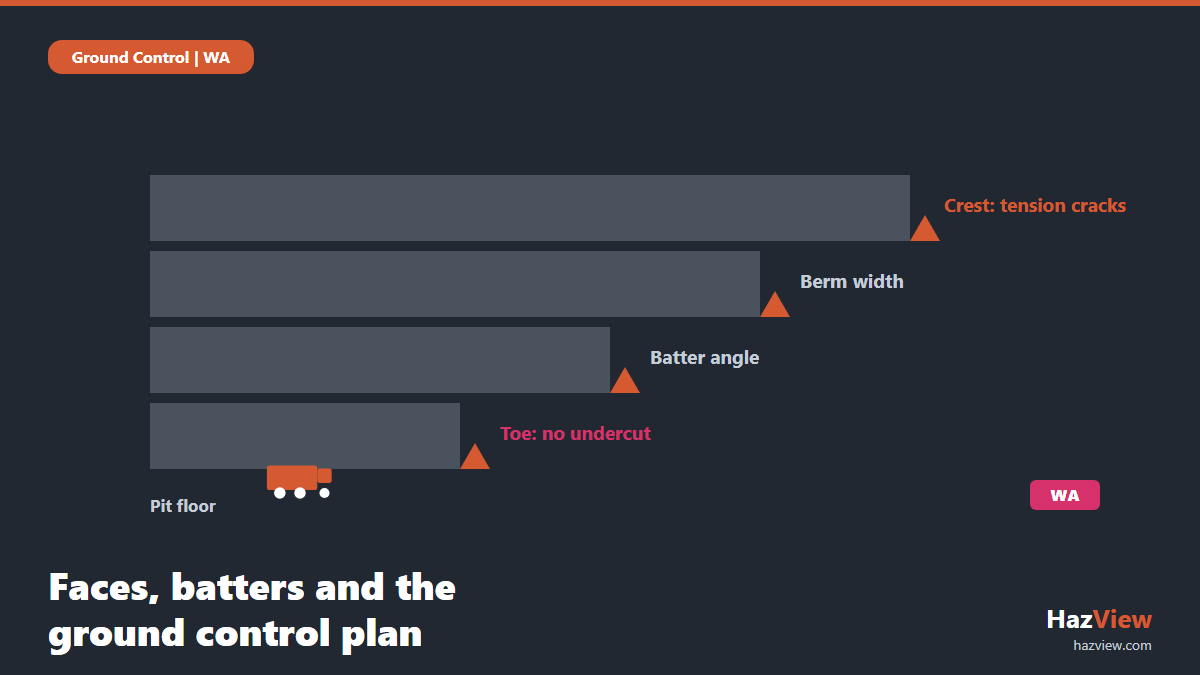
A ground control management plan for a quarry is how you manage geotechnical instability, which is a listed principal mining hazard under the Work Health and Safety (Mines) Regulations 2022. Western Australia’s Ground control for Western Australian mining operations code of practice, published 14 February 2025, is written to accommodate everything from small sandpits and quarries through to deep underground operations. It applies to you.
This guide covers what a quarry GCMP needs to contain, how face and batter inspection should work in practice, and the failure patterns that keep recurring.
Why small quarries get this wrong
Two beliefs cause most of the trouble. The first is that ground control is a big-mine discipline requiring a resident geotechnical engineer. The second is that a small face is a safe face.
Neither holds. Ground control at quarry scale is mostly about design discipline, inspection and housekeeping rather than instrumentation. And a four metre face of weathered material with an undercut toe can kill a person just as effectively as a highwall, particularly when the person is standing at the toe looking up at it.
The code is structured to support a risk management approach through a ground control management plan and the related safe systems of work, which is exactly what a small operation can deliver.
What a quarry GCMP should contain
The ground you are working in
Material types, weathering profile, structure and defects, groundwater, and how the ground behaves when wet. This does not require a research programme. It requires someone competent to write down what is actually there, informed by the drilling and the faces you have already exposed.
Design parameters
Batter angle, bench height, berm width, overall slope angle, and crest and toe standards. The design has to be justified by the ground conditions, not inherited from whoever cut the first face. Where the ground varies across the pit, the design varies with it.
State the design explicitly so that a deviation is visible. “Batters at 60 degrees, maximum bench height 6 metres, minimum berm width 4 metres in the weathered zone” is a design. “Faces cut to a safe angle” is not.
Excavation and extraction method
How the face is worked, what plant is used, and the rules for the exclusion zone at the toe. Undercutting is the single most common quarry face failure mechanism and it is a method problem, not an inspection problem. If your excavator can undercut the face, the method needs to prevent it.
Inspection regime
What is inspected, how often, by whom, against what criteria, and how it is recorded. Cover faces and batters, crests, benches, the tip head and stockpiles, and excavation edges. Then set what happens after rain, after a blast, and after any observed movement, because those are the triggers that matter.
Triggers and responses
Observable indicators with defined actions: tension cracks at the crest, fresh material at the toe, seepage, overhangs, loose blocks, undercut. Each with a response ranging from monitor, through exclude and batter down, to stop work. A trigger action response plan is the right format, and the TARP structure transfers directly.
Competency, training and communication
Who is competent to inspect a face and make a call on it, and what every operator working near a face needs to recognise. The code identifies communication, training and supervision as part of ground control, not as an add-on.
Edge protection and access
Crest windrows, bunding, barricading, and rules for access above and below a face. Tip heads deserve their own treatment: edge protection, a spotter or a defined tipping procedure, and a stop point that is not the edge.
Inspecting a face properly
A face inspection that consists of a supervisor glancing at the wall from the cab on the way past is not an inspection. What good looks like:
- From a safe position. Not at the toe, and not on the crest without edge protection. A view from a safe distance and a look from above where access allows.
- Against defined criteria. Overhangs, loose material, tension cracks, seepage, undercut, blast damage, material change. A checklist, not a general impression.
- Recorded, including when nothing is found. “Inspected, no defects” is the record that proves the regime operates. A file containing only the days something was wrong looks like an incident log.
- With a photo and a location. Ground conditions change slowly and a dated photo series is the cheapest monitoring you will ever run.
- Closed out. A defect raised and never closed out is worse than a defect never raised, because it demonstrates you knew.
See quarry inspections that stand up for the wider inspection routine.
The recurring failure patterns
- Undercutting the toe to win the last of the material, leaving an unsupported mass above.
- Working under an unscaled face after a blast, before loose material has been brought down.
- Bench heights creeping up as production pressure grows, until the design no longer describes the pit.
- Berms lost to spillage until they no longer catch anything.
- Wet season neglect. Water is the main driver of quarry face failure and the inspection frequency rarely increases with rainfall.
- Nobody competent looking. Everyone assumes the geotech signed off on a design drawn three years ago.
Do you need a geotechnical engineer?
Not necessarily resident. What you need is competent input into the design proportional to the risk, and a competent person doing the routine inspections.
For a small sand or gravel operation with low faces in known material, that may be a periodic review by a consultant with a trained supervisor inspecting day to day. For a hard rock quarry with high faces, structural control and blasting, it means real geotechnical involvement in the design and in reviewing changed conditions. The test is whether the person making the call has the competence to make it, and whether you could demonstrate that afterwards. See how geotechnical engineers use HazView.
Making ground conditions visible
Ground control has a communication problem more than a technical one. The geotech identifies a zone of concern, the supervisor knows about it, and the loader operator on nights does not. Exclusion zones described in a report are boundaries nobody can find in the dark.
Marking unstable ground, exclusion zones and monitored areas on a live shared map, with the inspection photos attached where they were taken, means everyone on site sees the same picture and the history of a face is one tap away. That is what HazView is used for on active pits. Book a demo.
Ground control is one plan inside a wider system. See identifying principal mining hazards, writing the management plan, and quarry safety in Western Australia.
Related guides
- Quarry Safety in Western Australia: A Compliance Guide for Quarry Managers
- Silica Dust at WA Quarries: RCS Monitoring and the Air Quality Officer
- Quarry Inspections That Stand Up: Daily Checks, Records and Evidence
- Quarry Traffic Management Plan: What a WA Site Needs to Include
- All WA Quarries & Mines guides
Frequently asked questions
Does a small quarry need a ground control management plan?
If geotechnical instability is a principal mining hazard at your site, and it is at any quarry with a face, you need a management plan for it. The WA ground control code of practice is expressly written to cover small sandpits and quarries as well as large operations.
How often should quarry faces be inspected?
Set the frequency in your GCMP based on the ground, the exposure and the rate of change, then add triggers: after rain, after blasting, and after any observed movement. Faces being actively worked warrant inspection before work each shift.
What is undercutting and why does it matter?
Excavating the base of a face so material above is unsupported. It is the most common quarry face failure mechanism, it usually happens while chasing the last of the material at the toe, and it is prevented by the extraction method rather than by inspection.
Is the WA ground control code mandatory?
It is a code of practice, so it sets the practical benchmark rather than a prescriptive rule. You can comply another way if you achieve an equivalent or better standard, and the code carries evidentiary weight in proceedings.
Who can inspect a quarry face?
A competent person, with the competence proportionate to the complexity of the ground. Define who that is in your GCMP, along with when specialist geotechnical input is required.