A quarry inspection checklist is only as good as the record it leaves behind. Most Western Australian quarries inspect more thoroughly than their paperwork suggests, and that gap is what turns a well-run site into a poor audit result. This guide covers what to inspect, how often, and how to make the record hold up when someone tests it.
Why inspections carry so much weight
Under the Work Health and Safety (Mines) Regulations 2022, your controls need performance standards and your mine safety management system needs to demonstrate those standards are met. In practice, inspection is how nearly every physical control gets verified. Windrows, faces, guarding, roads, edge protection, isolation and housekeeping are all checked by someone looking at them.
Which means the inspection record is the evidence that your management plans are real. No record, no verification. No verification, no demonstrated control.
The layers of inspection
Do not try to do everything in one checklist. Separate them by frequency and purpose.
Pre-start, by the operator
Plant condition, guarding, fire suppression, seatbelts, tyres, lights, horns and reversing alarms, cab filtration, and any defects carried from the previous shift. The operator is the person best placed to notice change on their own machine.
Shift inspection, by the statutory supervisor
The core statutory inspection of the area supervised, before work and as conditions change. This is the one that matters most and the one most often reduced to a signature.
Weekly or periodic, by the quarry manager
A wider look with fresh eyes. Compliance with the traffic management plan, condition of infrastructure, contractor areas, and whether the shift inspections are actually finding things.
Triggered inspection
After rain, after a blast, after an incident, after a plant change, and after any period of shutdown. These are where failures concentrate and where inspection frequency almost never increases in practice.
What a quarry shift inspection should cover
Adapt this to your site rather than adopting it wholesale. The value is in the specificity.
- Faces and batters. Overhangs, loose material, tension cracks at the crest, seepage, undercut at the toe, blast damage, changed material. See ground control at a quarry.
- Crests, benches and edges. Edge protection present and competent, berms not lost to spillage, access controlled above and below faces.
- Roads. Surface condition, potholing, corrugation, drainage, crossfall, sight lines at intersections, and windrows continuous where there is a drop-off. See quarry haul road design.
- Signage and delineation. Present, legible, correctly positioned, consistent with the traffic management plan. See speed limits and signage.
- Segregation. Pedestrian walkways clear and defined, parking in the right places, exclusion zones intact. See segregating vehicles and people.
- Tip heads and stockpiles. Edge protection, stop points, stockpile stability, no undercutting by the loader.
- Fixed plant. Guarding in place, walkways and handrails, isolation points accessible and labelled, housekeeping around transfer points and under conveyors.
- Dust and water. Suppression operating, sprays working, roads treated, ponding managed. See silica dust at WA quarries.
- Emergency provisions. Access routes clear, firefighting equipment in place and in date, muster points accessible, communications working.
- Contractors and visitors. Inducted, where they are supposed to be, working to the permit or scope agreed.
Why inspection records fail
Six patterns account for nearly all of it.
- All ticks, no findings. A quarry that inspected 180 times and found nothing did not inspect 180 times. An inspection regime that never finds anything is evidence that it is not working.
- Findings with no close-out. The most damaging record of all, because it proves you knew and cannot show what you did.
- No location. “Loose material on face” is unactionable a week later. Which face, where on it.
- Written up hours later. Detail decays fast, and the record ends up describing what the inspector remembers rather than what they saw.
- Gaps nobody notices. Missing days, missing shifts, missing the weeks the supervisor was on leave.
- Records in three places. A book in the site office, photos on a phone, and defects in an email. Nobody can assemble the picture, including you.
What a strong record contains
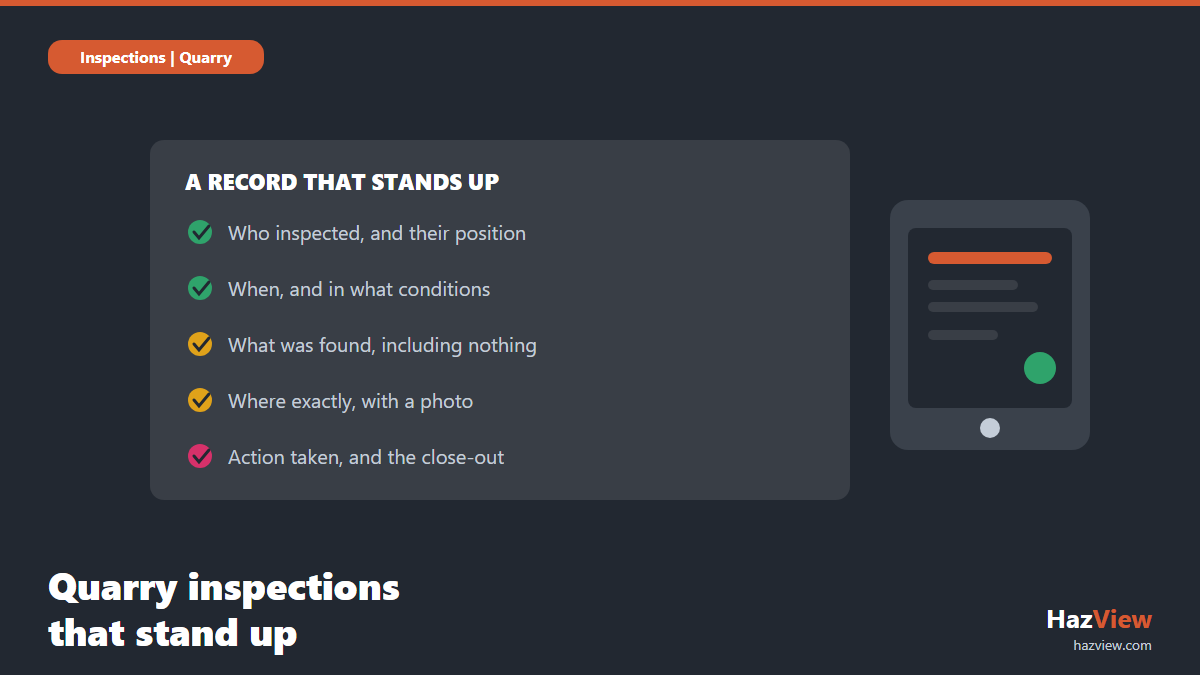
- Who inspected, and their statutory position.
- When, to the time, and what the conditions were. Weather matters for faces and roads.
- What area was covered, so the scope is clear.
- What was found, including nothing. “Inspected, no defects” is a positive record.
- Where exactly, ideally with a location rather than a description.
- A photo where the condition is visual. One photo removes an argument.
- The action taken and by when, with a close-out that references the original finding.
Reading inspections as data
Most quarries file inspections and never look at them again, which wastes the most useful safety dataset the operation produces. Three questions worth asking every month:
- What keeps coming back? The same defect at the same place is a design or method problem, not a housekeeping problem.
- How long do findings stay open? A rising close-out time is the earliest warning that the system is under strain.
- Who is finding things and who is not? A supervisor whose inspections never raise anything needs support, not a please explain.
That analysis is the argument made in lessons from shift reports: the information to prevent the next incident is usually already in your records.
Making the record a by-product of the work
The reason inspection records are weak is almost never attitude. It is that recording properly on paper costs time at the end of a shift when there is none, so it gets compressed into a signature.
Completing the inspection in the field on a phone, against the actual location, with a photo attached, removes that cost. The record exists the moment the observation is made, it carries a location and a timestamp automatically, and the finding is visible to the next shift straight away rather than sitting in a book. Findings and close-outs are then queryable instead of being filed.
That is exactly what HazView was built for, and why hazard reporting works better where the hazard is. It also works offline, which matters in a pit with no reception. Book a demo to see it on your inspection routine.
For the wider WA obligations, see quarry safety in Western Australia and the mine safety management system.
Related guides
- Quarry Safety in Western Australia: A Compliance Guide for Quarry Managers
- Quarry Traffic Management Plan: What a WA Site Needs to Include
- Keeping Vehicles, Mobile Plant and People Apart at a Quarry
- Quarry Haul Road and Access Road Design: WA Standards Explained
- All WA Quarries & Mines guides
Frequently asked questions
How often should a quarry be inspected?
Set the frequency in your mine safety management system and hazard management plans. In practice: operator pre-starts each shift, a supervisor inspection of the area supervised before work and as conditions change, a wider periodic inspection by the quarry manager, and triggered inspections after rain, blasting, incidents and shutdowns.
Who can carry out a statutory inspection?
A competent person appointed to the relevant statutory position for the area concerned. Define who that is, and their scope, in your safety management system. See statutory supervisors at a WA quarry.
Do we need to record inspections where nothing was found?
Yes. A record of “inspected, no defects” is what demonstrates the regime operates. A file containing only the days something was wrong looks like an incident log rather than an inspection programme.
Can inspections be done digitally in WA?
Nothing in the regulations requires paper. What matters is that the record is accurate, complete, attributable and retained. A digital record with location and timestamp is generally stronger evidence than a handwritten one.
How long should inspection records be kept?
Set retention in your safety management system, and keep them longer where they relate to health exposure or geotechnical conditions. Those records get reconstructed years later and are worth holding well beyond the minimum.