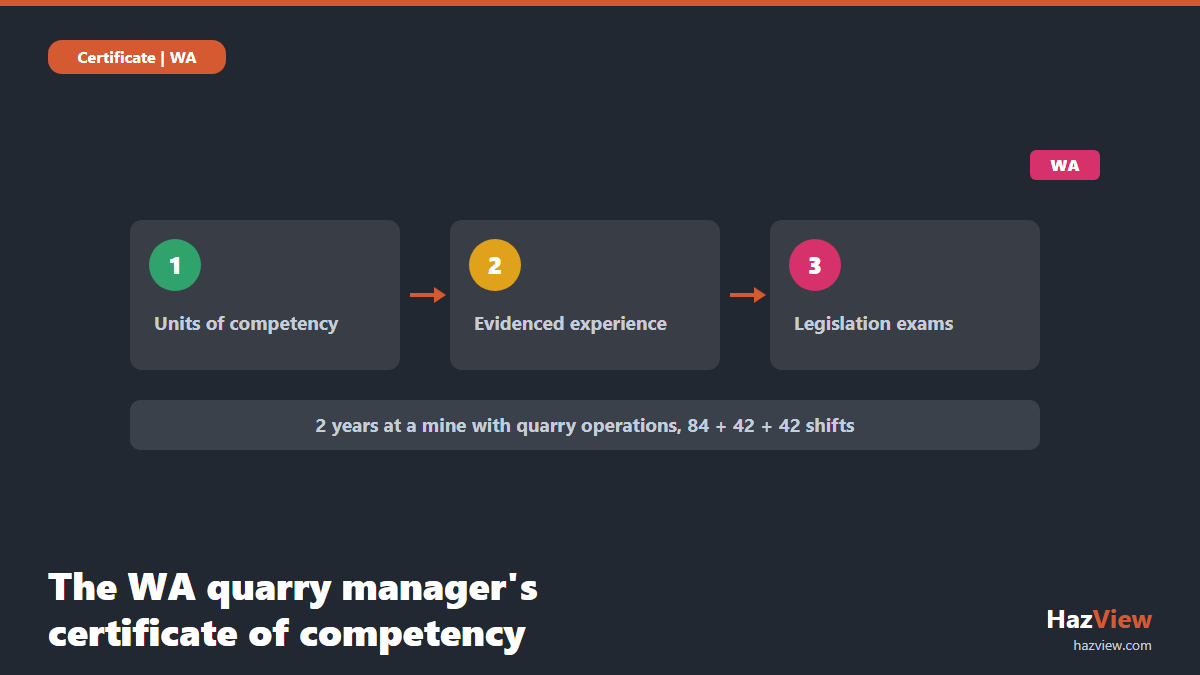
A WA quarry manager’s certificate of competency is issued by WorkSafe WA and is required to hold the statutory position of quarry manager under the Work Health and Safety (Mines) Regulations 2022. Getting one takes three things: approved units of competency, evidenced practical experience across defined areas of quarry work, and passing the mining legislation exams. This guide walks through each.
Requirements do change. Confirm the current detail on the WorkSafe WA quarry manager’s certificate page before you start assembling an application.
Do you actually need one?
Check this first, because the answer changes with the size of the operation. A quarry manager must be appointed where quarry operations are carried out at a mine and a levy is payable under the Mines Safety and Inspection Act 1994.
Where, on average, more than 25 persons per day carry out quarry operations, the quarry manager must hold a first class mine manager’s certificate rather than a quarry manager’s certificate. Below that threshold, the quarry manager’s certificate is the applicable ticket. The full appointment picture is in the quarry manager’s duties and appointment.
Step 1: The units of competency
WorkSafe requires approved national units in WHS risk management, at the manager level. For the quarry manager’s certificate these are:
- RIIRIS501E or BSBWHS513 as the risk management core unit.
- BSBWHS411 to contextualise work health and safety risk for a statutory position holder.
- RIIRIS402E or BSBWHS414 to assist in risk communication.
- HLTAID011 Provide first aid as the minimum acceptable first aid unit.
These come from a registered training organisation. Confirm before you enrol that the RTO’s units are the approved ones for the certificate you are pursuing, because the manager-level and supervisor-level requirements differ and enrolling in the wrong tier wastes a course.
Step 2: The experience
This is where most applications stall, because the experience has to be evidenced rather than asserted. The requirement covers at least two years at a mine where quarry operations are carried out, with minimum shift counts across defined areas:
- 84 shifts in ground stability, planning or emergency management.
- 42 shifts in drilling and the use of explosives.
- 42 shifts in mine transport and services.
- At least three months in each relevant quarry operations activity.
Experience is submitted on the relevant Statement of Experience template, with a nominated supervisor confirming your competency. Two practical warnings.
First, keep the record as you go. Reconstructing 84 shifts of ground stability work two years after the fact, from memory and a roster, is painful and the result is usually thin. A dated log of what you did, where and under whose supervision is the single most useful thing you can start today.
Second, your nominated supervisor has to be able to confirm it. If they have moved on and the site has no record of your involvement, the confirmation gets weaker. Sites that log inspections and hazard work against the person who did it, rather than against a shift, make this straightforward. That is a side benefit of running hazard and inspection records in a system with attribution rather than on paper.
Step 3: The exams
You must pass the applicable mining legislation exams for a quarry manager’s certificate. Exams are booked through the Mines Statutory Positions Portal, and there is no exam fee.
The exams test WHS legislation as it applies to WA mine sites, so the study material is the Work Health and Safety Act 2020, the Work Health and Safety (Mines) Regulations 2022 and the relevant codes of practice. Candidates consistently report that the regulations, not the general safety theory, are what catches them out. Know your way around the mine safety management system duty in regulation 622, the principal mining hazard duties in regulations 627 to 629, the statutory positions in Schedule 26, and incident reporting.
Our plain-English guides to the mine safety management system, principal mining hazards and notifiable versus reportable incidents cover the areas that carry the most exam weight. Read the primary sources too. The exam is on the law, not on our summary of it.
Restricted quarry manager’s certificates
WorkSafe WA also issues restricted quarry manager’s certificates, including a restricted quarry manager’s (non-explosives) certificate. These suit operations with a narrower scope, most obviously a quarry that does not drill and blast, such as a sand or gravel extraction operation.
If your site does not use explosives, the non-explosives pathway removes the drilling and explosives experience requirement and is a faster route. The trade-off is that the certificate restricts what you can manage. If there is any prospect of the operation moving to hard rock and blasting, the full certificate is the better investment.
A realistic timeline
The experience requirement sets the floor. Two years at a mine with quarry operations, with the shift counts spread across three areas, is the binding constraint for most applicants. The units of competency can be done in a matter of weeks and the exams booked once you are ready.
If you are on a pathway to a quarry manager appointment, the sequence that works is: start the experience log immediately, get the risk management units done early because they also make you better at the job, then book exams when your statement of experience is complete and signed.
After you are certificated
A certificate qualifies you. It does not appoint you. The mine operator makes the appointment, you must accept it in writing, and the quarry manager’s statutory functions then apply to you personally: directing and controlling quarry operations, ensuring people understand the duties they are given, and assisting the SSE in emergencies.
For where that fits in the wider compliance picture, start with quarry safety in Western Australia.
Related guides
- Quarry Safety in Western Australia: A Compliance Guide for Quarry Managers
- Statutory Supervisors at a WA Quarry: Schedule 26 Explained
- Building a Mine Safety Management System for a Small Quarry
- Notifiable vs Reportable Incidents at a WA Quarry
- All WA Quarries & Mines guides
Frequently asked questions
How long does it take to get a quarry manager’s certificate in WA?
The experience requirement sets the pace: at least two years at a mine where quarry operations are carried out, with 84 shifts in ground stability, planning or emergency management, 42 in drilling and explosives, and 42 in mine transport and services. The units and exams can be completed alongside that.
Is there a fee for the exams?
WorkSafe WA advises there are no fees for the statutory position exams, which are booked through the Mines Statutory Positions Portal. Training through an RTO is a separate cost.
What is a restricted quarry manager’s certificate?
A certificate with a narrower scope than the full ticket. The non-explosives version suits operations that do not drill and blast, such as sand and gravel extraction, and removes the explosives experience requirement while limiting what you can manage.
Does a quarry manager’s certificate from another state transfer to WA?
WA runs its own certificate regime and its own legislation exams. Interstate qualifications and experience may support an application, but confirm recognition directly with WorkSafe WA before assuming a ticket transfers.
What first aid qualification is required?
HLTAID011 Provide first aid is the minimum acceptable unit for the certificate.