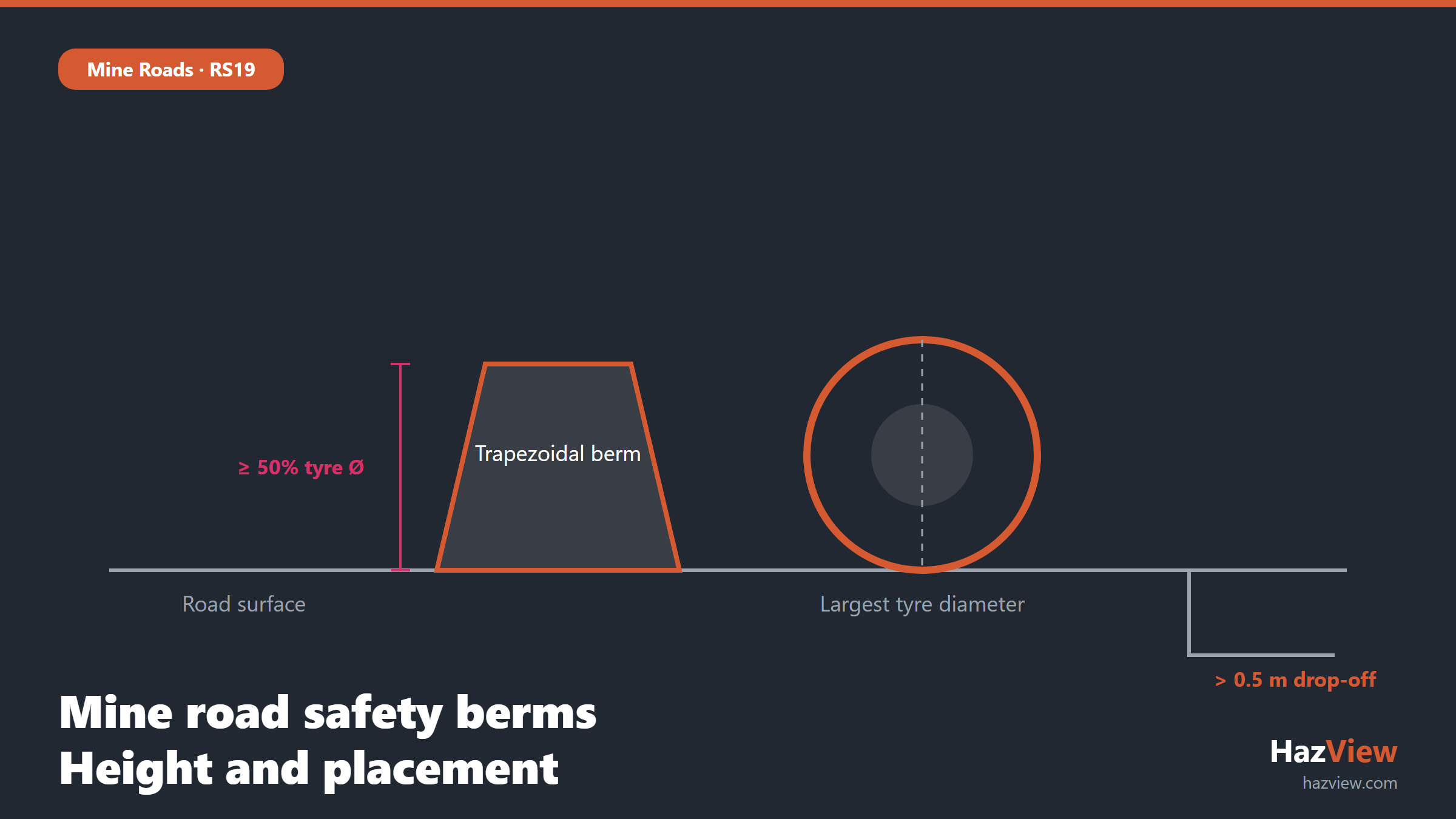
Understanding mine road safety berm requirements comes down to two questions: when do you need a berm, and how high does it have to be. A safety berm, also called a windrow, is an earth mound built along the edge of a mine road to reduce the risk of a vehicle running off. Under Recognised Standard 19 (RS19), a berm is generally warranted wherever there is a drop-off, with a commonly cited trigger of more than about 0.5 metres. For height, RS19 recommends a trapezoidal berm of at least about 50% of the largest tyre diameter of the vehicles using the road, and a triangular berm of at least about 66% of that diameter.
This guide sets out what a berm is designed to do, when RS19 calls for one, how to size and place it, and how to inspect and record berm condition so your controls hold up. It sits alongside our broader RS19 design and construction of mine roads guide and our articles on mine road intersection design and haul road grades and ramps.
What a safety berm (windrow) does
A safety berm is a continuous mound of compacted material placed along the outer edge of a road or dump. Its job is to give a driver a physical and visual edge, and to redirect a vehicle that begins to run off the road back towards the running surface. On elevated roads, ramps and tip heads, this run-off protection is one of the most important controls you have against a vehicle leaving the road and rolling or falling to a lower level.
It is worth being clear about what a berm is not. A berm is a run-off protection measure, not a barrier designed to stop a vehicle travelling at speed. A large haul truck carries enormous momentum, and no reasonable earth mound will halt one that has left the road at operating speed. The berm buys reaction time and correction, discourages a slow drift over the edge, and provides a clear tactile cue when a wheel makes contact. Treating it as a crash barrier is a mistake that leads to under-sizing and complacency.
Because the berm is an earthwork rather than a fixed structure, its effectiveness depends entirely on how it is built and maintained. A windrow that has been knocked down by a grader pass, scalped for material, or eroded by rain is no longer doing its job, even though it still looks like a berm from the cab.
When RS19 requires a berm
RS19, the Queensland Recognised Standard 19 “Design and Construction of Mine Roads” made under the Coal Mining Safety and Health Act 1999, treats edge protection as a function of the consequence of running off. The general principle is straightforward: where a vehicle leaving the road could travel onto ground that presents a hazard, edge protection is warranted. The most common trigger discussed in practice is a drop-off, and the figure widely used across Queensland operations is a change in level of greater than about 0.5 metres.
In plain terms, if the ground beside the running surface falls away by more than roughly half a metre, you should expect a berm along that edge. The larger the drop and the more serious the consequence below, the less room there is for judgement: elevated roads, ramps, dump edges and tip heads all sit firmly in berm territory. Situations that commonly call for a berm include the following.
- Elevated or benched roads where one side falls away to a lower level.
- Ramps and haul road grades with drop-offs on the low side.
- Dump and tip head edges where vehicles reverse or tip near an edge.
- Roads running alongside voids, highwalls, low walls, water or steep batters.
- Any road edge with a drop-off greater than about 0.5 metres.
Where you cannot verify a precise threshold against your own site standard, treat the 0.5 metre figure as a screening trigger and escalate on consequence. RS19 recommends assessing each edge on the hazard it presents rather than applying a single number blindly, so a shallow drop onto a hard, unforgiving surface can warrant a berm just as a deeper drop does.
How high must a berm be
Berm height is set relative to the largest vehicle using the road, because a berm that suits a light vehicle is meaningless to a haul truck. RS19 ties the height to tyre diameter, which is a sensible proxy for the size and ground clearance of the machine. The guidance is:
- Trapezoidal berms: at least about 50% of the largest tyre diameter of the vehicles using the road.
- Triangular berms: at least about 66% of the largest tyre diameter of the vehicles using the road.
The practical point is that you size the berm to the biggest tyre on the road, not the average vehicle. If a road carries both light vehicles and large haul trucks, the truck governs. As a worked example, a haul truck with a tyre roughly 3.5 metres in diameter would call for a trapezoidal berm of about 1.75 metres, or a triangular berm of about 2.3 metres, along that edge. Always confirm the actual tyre diameter for the fleet on the road rather than assuming, because tyre sizes vary widely between truck classes.
These are minimums, not targets to shave down to. Erosion, traffic wear and grading all tend to reduce berm height over time, so building to the minimum on day one leaves no margin before the berm falls out of compliance. Many operations build a little above the minimum precisely so that normal wear does not immediately breach the standard.
Trapezoidal vs triangular profiles
The two common berm profiles behave differently, which is why RS19 sets a higher fraction for the triangular shape.
A trapezoidal berm has a flat top and sloped sides, giving it a broad base and a substantial mass of material. It holds its shape well, resists erosion, and presents a more consistent barrier to a drifting wheel. The trade-off is that it consumes more material and takes more road width to build. This is why the required height fraction is lower, at about 50% of tyre diameter: the profile is inherently more stable and effective for a given height.
A triangular berm is quicker to form with a grader or dozer and uses less material, but it comes to a narrow crest and is easier to knock down, erode or override. To compensate for the less robust shape, RS19 recommends a greater height, at about 66% of tyre diameter. Triangular berms suit temporary or lower-consequence edges, while trapezoidal berms are generally preferred on permanent, high-consequence edges such as ramps and dump crests.
Whichever profile you choose, the material matters. A berm built from loose, oversized or non-cohesive material will not hold together under impact and will erode quickly. Compacted, well-graded material of a suitable size gives the berm the integrity it needs to perform.
Placement, gaps and maintenance
Height alone does not make a berm effective. Placement and continuity are just as important. The berm should run continuously along the hazard side of the road, set back far enough from the edge that the ground beneath it is stable and will not slough away under the weight of the material or a vehicle bearing against it. A berm built right on a soft or cracked edge can fail together with the edge it is meant to protect.
Gaps are a particular weakness. Every break in a berm, whether for drainage, access or a crossing point, is a place where a vehicle could leave the road. Gaps should be minimised, justified, and clearly identified. Where drainage requires a break, consider carrying the water through or under the berm rather than cutting it. Intersections and access points need particular thought, because they naturally interrupt edge protection.
Maintenance is where many berms quietly fail. A grader clearing the running surface can pull material off the berm or knock the crest down. Rain erodes the profile. Traffic contact flattens sections. Without a maintenance routine and a clear owner, a compliant berm degrades into a token mound over a few weeks. Berm restoration should be part of routine road maintenance, not an afterthought raised only when someone notices a problem.
Inspecting berms and recording drop-offs
Berms are a critical control, and critical controls need verification rather than assumption. The person best placed to check a berm is whoever holds responsibility for the road, typically supervisors and operators on shift, supported by regular checks from surveyors and geotechnical staff. Height should be measured against the largest tyre on the road, not judged by eye from a light vehicle, because the view from a ute badly overstates how tall a berm looks.
The recurring problem is knowing where every drop-off and every berm actually is, and whether each one currently meets height. Roads change daily as pits develop, so a berm that was compliant last week may not be today. This is exactly the kind of control that fails quietly when there is no live picture of its condition, a pattern we cover in why critical controls fail and how to fix it with real-time visibility.
This is where HazView helps. Teams use HazView to track berms, drop-offs and edge-protection inspections on a shared hazard map, so every open drop-off has a location, a status and an owner, and every berm inspection is logged against the point it relates to. Instead of a berm hazard living in someone’s notebook, it sits on the map where the next shift, the surveyors and the geotechnical team can all see it and act.
Berm compliance checklist
Use the following checklist when assessing a berm against RS19 principles. It is a screening aid, not a substitute for your site road standard.
- Is there a drop-off greater than about 0.5 metres, or another hazard, along this edge?
- Is a berm present continuously along the full length of the hazard?
- Is the berm height at least about 50% of the largest tyre diameter (trapezoidal) or 66% (triangular)?
- Was height measured against the largest vehicle using the road, not a light vehicle?
- Is the berm built from compacted, suitable material that holds its shape?
- Is the berm set back on stable ground clear of a soft or cracked edge?
- Are gaps minimised, justified and clearly identified?
- Is berm maintenance owned and scheduled as part of road upkeep?
- Is the berm and any open drop-off recorded, located and tracked to closure?
Related guides
- Haul Road Grades and Ramps: RS19 Design Limits Explained
- What Is a TARP? Building a Trigger Action Response Plan for Mine Roads
- Managing Vehicle Interaction as a Principal Hazard (QLD, NSW & WA)
- All Mine Roads & RS19 guides
Frequently Asked Questions
How high does a mine road berm need to be?
RS19 ties berm height to the largest tyre diameter of the vehicles using the road. A trapezoidal berm should be at least about 50% of that diameter, and a triangular berm at least about 66%. Size the berm to the biggest machine on the road, so a haul truck governs even where light vehicles also use it, and build a little above the minimum to allow for wear.
When is a berm required?
A berm is generally warranted wherever a vehicle running off the road could reach a hazard. The common screening trigger is a drop-off of more than about 0.5 metres, but RS19 recommends assessing each edge on consequence, so a shallow drop onto an unforgiving surface can also call for a berm.
Trapezoidal or triangular berm?
Trapezoidal berms are more stable and erosion-resistant and are preferred on permanent, high-consequence edges such as ramps and dump crests. Triangular berms are faster to form and use less material, which suits temporary or lower-consequence edges, but they must be built taller to compensate for the less robust shape.
Who inspects berms?
Responsibility usually sits with the people who own the road: supervisors and operators on shift, supported by regular checks from surveyors and geotechnical staff. Height should be measured against the largest tyre on the road rather than judged by eye, and results should be recorded so the control can be verified over time. The Queensland regulator, Resources Safety and Health Queensland (RSHQ), oversees compliance with the standard.
For the full requirements, read the Recognised Standard 19 PDF and always defer to your own site road design standard.
See your berms and drop-offs on one live map. HazView lets your crews record every drop-off, track berm height against RS19 and verify edge-protection inspections in real time, so nothing slips between shifts. Book a HazView demo to see how it works on your roads.