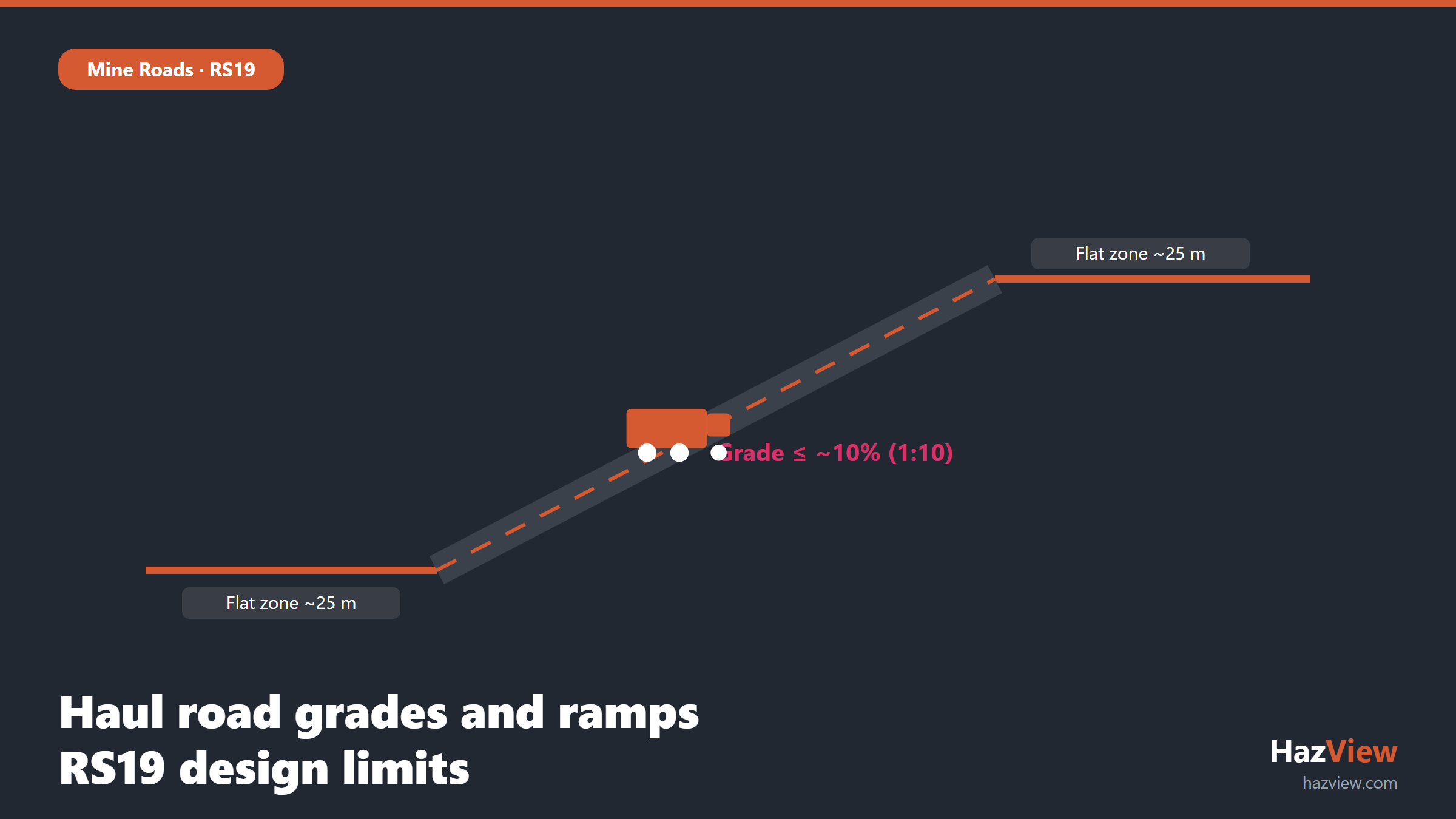
Mine road grade requirements exist because gradient drives braking distance, runaway risk and operator fatigue. On Queensland coal mines, Recognised Standard 19 (RS19), “Design and Construction of Mine Roads”, sets the expectations for haul road gradient and ramp design. In practice a commonly used maximum sustained grade on haul roads is around 10%, or 1 in 10, with short pinches sometimes steeper by design. Ramps also need flat zones at the top and bottom so vehicles can stop and queue safely. This guide explains what those limits mean and how to apply them.
Why grade matters on a mine road
Grade, or gradient, is the rate at which a road climbs or falls, expressed as a percentage or a ratio such as 1 in 10. It is the single biggest geometric factor in how a loaded haul truck behaves, and it works against you in three separate ways.
- Braking and stopping distance. A fully loaded truck descending a grade carries far more energy than the same truck on the flat. Service brakes, retarders and the road surface all have to absorb that energy. Steeper grades and longer descents mean longer stopping distances and more heat in the braking system.
- Runaway risk. If a truck loses braking or retardation on a steep descent, gravity keeps accelerating it. The steeper and longer the grade, the higher the runaway speed and the worse the consequences.
- Operator fatigue and productivity. Steep grades slow loaded trucks, increase cycle times and raise engine and driveline loads. Sustained steep hauls also add to operator workload and fatigue over a shift.
Grade never acts alone. It combines with surface condition, crossfall, sight distance and the layout of intersections and ramps. That is why RS19 treats gradient as one part of a whole road design rather than a single number to tick off.
What grade a haul road can be (RS19 guidance)
There is no single legislated number that fits every mine road, because the safe grade depends on the vehicles, the road surface, the length of the descent and the braking capacity of the fleet. RS19 approaches grade as a risk-based decision informed by good practice rather than a one-size-fits-all cap.
That said, a widely used rule of thumb across Australian mines is a maximum sustained grade of around 10%, or 1 in 10, on main haul roads. RS19 recommends keeping sustained grades within limits the fleet can safely handle both loaded and empty, and manufacturers typically publish grade and retardation limits for their trucks that should be checked against the design. Short, steeper pinches are sometimes built in where the terrain demands it, but these are the exception and should be justified, kept short and controlled.
The practical takeaways for mine road grade requirements are:
- Design sustained haul grades to a limit the whole fleet can descend and climb safely, commonly around 10% (1 in 10).
- Match the grade to the braking and retardation capacity of the largest loaded vehicle that will use the road.
- Treat any grade steeper than the standard limit as a short, engineered pinch with its own controls, not as normal running road.
- Consider the combined effect of grade and descent length. A moderate grade over a long descent can be as demanding on brakes as a steeper short one.
Where you set the number, record the basis for it. A documented grade limit tied to fleet capability is far easier to defend and audit than a figure with no rationale behind it.
Ramp design and flat zones
Ramps are where grade, geometry and traffic conflict come together, so they deserve particular attention. A ramp that starts or ends on a grade forces trucks to stop, hold and pull away on a slope, which is exactly where brake demand, roll-back and runaway risk are highest.
To manage this, RS19 references flat areas at the top and bottom of ramps, commonly around 25 m of near-level road, so vehicles can stop and queue safely before or after the grade. These flat zones do several jobs at once:
- They give trucks a level place to stop and hold without rolling back or straining service brakes on a slope.
- They provide safe queuing space at the base or crest of a ramp, away from the descent itself.
- They reduce the risk of a stationary truck being struck or of a following vehicle closing in on a slope.
- They ease the transition onto intersections, dumps and loading areas at the ends of the ramp, which ties into mine road intersection design.
When you review a ramp, look at the whole profile: the flat zone at the top, the grade through the middle and the flat zone at the bottom. If either flat zone is missing or too short, trucks end up stopping on the grade, and that is a hazard worth recording and correcting.
Runaway vehicle controls and escape provisions
Runaway vehicle risk on a mine is managed through a layered set of controls rather than any single measure. The first line of defence is design: keeping grades within fleet capability, keeping descents to a sensible length and building flat zones so trucks are not forced to stop on a slope.
Beyond geometry, the controls that reduce runaway consequences typically include:
- Grade limits and descent length. Capping sustained grade and avoiding long, uninterrupted descents keeps brake and retarder temperatures within limits.
- Escape provisions. Escape ramps, arrester beds or run-out areas give a runaway vehicle somewhere to shed speed safely away from other traffic and infrastructure.
- Safety berms and windrows. Edge protection along descents helps keep a vehicle on the road, which connects directly to mine road safety berms.
- Speed limits and traffic separation. Setting descent speeds to the road and separating light and heavy vehicles reduces both the likelihood and the severity of a loss of control.
- Fleet condition and operating discipline. Brake and retarder maintenance, correct gear selection on descent and driver training all keep the vehicle-based controls effective.
These controls sit alongside the wider duties in the Coal Mining Safety and Health Regulation 2017, made under the Coal Mining Safety and Health Act 1999. Runaway vehicle interaction is also a natural trigger point for a TARP for mine roads, so that a change in road condition or a near miss drives a defined response rather than being left to judgement.
Surface, drainage and crossfall
A well set grade only works if the road surface can deliver traction and shed water. Surface condition, drainage and crossfall all interact with gradient, and a fault in any of them can turn a compliant grade into a hazard.
- Surface condition. Loose material, potholes, corrugations and spillage reduce traction and braking, which matter most on a grade. A steep road with a poor surface is far more demanding than the same grade well maintained.
- Drainage. Water running down or across a grade scours the surface and creates slippery or soft patches. Drains, table drains and culverts need to carry water off the road rather than along the running surface.
- Crossfall. A consistent crossfall sheds water to the side and helps vehicles track predictably. Too little crossfall ponds water; too much, or crossfall that reverses through a curve, upsets a loaded truck on a grade.
The key point is that grade, surface, drainage and crossfall are one system. When you inspect a ramp or a descent, check them together, because a change in the surface or drainage can quietly erode the safety margin the grade was designed with.
Recording grade and ramp hazards
Grade and ramp issues are location-specific, so they are best recorded against the place on the road where they occur rather than in a spreadsheet that loses the geography. A steep pinch, a missing flat zone at the base of a ramp or a scoured descent all need to be found again, tracked and closed out at the right spot.
This is where HazView helps: you can record grades, ramp hazards and TARP triggers directly on the map, so the descent that needs attention, the flat zone that is too short and the trigger condition that escalates the response are all visible in one place. That keeps the road design intent, the current condition and the required action tied to the actual location on site.
Grade and ramp checklist
Use this checklist when reviewing a haul road grade or ramp against RS19 expectations:
- Is the sustained grade within the design limit for the fleet, commonly around 10% (1 in 10)?
- Is any steeper section a short, justified pinch with its own controls, not normal running road?
- Has the grade been checked against the braking and retardation limits of the largest loaded vehicle?
- Is the combined effect of grade and descent length within brake and retarder capacity?
- Does the ramp have a flat zone at the top and at the bottom, commonly around 25 m, so trucks are not stopping on the grade?
- Are escape provisions, arrester beds or run-out areas provided where descent length or grade warrant them?
- Are safety berms and edge protection continuous along the descent?
- Is the surface maintained, free of loose material and providing traction on the grade?
- Does drainage carry water off the road, and is crossfall consistent and correct through curves?
- Are descent speed limits and traffic separation set to suit the grade?
- Are grade and ramp hazards recorded against their location, with TARP triggers defined?
Related guides
- What Is a TARP? Building a Trigger Action Response Plan for Mine Roads
- Managing Vehicle Interaction as a Principal Hazard (QLD, NSW & WA)
- NSW Vehicle Interaction on Mine Roads: The 2025 Technical Reference Guide
- All Mine Roads & RS19 guides
Frequently Asked Questions
What is the maximum grade for a haul road?
There is no single legislated maximum, because the safe grade depends on the fleet, the surface and the descent length. In practice a commonly used maximum sustained grade on Australian haul roads is around 10%, or 1 in 10, with short pinches sometimes steeper by design and controlled separately. RS19 recommends setting the limit to what the whole fleet can descend and climb safely, loaded and empty.
What is a 1 in 10 grade?
A 1 in 10 grade means the road rises or falls 1 metre for every 10 metres travelled horizontally, which is a gradient of 10%. It is a common reference point for the upper limit of sustained haul road grade, because it keeps braking demand and runaway risk within the capability of most haul truck fleets.
Why are flat zones needed on ramps?
Flat zones give trucks a level place to stop, hold and queue at the top and bottom of a ramp, rather than forcing them to stop on a slope where roll-back, brake strain and runaway risk are highest. RS19 references flat areas around 25 m at each end of a ramp for this reason. A missing or short flat zone is a hazard worth recording and correcting.
How is runaway risk controlled?
Runaway risk is controlled through layered measures: grade limits and sensible descent lengths, flat zones so trucks do not stop on slopes, escape ramps or arrester beds, safety berms along the edge, descent speed limits, traffic separation, and disciplined brake and retarder maintenance. No single control is enough on its own, so the design and operating controls work together.
For the full standard, see the Recognised Standard 19 PDF and our RS19 guide.
Want grades, ramp hazards and TARP triggers mapped and tracked in one place? Book a HazView demo and see how your haul road controls come together on the map.