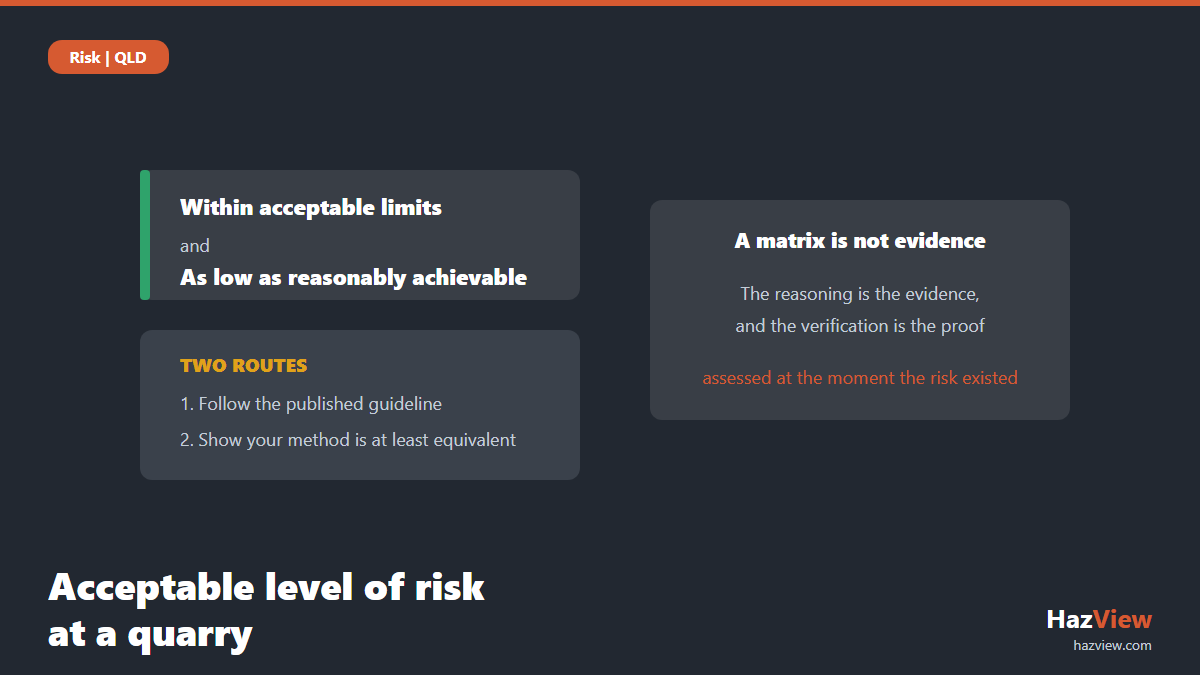
Acceptable level of risk at a quarry is the phrase the entire Queensland framework turns on, and it is the one most often signed off without anyone stopping to ask what it means. The safety and health management system must be intended to ensure the risks to persons from operations at the mine are at an acceptable level. Everything else is machinery for getting there.
This guide covers what the standard actually asks, the two legitimate routes to meeting it, and why a colour on a risk matrix is not an answer.
The two-part test
A safety and health management system is examined against two requirements: that risk is within acceptable limits, and that it is as low as reasonably achievable.
Both have to hold. A risk can be inside acceptable limits and still not be as low as reasonably achievable, and that gap is where most findings live. If a cheap, available control would have reduced the risk further and you did not apply it, “within acceptable limits” does not save you.
The second limb is also the one that moves over time. A control that was not reasonably achievable in 2015 may be routine and affordable now. Reasonably achievable is assessed against what is available today, not against what was available when you wrote the assessment.
The two routes to compliance
Route 1: follow the published way
Under section 63(1) of the Mining and Quarrying Safety and Health Act 1999, the Minister may make guidelines that provide ways of achieving an acceptable standard of risk for people working in mineral mines and quarries. Follow the published way and you are on solid ground.
The catch for quarries is coverage. A lot of Queensland’s published guidance is written for coal, and working out what applies to a quarry takes deliberate effort. See recognised standards and guidance notes for quarries.
Route 2: do it your way, and show equivalence
An operator can manage the risk in a different way, but must be able to show that the method used is at least equivalent to the method in the guideline.
This route is entirely legitimate and often the right one at quarry scale, where guidance written for a large operation may be disproportionate. But “at least equivalent” is a demonstrable claim, not an assertion. You need to show what the guideline achieves, what your method achieves, and why yours is not worse.
The practical failure here is quiet. Nobody writes down “we have chosen a different method and here is why it is equivalent”. They just do something different, and the difference is only discovered after an incident, at which point it looks like a gap rather than a decision.
Why a risk matrix is not evidence
A five by five matrix producing “residual risk: low” tells you what someone concluded. It does not tell you why, and the why is the whole of the obligation.
Three specific problems with leaning on the matrix.
- The rating is chosen to fit the answer. Consequence and likelihood are judgement calls, and once someone has decided the job proceeds, the numbers arrange themselves.
- Residual risk assumes controls work. A residual rating of low is conditional on every control being in place and effective on the day. Nothing in the matrix tests that.
- It answers the wrong question. The Act asks whether risk is at an acceptable level and as low as reasonably achievable. A matrix answers neither directly.
Use the matrix to prioritise, by all means. Do not mistake it for the justification. This is the argument we made in acceptable level of risk depends on what you can prove.
What good evidence looks like
For a significant quarry hazard, the record that actually discharges the obligation contains:
- The hazard described as it exists here. Not the category, the actual thing.
- The credible worst outcome, stated plainly.
- The controls, in hierarchy order, with which ones are critical.
- What was considered and rejected, and why. This is the single most valuable and most commonly missing element. Rejecting a control for good reasons is defensible. Never having considered it is not.
- The performance standard for each critical control, and how it is verified.
- Who was consulted and what changed as a result.
- Evidence the controls were in place on the day. Inspection records, verification checks, close-outs.
The time dimension
Acceptable level of risk is assessed at the moment the risk existed, not at the moment you wrote the assessment. That is a harder standard than it first appears.
Your assessment might conclude that a windrow keeps the risk of a truck leaving a ramp acceptable. On the day, the windrow had a gap where trucks turned in. The assessment was fine. The risk was not at an acceptable level, because the control was not there.
This is why verification records carry more weight than risk assessments in practice. The assessment shows what you intended. The verification shows what was true. See quarry inspections that stand up.
Making it provable
Everything above turns into one operational question: can you show, for any hazard on any day, that the controls were in place and someone checked.
Sites that can answer that are not doing more paperwork than everyone else. They are capturing it differently, in the field, where the hazard is, with the location and the time and the person attached automatically. That is what HazView is built for. Book a demo to see what your evidence would look like.
For the wider framework, see quarry safety in Queensland and building an SHMS.
Related guides
- Quarry Safety in Queensland: An MQSHA Guide for Quarry Operators
- Recognised Standards, Guidelines and Guidance Notes: Which Apply to a Quarry
- The Site Senior Executive at a Queensland Quarry: Obligations Explained
- Building a Safety and Health Management System for a Queensland Quarry
- All QLD Quarries & Mines guides
Frequently asked questions
What does acceptable level of risk mean in Queensland?
Risk that is within acceptable limits and as low as reasonably achievable. Both limbs apply, and being inside acceptable limits does not excuse failing to apply a control that was reasonably achievable.
Do we have to follow the guideline exactly?
No. You can manage the risk a different way provided you can show the method used is at least equivalent to the method in the guideline. Record that decision and the reasoning at the time, not afterwards.
Is a risk matrix enough?
No. A matrix records a conclusion. The obligation is about the reasoning behind it and the evidence that controls were actually in place. Use the matrix to prioritise, not to justify.
Who decides what is acceptable?
You do, in the first instance, through the safety and health management system the SSE develops and implements. An inspector, and ultimately a court, tests that decision against what was reasonably achievable and what published guidance says.
Does acceptable level of risk change over time?
Yes. As low as reasonably achievable is measured against what is available and practicable now. Controls that were once expensive or unavailable become standard, and the expectation moves with them.