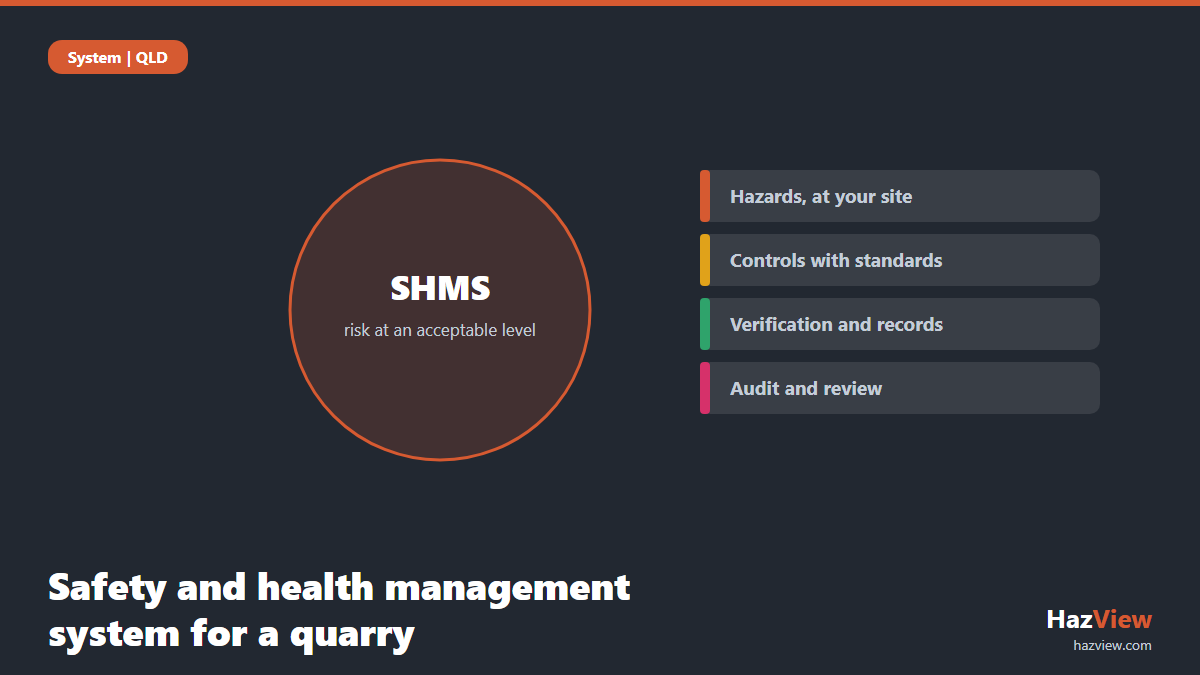
A safety and health management system at a Queensland quarry has one legal test to meet: it must be intended to ensure that the risks to persons from operations at the mine are at an acceptable level. Not that it exists. Not that it is comprehensive. That it holds risk at an acceptable level, and that it does so in practice.
Under the Mining and Quarrying Safety and Health Act 1999 the site senior executive develops and implements the SHMS, and the mine operator audits and reviews its effectiveness. This guide covers how to build one that survives that review.
The failure mode: building the wrong thing
Two ways quarries get this wrong, and they look opposite but come from the same place.
Too thin. A folder of generic procedures downloaded from somewhere, with the site name changed. It describes no hazard specific to your pit, so it cannot show that risk is at an acceptable level anywhere.
Too thick. A coal mine’s system adapted over months into 400 pages that nobody opens. This one is worse in a way, because it demonstrates that the operation could not describe its own risks and reached for someone else’s.
The right size is whatever it takes to describe your hazards, your controls and how you verify them. For a 15-person quarry that is a readable document, not a library.
Build it in this order
1. Identify the hazards, at your site
Everything hangs off this. Walk the operation by area: faces and batters, roads and traffic, fixed plant, stockpiles and tip heads, workshop, fuel and chemicals, explosives if you blast, and the office and weighbridge precinct. At each one, what can kill or seriously injure someone.
Do it in consultation with the workers, because the SSE is required to ensure risk management practices are established in consultation with mine workers, and because the loader operator knows things the assessment team does not.
2. Decide what acceptable looks like for each
This is the step most systems skip. For each significant hazard, state what an acceptable level of risk means here and what gets you there. Where a recognised standard or guideline covers it, say so. Where you are managing it differently, state the method and why it is at least equivalent. See acceptable level of risk at a quarry.
3. Specify controls with performance standards
For each critical control, answer three questions: what must it achieve, how do we verify it, and what happens when it fails. Two or three sentences each. This is what turns a description into a system.
Worked example. Control: fixed guarding on all conveyor nip points. Standard: guards in place and secure whenever the conveyor is capable of operation, with no guard removed except under isolation. Verification: recorded plant inspection each shift, plus a monthly guarding audit against the register. Trigger: any missing or damaged guard stops the conveyor until repaired or the section is isolated and barricaded. See conveyor guarding at a quarry.
4. Set the routine
Inspections, pre-starts, maintenance, monitoring, reporting. What happens, how often, by whom, and recorded where. If a control is verified by inspection and there is no inspection routine, the control is a hope.
5. Document the structure and competency
Who holds which position, what each is accountable for, how vacancies and acting arrangements are filled, who is competent to do what and how that is verified. See the SSE at a Queensland quarry.
6. Cover contractors explicitly
There can only be one SHMS on the site. Contractors come under yours, and the SSE must give them information about the relevant components they must adhere to. Set out how that happens, how competence is verified and how contractor work is supervised.
7. Build in audit and review
The mine operator has to audit and review effectiveness, so make that possible. State what gets audited, how often, against what, and what happens to findings. A system with no defined audit method makes the operator’s obligation impossible to discharge.
What an auditor actually tests
- Pick a hazard, follow the thread. Is it identified, is there a control, is there a standard, is there verification, are there records, were findings closed out. A break anywhere breaks the chain.
- Walk the site against the system. Does the pit look like the document says it should.
- Ask a worker. What are the three things here that could kill you and what stops each one. If they cannot answer, implementation has failed regardless of the paperwork.
- Check the dates. Review cycles, hazard identification intervals, competency currency.
- Check consultation. Who was in the room and what changed because they were.
Keeping it current
The SHMS is not a document you finish. A new pit, new plant, a change of contractor, an incident or a change in scale all warrant revisiting it, and the hazardous chemicals and dangerous goods hazard identification has a five-year outer limit of its own.
The part that drifts fastest is not the policy, it is the picture of the site. Which faces are live, where the roads run, which controls are currently in or out of service. When that picture lives only in a document, the system ages the moment it is printed.
Running hazards, inspections and control status on a shared live map keeps the system anchored to the site as it actually is, and produces the verification records the audit needs. That is the argument in moving from paper to real-time control. Book a demo.
For the wider framework, see quarry safety in Queensland. For the WA equivalent, see the mine safety management system.
Related guides
- Quarry Safety in Queensland: An MQSHA Guide for Quarry Operators
- Acceptable Level of Risk at a Quarry: What Queensland Actually Requires
- Recognised Standards, Guidelines and Guidance Notes: Which Apply to a Quarry
- The Site Senior Executive at a Queensland Quarry: Obligations Explained
- All QLD Quarries & Mines guides
Frequently asked questions
What must a quarry SHMS achieve?
It must be intended to ensure the risks to persons from operations at the mine are at an acceptable level. That is the legal test, and it is a test of capability and practice rather than of documentation volume.
Who writes it and who checks it?
The site senior executive develops and implements it. The mine operator audits and reviews its effectiveness.
Can we use an SHMS template?
Use one for structure only. The content has to describe your hazards, your controls and your verification. A system that describes another operation is evidence that you did not assess your own.
How often should the SHMS be reviewed?
On a defined cycle set in the system itself, and on trigger: significant change to the operation, an incident, or an audit finding. Some hazard identification carries its own interval, including the five-year limit for hazardous chemicals and dangerous goods.
Do contractors need to be in our SHMS?
Yes. There is one SHMS on a Queensland site and contractors work under it. The SSE must give them information about all relevant components they are required to adhere to.