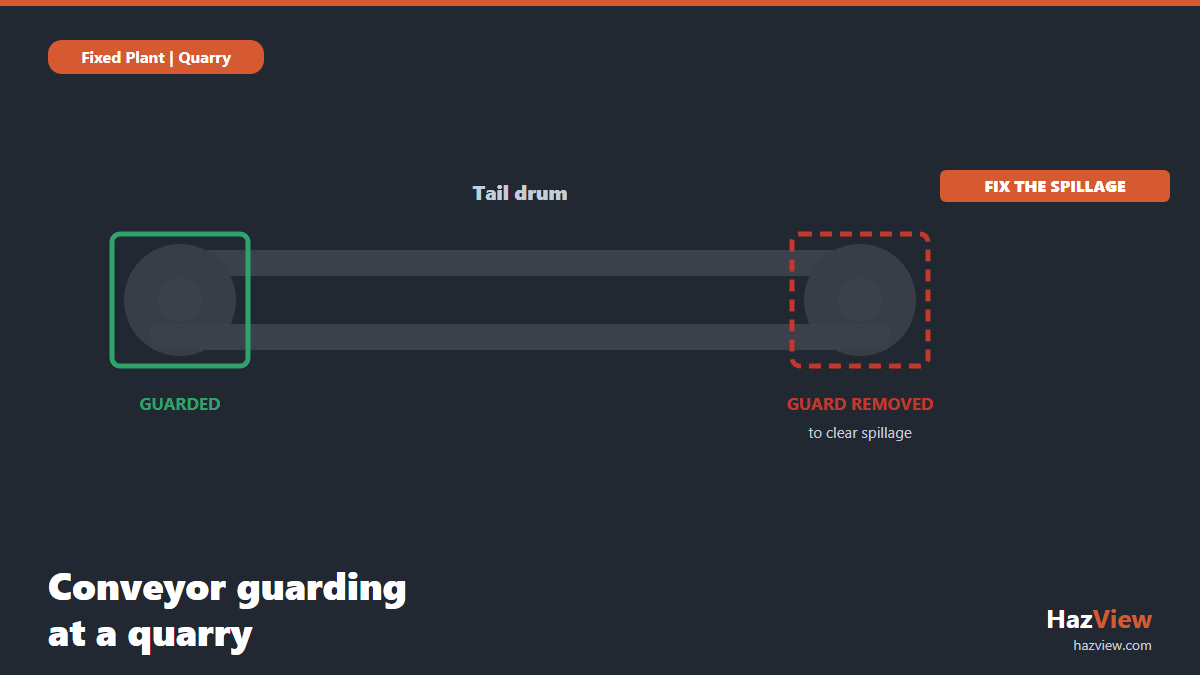
Conveyor guarding at a quarry has one recurring failure mode, and the incidents read almost identically wherever they happen. A guard is removed to clear spillage. The conveyor is left running because stopping it costs production. Someone reaches in. The Australian regulators have published the same warning repeatedly, and it keeps happening.
On 15 November 2018 a worker was fatally injured at a quarry after becoming entangled in the rotating tail drum of a conveyor belt. Preliminary findings were that the tail drum guard had been removed to allow rocks to be cleared, and the conveyor was operating with the guard removed. WorkSafe WA published a conveyor guarding special edition incident summary in August 2025, which tells you the pattern has not gone away.
Why the guard comes off
This is the part that matters, because guarding is not really a guarding problem. It is a spillage problem.
If a transfer point spills material every shift, someone has to clear it every shift. If clearing it properly means isolating the conveyor and losing production, and clearing it improperly takes ninety seconds, the improper method wins eventually. Not because people are reckless, but because the system has made the safe method expensive and the unsafe one convenient.
The regulator guidance following the 2018 fatality made this explicit: operate and maintain the conveyor in a way that eliminates or reduces the occurrence of spillage, so that the need to remove guarding to clear it does not arise. That is the engineering fix. Everything else is managing a problem you could have designed out.
The four rules
The guidance that followed the fatality is short enough to put on a wall:
- Always stop and isolate a conveyor before undertaking work on it.
- Never operate a conveyor without the necessary guarding in place.
- Operate and maintain the conveyor so spillage is eliminated or reduced, removing the need to take guards off to clear it.
- Ensure people operating or maintaining conveyors understand the hazards and the critical controls, being separation through fixed guarding and isolation lock-out.
What has to be guarded
Every point where the belt meets something rotating, and every point where a person could reach a moving part.
- Head and tail drums. The tail drum is the one in the fatalities, because it sits where spillage accumulates.
- Nip points at every idler and pulley, including return idlers, snub pulleys and take-up arrangements.
- Drive arrangements. Couplings, gearboxes, shafts and any belt drive.
- Transfer points and chutes, which is where people are drawn in by spillage and blockages.
- The take-up. Gravity take-ups store energy and move without warning.
- Any point reachable from a walkway, platform or ladder. Guarding is about reach, not about intent.
Guards must be fixed and require a tool to remove, be robust enough for a quarry environment, and be designed so that routine tasks such as inspection, greasing and belt tracking can be done without taking them off. A guard that has to come off weekly will eventually stay off.
Emergency stops are not guarding
Pull-wire and lanyard stops along a conveyor are valuable and they are not a substitute for fixed guarding. They act after someone is already in trouble, and entanglement is faster than a person’s ability to reach a wire.
They still need their own regime: tension checked, full length functional, tested and recorded on a defined frequency, and every activation investigated rather than reset.
Breaking the cycle at your site
- Find out where spillage actually happens. Walk the plant on a normal shift and look at where material sits on the ground. That is your list.
- Fix the worst transfer point properly. Chute redesign, skirting, belt scrapers, tracking, feed rate. One engineered fix removes a recurring exposure permanently.
- Make the safe method affordable. If clearing spillage safely requires a 20-minute isolation, schedule it rather than leaving it to the person who finds the blockage.
- Build a guard register. Every guard, its location, its condition, and when it was last verified in place.
- Verify guards on the shift inspection. Not annually. See quarry inspections that stand up.
- Treat any guard found off as an incident. Investigate why, not who. The answer is almost always spillage or an access requirement nobody designed for.
Guarding as a critical control
Fixed guarding is a textbook critical control: its failure allows a fatality, so it needs a performance standard and verification rather than an assumption. In a Queensland safety and health management system, a WA mine safety management system or a NSW safety management system, it should appear with a standard, a verification method and a trigger.
The standard is straightforward: guards in place and secure whenever the conveyor is capable of operation, with no guard removed except under isolation. The hard part is verification, because it means someone physically checking and recording it often enough to matter.
Recording those checks against the actual asset, with a photo and a location, turns guard verification from an annual audit into a running record. See HazView, or book a demo. Isolation is the other half of the pair: see isolation and lockout on quarry plant.
Related guides
- Isolation and Lockout on Quarry Crushing Plant
- Working at Height on Crushing and Screening Plant
- Contractor Management at a Quarry: One System, Not Three
- All Quarry Operations guides
Frequently asked questions
What parts of a conveyor need guarding?
Head and tail drums, nip points at idlers and pulleys, drives and couplings, transfer points and chutes, take-up arrangements, and any moving part reachable from a walkway or platform.
Can a conveyor run with a guard removed?
No. The regulator guidance is explicit: never operate a conveyor without the necessary guarding in place, and always stop and isolate before undertaking work on it.
How do we clear spillage safely?
Isolate first. Better still, reduce the spillage through chute design, skirting, scrapers, tracking and feed control so the task arises far less often. The regulator guidance names spillage reduction as a control in its own right.
Are pull-wire stops enough?
No. Emergency stops act after someone is already in trouble. Fixed guarding is the separation control. Both should exist, and neither replaces the other.
How often should guards be checked?
Set it as a performance standard in your safety management system. Practically, guard presence belongs on the routine plant inspection each shift, with a periodic detailed audit against a guard register.