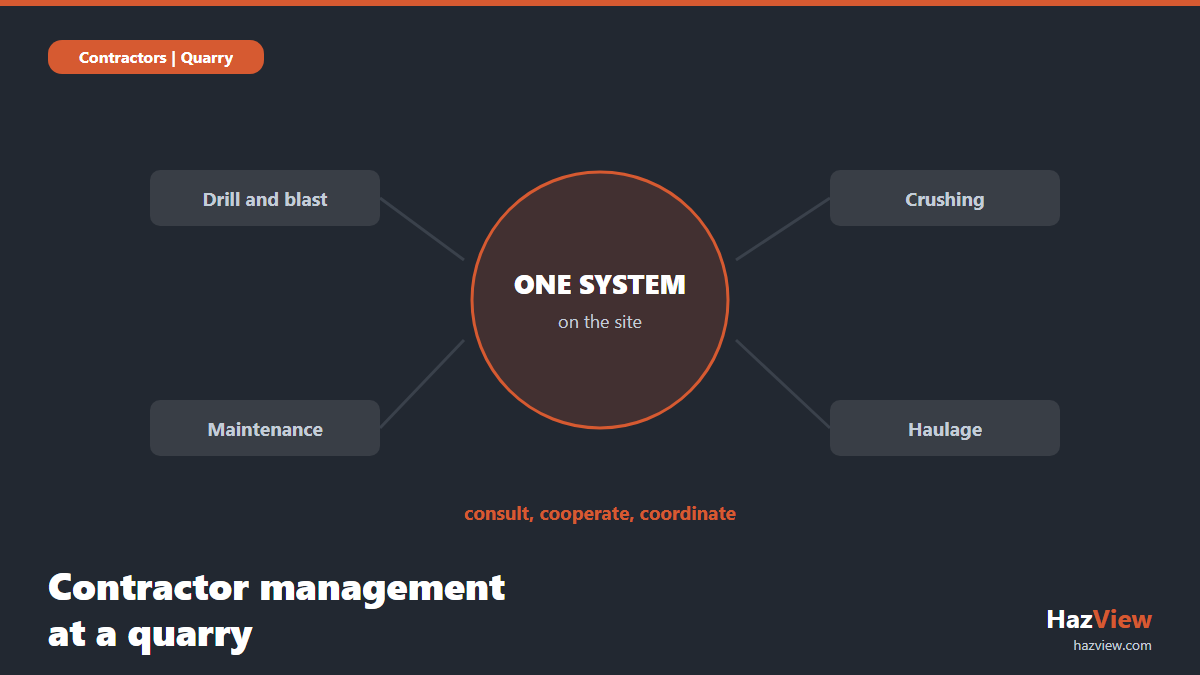
Contractor management at a quarry is where the largest share of the exposure usually sits and where the safety system is usually thinnest. Drill and blast, crushing, maintenance, haulage and carting are frequently done by people who do not work for you, arrive on a schedule you do not control, and leave before anyone checks what they did.
The legal position is clearer than most operators assume. This guide covers what it is, and how to run contractors properly at quarry scale.
One system on the site
In Queensland the position is explicit: there can only be one safety and health management system on a site, and contractors come under the principal operator’s SHMS. The site senior executive is required to give a contractor information about all relevant components of the SHMS that the contractor must adhere to.
WA and NSW get to the same place by a different route. WHS law requires duty holders with shared responsibilities to consult, cooperate and coordinate. Two organisations running parallel safety systems on one quarry are doing none of those three.
The practical rule: your system governs the site. A contractor’s system can be better than yours in places and they should keep using what works, but where the two differ on how something is done at your quarry, yours wins and everyone knows it does.
The contractor’s own obligations
Contractors are not passengers. They carry their own duties, including ensuring workers are inducted into the mine’s safety system and have received training about the hazards and risks relating to the work they are doing.
That cuts both ways in a useful sense: you cannot discharge your obligations by pointing at the contract, and they cannot discharge theirs by pointing at your induction. Both duties exist simultaneously, which is exactly why coordination is the legal requirement rather than delegation.
Before they arrive
- Define the scope precisely. Vague scope produces improvised work, and improvised work is where people get hurt.
- Pre-qualify against the actual risk. A carting contractor and a drill and blast contractor should not be assessed with the same form.
- Get and read the safe work method statements. Read them. A SWMS filed unread is a document that will be produced at an inquiry with your acknowledgement on it.
- Agree the interfaces. Traffic rules, isolation system, exclusion zones, permit requirements, emergency response, who they report to.
- Verify plant. Registration, maintenance, guarding, fire suppression, and whether it suits your roads. See quarry haul road design.
- Verify competence. Not just tickets. Verification of competence assessments are commonly recommended on a two-yearly cycle.
Induction that works
A site induction covers basic safety orientation for anyone entering the site. That is different from statutory training, which is a structured regulator-approved program for people in formally appointed roles.
Both matter, and quarries tend to over-invest in the video and under-invest in the part that changes behaviour. What a contractor actually needs before they start work:
- The current site layout. Where the roads run today, not on a plan from last year. Faces advance and haul routes move.
- The live hazards and exclusion zones. Blast areas, unstable ground, closed ramps.
- Traffic rules and segregation. Especially where to park and where not to walk. See segregation at a quarry.
- Isolation and permits. Which system, whose locks, who authorises. See isolation and lockout.
- How to report a hazard, and confidence that it will be acted on.
- Emergency response. Muster, first aid, communications, and what happens if someone is hurt. See emergency response planning.
Scale it to exposure. A regular carter who comes three times a day for two years needs more than a one-off visitor, and a lot less than a drill and blast crew.
While they are on site
The gap between induction and supervision is where contractor incidents live.
- Know who is on site. By name, in real time. This matters most during blast clearance and emergency evacuation.
- Supervise proportionally. Higher risk and less familiarity means more presence, not more paperwork.
- Include them in pre-starts and toolbox talks. Not a parallel briefing in the car park.
- Give them the same hazard reporting channel. Contractors see things your crew has stopped noticing.
- Capture their incidents. Contractor incidents handled internally by the contractor and never reported to the operator is a common and serious gap. Your reporting obligations extend to incidents arising out of operations at the mine regardless of who employs the person. See notifiable versus reportable incidents.
The information problem
Every requirement above depends on the contractor knowing the current state of your site, and the current state changes weekly. A drill crew that inducted in March and returns in August is working from a picture that no longer exists.
Handing them a live view of the site on their own phone, showing today’s roads, today’s exclusion zones and today’s hazards, solves this in a way no induction pack can. It also means when they raise a hazard, it lands in your system with a location attached rather than in a text message to a supervisor.
That is what HazView does, and why visual maps outperform text-based systems for people who are not on site every day. Book a demo.
For the state frameworks, see Queensland, NSW and Western Australia.
Related guides
- Emergency Response Planning at a Quarry
- Fatigue Management at a Quarry
- Stockpile and Tip Head Safety at a Quarry
- All Quarry Operations guides
Frequently asked questions
Do contractors need their own safety management system?
In Queensland there can only be one safety and health management system on a site and contractors come under the principal operator’s. Elsewhere the requirement to consult, cooperate and coordinate produces the same practical answer: one set of site rules.
What must we give contractors?
Information about all relevant components of the safety system they are required to adhere to, plus the site-specific detail they need to work safely: layout, hazards, traffic rules, isolation, permits and emergency arrangements.
How often should competency be verified?
Verification of competence assessments are commonly recommended every 24 months, alongside checking that tickets and licences remain current. Set the interval in your safety system and apply it to contractors as well as employees.
Are we responsible if a contractor is injured?
Your duties extend to people affected by operations at the mine, not only to your employees. The contractor also carries duties. Both exist at once, which is why coordination rather than delegation is the legal expectation.
Do carters and delivery drivers need inducting?
Anyone driving on site is inside the traffic hazard. Scale the induction to exposure: a regular carter needs the traffic rules, parking, weighbridge protocol and hazard reporting channel, not just a sign at the gate.