A quarry emergency response plan is the control that decides whether a serious injury becomes a fatality. Most quarries are some distance from a hospital, many are a long way from an ambulance, and a good number have no mobile reception in the pit. Response time is not an administrative detail at a quarry. It is a control on every other hazard you have.
This guide covers what a workable plan contains, how to size it to your isolation, and how to test it so you find the gaps before an incident does.
Start with your actual response time
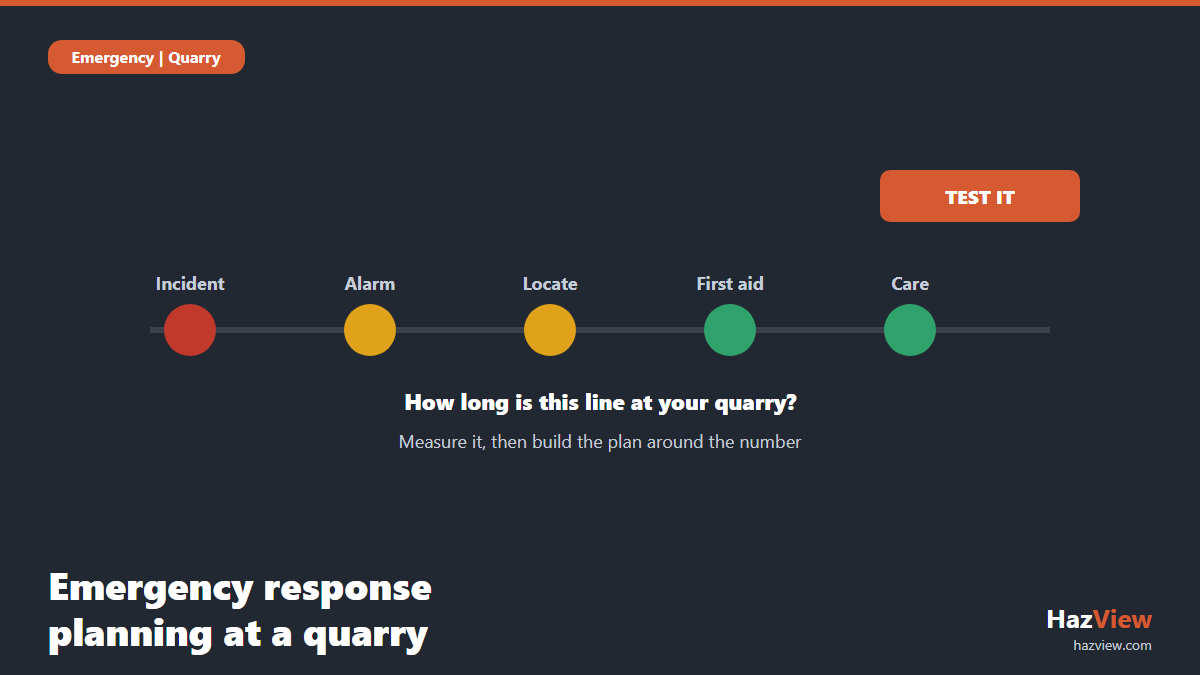
Before writing anything, establish one number: from the moment someone is seriously injured at the furthest point of your operation, how long until they are in professional medical care.
Measure it honestly. Time to raise the alarm from a place with no reception. Time to locate the person. Time to reach them with a vehicle that can carry a stretcher. Time to get them to the gate. Time for an ambulance to arrive from where ambulances actually come from, at the time of day the incident happens.
That number drives everything. A quarry twenty minutes from a regional hospital can rely on the public system. A quarry ninety minutes away, on a road an ambulance will not take at speed, cannot. It has to hold the person itself for an hour or more, which means different equipment, different training and a different plan.
What to plan for
Work from your hazards rather than from a generic list. At most quarries the credible emergencies are:
- Serious injury or entrapment in fixed plant. Crusher, conveyor, screen. Extraction may need isolation and specialist equipment before anyone can even reach the person. See conveyor guarding.
- Vehicle incident. Rollover on a ramp, collision, a vehicle over an edge.
- Ground failure. Someone caught by a face or batter collapse, or buried at the toe. See ground control at a quarry.
- Engulfment. In a stockpile, bin or hopper. See stockpile and tip head safety.
- Explosives incident. Misfire, premature initiation, flyrock beyond the boundary. See managing misfires.
- Fire. Mobile plant, workshop, fuel storage, conveyor.
- Fall from height, including suspension in a harness. See working at height on plant.
- Medical event. Cardiac and heat illness, which are among the most likely things to actually happen.
- Severe weather and flooding. Including pit inundation. See water management and inrush.
What the plan needs to contain
- How the alarm is raised from anywhere on site, including places with no mobile coverage. Radio, satellite, a fixed point, or a check-in protocol for people working alone.
- Who does what. Named roles rather than named people, so it survives leave and turnover. Incident controller, first aid, gate and emergency services liaison, communications.
- How the injured person is located. Obvious in a small pit, less obvious at night in the rain at the far end of a lease.
- First aid capability and equipment, matched to your response time. A site an hour from help needs more than a wall cabinet.
- Access and egress for emergency services, including whether an ambulance can physically reach the pit floor, and a gate that will be open and staffed.
- Communications. Who calls 000, what they say, who meets the ambulance, and who notifies the regulator.
- Site-specific rescue capability, where the hazard requires it. Confined space, height rescue, plant extraction.
- Muster, headcount and accounting for everyone, including contractors and carters.
- Regulatory notification. Immediate notification obligations do not wait until the incident is resolved. See notifiable versus reportable incidents.
- Preserving the site. After a notifiable incident the scene must be preserved until an inspector directs otherwise, which conflicts with the instinct to clean up and restart.
Rescue capability you have to actually have
Two hazards create rescue obligations quarries commonly under-resource.
Height and suspension. If you use fall arrest harnesses, you need a rescue capability that works in minutes, because suspension trauma develops fast. Waiting for an ambulance is not a plan.
Plant extraction. Someone caught in a crusher or conveyor may need the plant de-energised, secured against movement and partially dismantled before they can be reached. That is a planned procedure with the right people and equipment, not something to work out under pressure.
If you cannot resource a capability, that is a legitimate finding: it means the hazard needs to be controlled harder upstream so the rescue is never needed.
Testing it
An untested plan is a document with an unknown number of wrong assumptions in it. Exercises find them cheaply.
- Run a real scenario, not a fire drill. “Operator trapped at the tail drum, no reception at that location” tells you more than a muster.
- Pick a bad time. The plan works at 10am on a Tuesday with everyone present. Test it at shift change, or when the first aider is on leave.
- Involve contractors. They are on site and they are in the plan whether you exercised them or not.
- Time it. Compare against the number you established at the start.
- Write down what failed and fix it. An exercise that surfaces three problems is a success. One that surfaces none was not a real test.
Knowing where everyone is
Two things determine how an emergency goes: how fast you know something happened, and how fast you find the person. Both are location problems.
Sites that keep a live picture of who is on site, where the active work areas are and where the current hazards sit, answer both faster. It is also the difference between a headcount that accounts for the carter in the queue and one that does not. See HazView, which works offline for exactly the pits where reception fails, and why that matters. Book a demo.
Related guides
- Fatigue Management at a Quarry
- Stockpile and Tip Head Safety at a Quarry
- Water Management, Dewatering and Inrush at a Quarry
- All Quarry Operations guides
Frequently asked questions
Does a small quarry need an emergency response plan?
Yes, and arguably more than a large one, because a small remote site has fewer people, less equipment and a longer wait for help. Size the plan to your response time and your hazards.
How often should we exercise the plan?
Set the frequency in your safety management system, exercise at least annually, and run additional scenario-based tests when the operation changes materially or after an incident reveals a gap.
Do we need trained mine rescue people?
Not necessarily a formal mine rescue team, but you need capability matched to your credible emergencies. Height rescue and plant extraction are the two that most often require capability a quarry does not have by default.
Who notifies the regulator?
Name the role in the plan. Notifiable incidents must be notified immediately, which means during the response rather than after it, so someone other than the incident controller usually holds that job.
Can we clean up after an incident?
Not after a notifiable incident. The site must be preserved until an inspector directs otherwise, apart from what is needed to help an injured person, make the site safe or protect against further harm.