A quarry misfire is the highest-consequence event in quarry blasting, because it leaves explosive energy in the ground where people are about to work. Excavators dig into it, crushers receive it, and the people involved usually had no idea it was there. Every serious misfire incident follows the same pattern: the misfire was not identified, or it was identified and the response was rushed.
This guide covers identification, the immediate response, who is allowed near it, and the separate problem of sleeping shots.
What counts as a misfire
Any explosive charge that has not detonated as intended. That is broader than the obvious case of a hole that clearly did not fire. It includes partial detonation, a hole that fired out of sequence, a cut-off where the initiation system was severed before the charge fired, and explosive remaining in the muckpile after an apparently normal blast.
The last one is the dangerous one, because a blast can look entirely normal from the firing point while explosive sits in the broken rock. Detection depends on the post-blast inspection being done properly rather than on anything being obviously wrong.
Post-blast inspection is the detection control
Nobody re-enters until the shotfirer has inspected and released the area. The inspection is looking for more than fumes and stability.
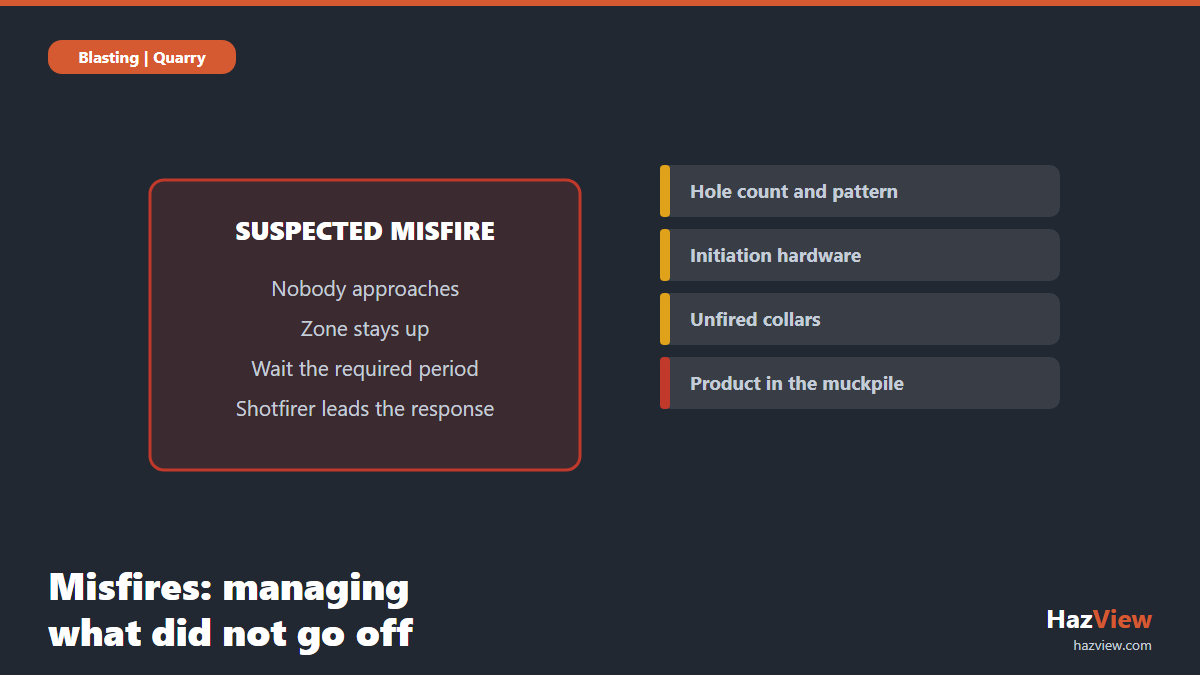
- Hole count and pattern. Does the muckpile reflect the number of holes fired. A shot that produced less movement than expected is a signal.
- Initiation hardware. Undetonated detonators, uninitiated downlines, lengths of shock tube or detonating cord in the muckpile or at the face.
- Unfired collars or stemming columns visible at the crest or in the remaining face.
- Explosive product visible in the broken rock.
- Cut-offs. Evidence that part of the initiation system was severed by earlier movement in the shot.
Record the inspection, including a clear result when nothing is found. “Post-blast inspection completed, no misfire indications” is the record that lets the next crew work with confidence, and the record you will want later if something turns up in the muckpile.
If you suspect a misfire
- Stop. Nobody approaches. The instinct to go and look is the thing that kills people.
- Maintain or re-establish the exclusion zone. Do not shrink it because the blast has already fired. See blast exclusion zones.
- Observe the waiting period required by your jurisdiction and your procedure before anyone approaches the face. The waiting period exists because delayed initiation is a real phenomenon.
- The shotfirer leads the response. Only the licensed shotfirer, or a person under their direct control, approaches or handles the misfire.
- Do not dig it out. Excavating into a suspected misfire with a machine is how the most serious incidents happen.
- Notify. Internally to the quarry manager or SSE, and externally where the jurisdiction requires it. Unplanned detonation or ignition of explosives is a reportable category in WA: see notifiable versus reportable incidents.
- Record everything. Location, time, what was seen, who made the call, what was decided.
Communicating a live misfire area
The window between identifying a misfire and clearing it is the most dangerous period on the site, and it is a communication problem. Shift changes, contractors arriving, a loader operator who was not on the radio call. Everyone needs to know where the area is and that it is closed.
A verbal warning at the pre-start does not reach the fitter who arrives at nine. Marking the misfire exclusion area on a shared live map that every phone and tablet on site sees is the control that actually holds across shifts and contractors, and it timestamps when the area went on and came off. That is precisely what blast crews use HazView for.
Sleeping shots
A sleeping shot is a loaded blast left overnight or longer before firing. Common enough at quarries where weather, neighbours or production sequencing delay a shot, and it needs its own rules.
The risks compound with time. Water ingress degrades product and stemming. Ground movement can cut off initiation lines. Security becomes a real issue, particularly on a site with informal access. And the crew who loaded it may not be the crew who fires it.
Minimum controls: a documented decision to sleep the shot with a defined maximum duration, physical security and signage over the loaded area, exclusion maintained, a handover that names the loaded shot explicitly, and a re-inspection before firing rather than an assumption that it is as it was left.
Preventing misfires
Response is the last line. Most misfires trace back to a handful of upstream causes:
- Initiation system damage during loading or from stemming operations.
- Cut-offs from timing that lets earlier holes move ground before later holes fire.
- Water in holes degrading product not rated for it.
- Product handling and age. Storage conditions and rotation.
- Poor hole records. If you do not know exactly what went into each hole, you cannot tell what did not come out.
That last point deserves emphasis. A complete loading record, hole by hole, is what turns misfire detection from an eyeball exercise into a reconciliation. It is also the document you will be asked for first.
For the wider framework, see quarry safety in Queensland, NSW and WA. Book a demo to see live exclusion areas in the field.
Related guides
- Conveyor Guarding at a Quarry: The Fatality Pattern That Keeps Repeating
- Isolation and Lockout on Quarry Crushing Plant
- Working at Height on Crushing and Screening Plant
- All Quarry Operations guides
Frequently asked questions
What is a misfire?
Any explosive charge that has not detonated as intended. It includes partial detonation, cut-offs, holes fired out of sequence and explosive product remaining in the muckpile after an apparently normal blast.
How long do you wait before approaching a misfire?
Follow the waiting period set by your jurisdiction and your site procedure, and do not shorten it. The period exists because delayed initiation happens. Only the licensed shotfirer, or someone under their direct control, approaches.
Can we dig out a misfire?
Not as a general practice, and never as an improvised one. Excavating into suspected undetonated explosive with a machine is the mechanism behind the most serious misfire incidents. The shotfirer directs the treatment.
Is a misfire reportable?
Explosives incidents are reportable in every Australian jurisdiction under one heading or another, and unplanned detonation or ignition of explosives is a listed reportable incident category in WA. Check your jurisdiction and report it.
What is a sleeping shot?
A loaded blast left in the ground before firing, usually overnight or longer. It needs a documented decision, a maximum duration, security, maintained exclusion, an explicit handover and a re-inspection before firing.