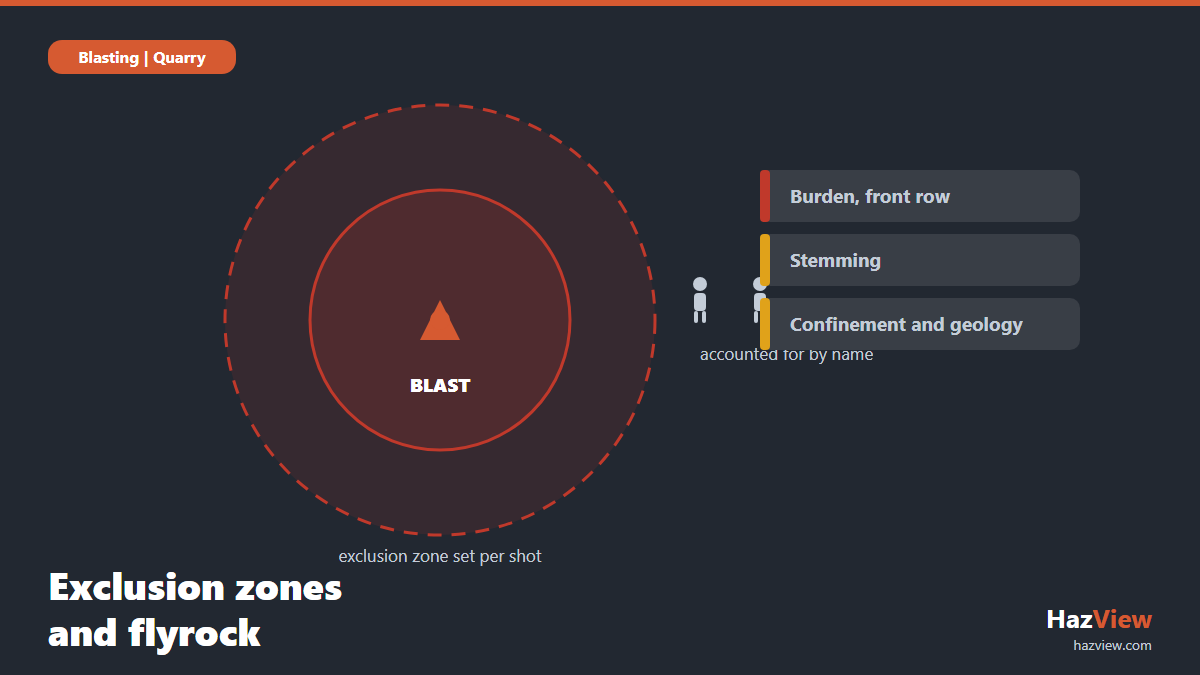
A quarry blasting exclusion zone is the control standing between a routine shot and a fatality, and it is the one most likely to be set by habit rather than by assessment. Flyrock is the hazard that does not respect your lease boundary: it has landed on neighbouring worksites, public roads and houses, and it is the reason blast clearance is the most procedurally rigid activity on a quarry.
This guide covers how exclusion zones should be set, what actually causes flyrock, and how clearance gets verified rather than assumed.
Who carries the responsibility
State dangerous goods and explosives legislation requires a licensed shotfirer to conduct charge-up, tie-in and initiation in every Australian jurisdiction. The shotfirer carries personal legal responsibility for the safety of the blast, including establishing the exclusion zone, verifying clearance, initiation system integrity and post-blast inspection.
That does not remove the quarry’s obligations. The site controls access, the traffic, the neighbours and the schedule. In practice a good blast is a shotfirer and a quarry manager agreeing on the zone and the clearance, with both able to show why.
In Queensland, a shotfirer licence allows the holder to use, possess, purchase, store and transport limited quantities of blasting explosives, including up to 250 kg of blasting explosives without a separate transport licence. Licensing detail varies by state, so check your own jurisdiction rather than assuming.
What causes flyrock
Flyrock is not random. The causes are well documented and mostly avoidable:
- Inadequate burden, particularly on front-row holes. The most common cause. Burden that looked right on the plan and is not right on the face.
- Inadequate or ineffective stemming. Wrong material, wrong length, or stemming that has been compromised by water or hole condition.
- Firing drop cuts, oversized boulders or toes. Constrained or unusual geometry where the energy has nowhere predictable to go.
- Geological variation. A soft seam, a void, an open joint or a weathered zone that channels energy toward the face.
Every one of those is a design and inspection issue rather than an initiation issue. The most valuable half hour before any shot is someone competent standing at the face with the drill log and a measuring device, checking that the front row burden is what the design assumed.
Setting the exclusion zone
Duty holders should perform risk assessments to identify potential flyrock generation and assess the adequacy of control measures such as exclusion zone extents and pre-shot clearance.
What that means in practice is that the zone is an output of the specific shot, not a standing site number. Inputs that should move it:
- Blast design. Burden, spacing, hole diameter, charge mass per delay, stemming.
- Face condition and geology. Measured, not assumed from the last shot.
- Confinement and geometry. Drop cuts, toes and boulders warrant larger zones.
- Direction. Flyrock is directional. The zone does not have to be a circle, and a zone that is genuinely asymmetric is more defensible than a generous circle nobody believes in.
- What is around you. Public roads, neighbouring properties, powerlines, rail, and your own infrastructure. This is the input most likely to be out of date, because the neighbourhood changes.
The standing site exclusion zone is a reasonable default provided someone confirms it is adequate for this shot. The failure mode is a default that nobody has re-derived in five years while the pit advanced toward the boundary.
Clearance that is verified, not assumed
Clearance is the step where quarries get hurt, because it depends on people confirming things about places they cannot see.
- Account for everyone, by name. Not a headcount. Employees, contractors, visitors, carters in the queue, the fitter who came in at lunchtime, the surveyor nobody logged.
- Guard every access point. Including the informal ones. Most quarries have at least one track a local uses.
- Confirm sentries are in position and can see their approach. A sentry parked where they cannot see the road is not a control.
- Check the boundary, not just the pit. Neighbouring properties, adjacent worksites, public roads and any recreational access.
- Positive confirmation back to the shotfirer. Each sentry confirms by name, and the shotfirer records it. Silence is not clearance.
- Record it. Who was where, at what time, and who confirmed.
The exclusion zone also needs to be a place people can find. A boundary described in a document is not a boundary anyone can stand on. Marking it on a shared live map that every operator, contractor and carter can see on a phone removes the “am I in or out” question entirely, and gives you a dated record of the zone that applied to that shot. That is one of the most common uses of HazView on operating sites, and it is why blast crews use it.
After the shot
Nobody re-enters until the shotfirer has inspected and released the area. Post-blast inspection covers fumes, face stability, loose material at the crest, and any sign of a misfire. Misfires are their own discipline and the highest-consequence part of blasting: see managing misfires at a quarry.
Then inspect the face against your ground control plan before anyone works under it. A blast changes the ground, and the face you assessed yesterday is not the face standing there now. See ground control at a quarry.
If flyrock leaves the site
Treat it as a serious incident even where nobody was hurt and nothing was damaged. Flyrock beyond the exclusion zone is a failure of the control that protects people outside your fence, and it is reportable in every Australian jurisdiction under one heading or another. In WA, flyrock incidents are a listed reportable incident category: see notifiable versus reportable incidents.
Stop blasting until you know why. Flyrock that reached a neighbour once will reach them again if the cause was burden, stemming or geology and nothing changed.
Book a demo to see how live exclusion zones work in the field.
Related guides
- Misfires at a Quarry: Managing What Did Not Go Off
- Conveyor Guarding at a Quarry: The Fatality Pattern That Keeps Repeating
- Isolation and Lockout on Quarry Crushing Plant
- All Quarry Operations guides
Frequently asked questions
How big should a quarry blast exclusion zone be?
There is no universal distance. The zone should come from a risk assessment of the specific shot, taking in blast design, face condition, geology, confinement, direction and what surrounds the site. A standing site zone is acceptable only if someone confirms it is adequate for this shot.
What is the most common cause of flyrock?
Inadequate burden, particularly on front-row holes, along with inadequate or ineffective stemming and firing constrained geometry such as drop cuts, oversized boulders or toes.
Who is responsible for the blast?
A licensed shotfirer must conduct charge-up, tie-in and initiation, and carries personal responsibility for the safety of the blast. The quarry retains its own duties for access control, the people on site and the surrounding environment.
Does the exclusion zone have to be circular?
No. Flyrock is directional, and a well-reasoned asymmetric zone that accounts for face orientation and confinement is more defensible than a circle chosen for convenience.
Do customer truck drivers need to be cleared?
Yes. Everyone on site is inside the clearance obligation, including carters in the queue, contractors and visitors. Account for people by name rather than by headcount.