Isolation and lockout on quarry plant is the control that lets a person put their hands inside a machine capable of killing them. It fails in a small number of predictable ways, and they are almost never “someone forgot to lock out”. They are stored energy nobody accounted for, a circuit that isolated less than the tag said, and group work where one person’s assumption became everyone’s exposure.
This guide covers what a workable isolation system looks like on a crushing and screening plant, and where quarry-scale operations get caught.
Isolation is not switching off
The distinction is the whole discipline. Switching off stops the machine now. Isolation makes it incapable of starting and removes the energy already stored in it.
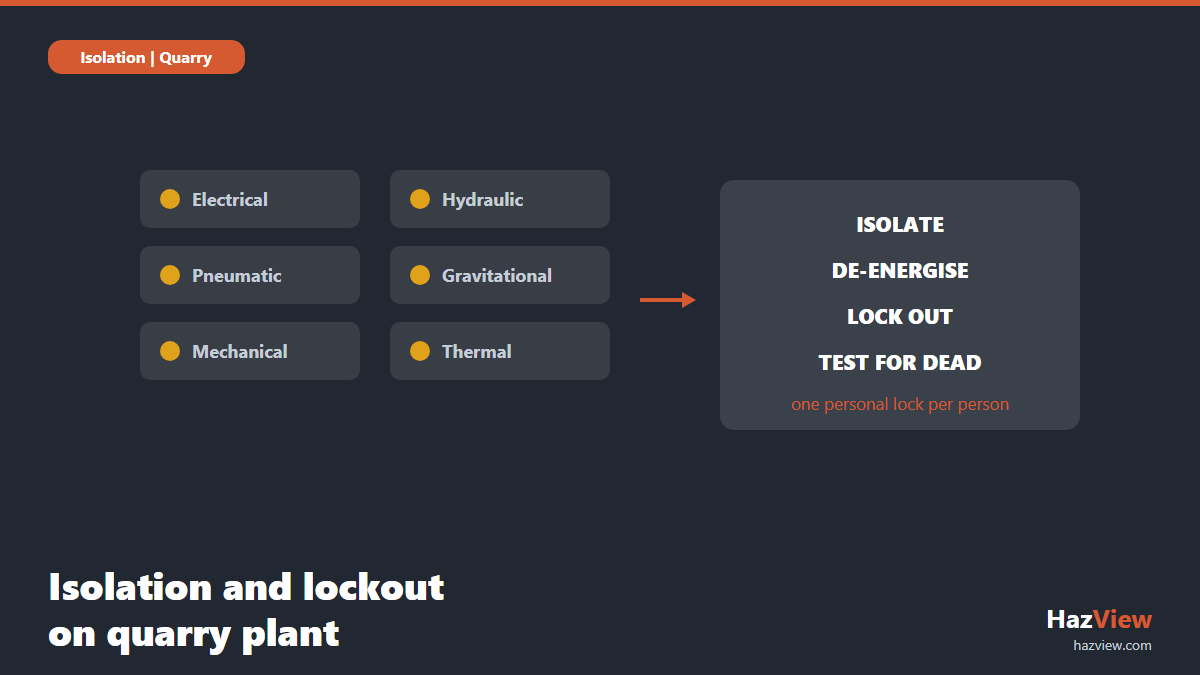
On a crushing plant the energy sources are more numerous than people expect: electrical supply including any secondary or control supply, hydraulic pressure and accumulators, pneumatic pressure, gravitational energy in a raised screen box, jib or take-up weight, mechanical energy in a flywheel that runs on for a long time after power is cut, spring energy in tensioners, and thermal energy in anything recently running.
The regulator guidance is consistent across states: isolate, de-energise, lock out and tag out plant before maintenance. All four verbs matter.
The steps that actually get skipped
Dissipating stored energy
The most commonly skipped step and the one behind the worst outcomes. A crusher flywheel can turn for minutes. A hydraulic accumulator holds pressure indefinitely. A raised screen box comes down when the hydraulics bleed. Locking the isolator does nothing about any of these.
Every isolation procedure needs an explicit stored-energy step: bleed, block, chock, pin or lower, and confirm.
Testing for dead
Try to start it. The single most valuable verification available, and the one people skip because it feels redundant after locking the isolator. It is not redundant: it is how you discover that the isolator you locked was not the one feeding the motor.
Mislabelled isolators are common on quarry plant, particularly where the plant has been extended, relocated or bought second-hand.
Personal locks, one per person
Each person working on the plant applies their own lock and removes it themselves when they are finished. No shared locks, no supervisor holding everyone’s keys, no lock left on overnight “so nobody starts it”.
The failure this prevents is specific: one person finishes, removes the group’s only lock, and the second person is still inside the chute.
Group isolation, done properly
Most real quarry maintenance is group work: a fitter, an offsider and a contractor electrician on the same plant. Group isolation exists to make that manageable and it introduces its own failure modes.
- A named isolation officer who performs and verifies the isolation and controls the group lock box.
- Every worker applies a personal lock to the box before starting and removes it when finished. The plant cannot be restored while any personal lock remains.
- A permit or isolation certificate listing every isolation point and every stored-energy step, signed.
- Shift handover explicitly covers live isolations. A plant isolated at 5am and still isolated at 5pm has been through a handover, and that is where isolations get lost.
- Contractors use your system. Not their own. Two isolation systems on one plant is worse than either alone.
Where quarries specifically get caught
- Clearing a blockage is not treated as maintenance. It is the highest-frequency reason anyone reaches into plant, and it is routinely done live because it is quick. This is the same dynamic behind conveyor guarding failures.
- Shared circuits. Isolating the crusher leaves the feeder live, and the feeder can deliver rock onto someone in the chute.
- Upstream plant not isolated. Work in a transfer chute needs everything that can deliver material into it isolated too.
- Second-hand plant with inherited labelling. Nobody has verified the isolation schematic since it arrived.
- Remote and automatic starts. Plant that can start from a control room or on a timer needs that pathway isolated, not just the local stop.
- Small crews. Where three people run the plant, formality feels like theatre. It is not: small crews have fewer people to notice a mistake.
Building the system
- Map the energy sources for each piece of plant. Electrical, hydraulic, pneumatic, gravitational, mechanical, thermal, chemical.
- Produce a plant-specific isolation procedure for each. Generic procedures do not tell anyone which valve to bleed.
- Verify and correct the labelling. Physically trace it. This is a day’s work that prevents the worst class of failure.
- Provide the hardware. Enough personal locks for everyone including contractors, lock boxes, hasps, tags, chocks and pins.
- Train and verify competence, including for contractors, and re-verify periodically.
- Audit live isolations rather than paperwork. Walk up to an isolated plant and check the locks, the tags and the stored energy steps.
- Design out the blockages. The most effective isolation control is not needing to enter the plant. Chute design, feed control and access for clearing from outside.
Isolation as a critical control
Isolation belongs in your safety management system as a critical control with a performance standard and verification, not as a procedure filed under maintenance. Its failure allows a fatality, which is the definition.
Recording isolations, permits and the audits of them against the actual asset, with time and person attached, gives you a live view of what is isolated right now and a record of how the system performs. That matters most at handover, which is where isolations go missing. See HazView or book a demo.
Related: working at height on crushing plant and contractor management.
Related guides
- Working at Height on Crushing and Screening Plant
- Contractor Management at a Quarry: One System, Not Three
- Emergency Response Planning at a Quarry
- All Quarry Operations guides
Frequently asked questions
What is the difference between isolation and switching off?
Switching off stops the machine. Isolation makes it incapable of starting and removes stored energy. Locking an isolator without dissipating stored energy is not isolation.
Does clearing a blockage require isolation?
Yes, if any part of a person can reach a hazardous zone. It is the most common reason people enter plant and the most common point at which isolation gets skipped for speed.
Can one person hold locks for the crew?
No. Every person working on the plant applies their own personal lock and removes it themselves. Group isolation with a lock box exists to make that practical for multiple workers.
Do contractors use their own isolation system?
They should work to the site’s system. Two isolation systems on one plant creates confusion at exactly the moment clarity matters. Provide the hardware and verify their competence in your process.
How do we know the isolation point is the right one?
Test for dead by attempting to start the plant after isolating, and physically verify the labelling against the actual circuits. Mislabelled isolators are common on plant that has been extended, moved or bought second-hand.