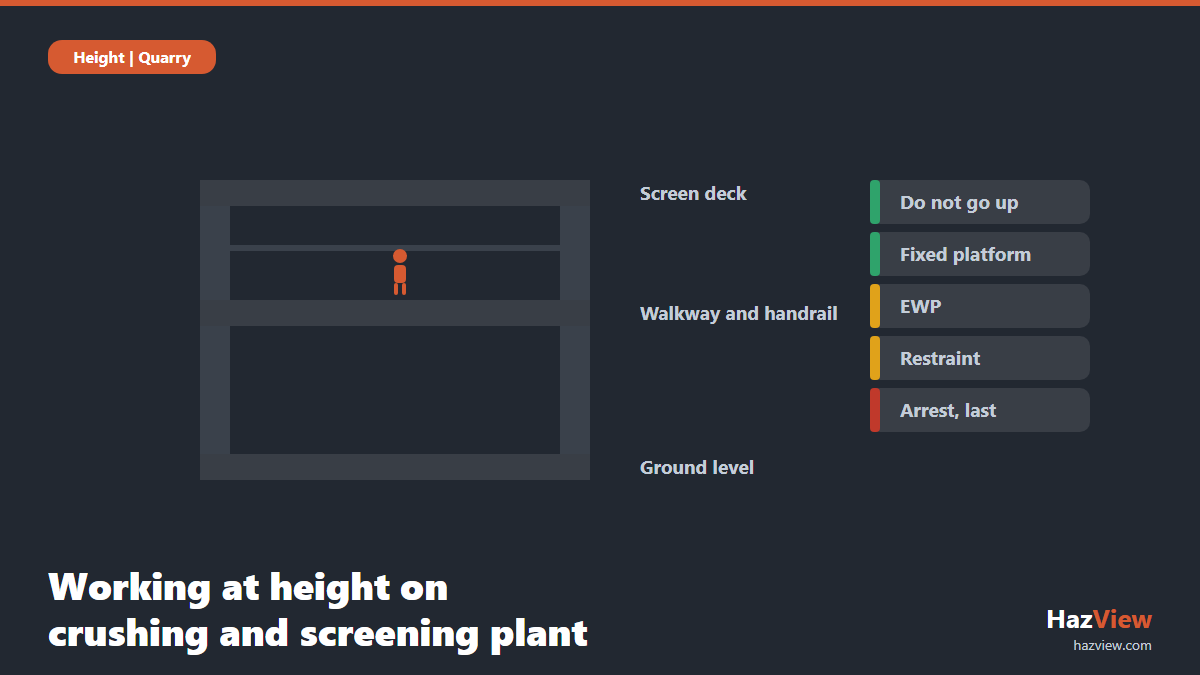
Working at height on crushing plant is a hazard quarries inherit rather than choose. The plant was designed to process rock efficiently, and access for the people who maintain it was a secondary consideration. The result is a structure that has to be climbed several times a shift by people carrying tools, in the wet, often alone.
This guide covers where falls actually happen on quarry plant, why fall arrest is the wrong first answer, and the access fixes that remove the exposure instead of managing it.
Where the exposure actually is
Not usually the obvious high platform with handrails. The exposure concentrates in the places nobody designed as a workplace:
- Screen decks. Changing screen media means standing on and around the deck, handling awkward panels, at height, often with the box tilted.
- Crusher tops. Checking the chamber, clearing bridged material, changing liners.
- Conveyor walkways and transfer towers. Especially where a walkway was added later and is narrower than the task requires.
- Bin and hopper edges. Where clearing a bridge means leaning over an opening into a void that will engulf you.
- Ladders and stairs on the plant itself. Steep, greasy, and used with hands full.
- The top of anything reached by climbing on something else. The improvised route is always the one where the fall happens.
A useful test: watch a screen media change and count how many times someone is somewhere the designer never intended them to stand.
The hierarchy, applied to plant
- Do not go up. Grease lines brought to ground level, inspection cameras, sight glasses positioned so they can be read from a walkway, sampling points at ground level. Every trip up you eliminate is an exposure removed permanently.
- Fixed platforms and stairs. Proper platforms with handrails, midrails and toe boards, and stairs rather than ladders where the route is used regularly.
- Elevating work platform. For occasional access to places a fixed platform is not justified.
- Fall restraint. A system that physically prevents reaching a fall edge. Better than arrest, because nobody falls.
- Fall arrest. Last. And it brings its own obligations.
Why fall arrest is the wrong first answer
Harness-based fall arrest is the default at many quarries because it is cheap to buy. It is expensive to run properly, and quarries routinely under-resource the parts that make it work.
- Anchor points. A rated, certified, inspected anchor. Not a handrail, a conveyor stringer or a convenient beam.
- Fall clearance. Enough distance below the anchor for the system to arrest the fall before the person reaches the ground or the plant beneath. On a screen structure there is frequently not enough.
- Rescue. Suspension trauma is a real and fast risk. If you use fall arrest you need a rescue plan that works within minutes, with people trained and equipment present. A plan that says “call 000” is not a rescue plan at a remote quarry. See emergency response planning at a quarry.
- Inspection and currency. Harnesses, lanyards and anchors all have inspection regimes and service lives.
Fall arrest with no rescue capability is a system that converts a fall into a slower fatality. If you cannot resource all four elements above, spend the money on access instead.
Height and isolation together
Most work at height on quarry plant is also work on plant that can move. Screen boxes, crusher chambers and conveyor structures are all live hazards in their own right, so the isolation has to be done before the climb, not after.
A person standing on a screen deck that starts is in a far worse position than a person standing beside it. Confirm isolation, stored energy and lockout first. See isolation and lockout on quarry plant.
Dropped objects
The other half of working at height, and frequently ignored. A shifter dropped from a transfer tower will kill someone on the ground. Toe boards, tool tethers, barricading beneath the work, and mesh on walkway grating where people work above others are all cheap and effective.
The barricade below is the one that gets skipped, because it requires thinking about someone who is not part of the job.
Practical fixes worth funding
- Remote greasing. Pays for itself in eliminated climbs alone.
- Purpose-built screen media handling. Lifting aids and a platform designed for the task, rather than three people wrestling a panel on a deck.
- Proper stairs instead of ladders on routes used every shift.
- Access designed for blockage clearing from outside the plant. This removes a height exposure and an isolation exposure at once.
- Lighting. A lot of plant access happens before dawn.
- An access review of your plant. Walk it with the fitters and mark every place they go and every place they should not have to.
Recording what you find
Access defects on plant are gradual: a handrail knocked out, grating that flexes, a ladder that has worked loose. They are noticed by whoever is up there and rarely make it into a system where anyone can act on them.
Capturing them where they are, with a photo and a location on the plant, gives maintenance something actionable and gives you the trend. See quarry inspections that stand up, or book a demo of HazView.
Related guides
- Contractor Management at a Quarry: One System, Not Three
- Emergency Response Planning at a Quarry
- Fatigue Management at a Quarry
- All Quarry Operations guides
Frequently asked questions
What height triggers working at height controls?
Australian jurisdictions set trigger heights for particular duties, but the practical answer at a quarry is any height from which a fall could cause injury. Plant falls of two metres onto steelwork are routinely serious.
Can we use a handrail as an anchor point?
No. Anchor points must be rated, certified and inspected for the purpose. Handrails, conveyor stringers and convenient beams are not anchors.
Do we need a rescue plan for fall arrest?
Yes, and it has to work in minutes. Suspension trauma develops fast. If you cannot resource a workable rescue capability, use access solutions or fall restraint instead of arrest.
Is a screen media change work at height?
Almost always, and it is one of the highest-exposure routine tasks on a quarry. It combines height, awkward manual handling and plant that must be isolated, which is why purpose-built access and handling aids pay off quickly.
What about people working below?
Dropped objects are the other half of the hazard. Barricade beneath the work, use toe boards and tool tethers, and mesh grating where people routinely work above others.