Fatigue management at a quarry looks different from fatigue management at a large mine, and most published guidance is written for the large mine. Quarries run smaller crews, less formal rosters, and a workforce that usually drives itself to and from site on public roads. That last point is where quarry fatigue actually bites.
This guide covers what drives fatigue at quarry scale, what a workable plan contains, and why the drive home is part of your risk.
Why it is a safety issue, not a wellbeing one
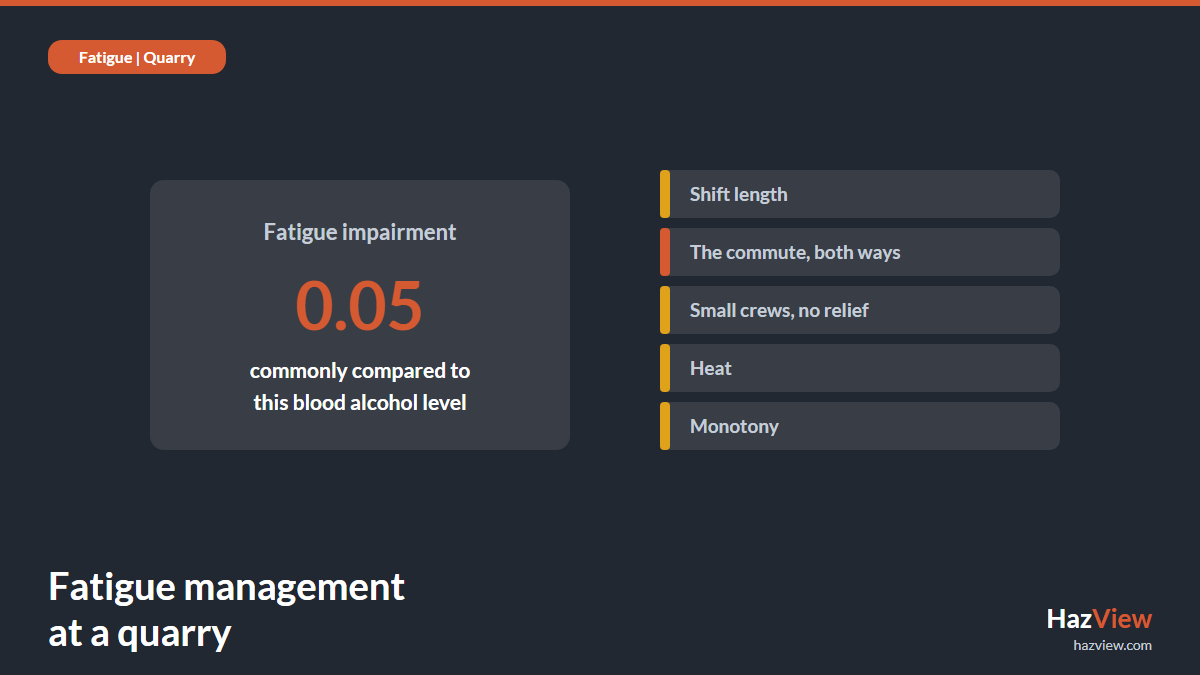
Fatigue impairment at sufficient levels is commonly compared to a blood alcohol concentration of 0.05, the legal driving limit in Australia. Slowed reaction time, degraded judgement, narrowed attention and micro-sleeps.
Put that next to the tasks a quarry runs: operating mobile plant near people, working near unprotected edges, reaching into fixed plant, and driving a loaded truck down a ramp. Fatigue is not a comfort issue at a quarry, it is a performance-shaping factor sitting underneath every other control you have.
Queensland publishes QGN 16 as its guidance note on fatigue risk management. It has no formal legal status, and it is the most useful starting document available to an Australian quarry.
What drives fatigue at a quarry
- Long shifts, especially seasonally. Quarries surge with construction demand. A crew doing 12-hour days for six weeks to feed a highway job is carrying accumulated fatigue nobody has assessed.
- The commute. The one quarries systematically miss. Regional workers often drive an hour each way on rural roads. That is two hours added to the wakefulness period, at the two times of day when alertness is lowest, on the roads where single-vehicle accidents happen.
- Small crews and no relief. When there are four operators and one is away, the other three absorb it. There is no depth to draw on.
- Dual roles. The quarry manager who runs the site all day and does the paperwork at night is on a longer shift than the roster says.
- Heat. Physically demanding work in an Australian summer produces fatigue independent of sleep.
- Monotony. Loading the same truck on the same route for ten hours is a known alertness problem.
- Second jobs and farm work. Common in regional operations and invisible unless someone asks.
Assess cumulative load, not just the shift
The common mistake is checking each shift against a rule and concluding the roster is compliant. Extended rosters require assessment of cumulative fatigue load, not just shift-by-shift compliance.
Two rosters can both satisfy a maximum shift length and a minimum break, and produce very different fatigue outcomes depending on consecutive days worked, direction of shift rotation, night work and recovery opportunity. And rosters that do not account for travel time underestimate actual fatigue exposure, which is the recurring failure at regional quarries.
What a fatigue plan contains
- Roster design rules, including maximum shift length, maximum consecutive shifts, minimum break between shifts, and how travel time is counted.
- Limits on overtime and callouts, with someone accountable for approving exceptions and a record of them.
- Fitness for work, covering self-assessment, the obligation to declare, and how a declaration is handled. This only works if declaring has no penalty attached.
- Task-based controls. Rotating monotonous work, scheduling high-risk tasks away from the low points of the day, and rules about who does not operate plant when short-crewed.
- Environmental controls. Heat management, hydration, shaded breaks, air-conditioned cabs that actually work.
- Journey management. Fatigue breaks before long drives home, accommodation for people who should not drive, and a rule for extended shifts.
- Education, for workers and supervisors, on sleep, recognition and the reporting pathway.
- Incident review. Fatigue considered as a contributing factor in every investigation, not just where it is obvious.
The declaration problem
Every fatigue policy asks workers to declare when they are not fit. Very few workplaces make that a genuinely safe thing to do.
At a quarry with a four-person crew, declaring fatigue means someone else covers your work or production stops. That is a strong disincentive, and it operates regardless of what the policy says. If people are never declaring, do not conclude that nobody is fatigued.
Fixing it needs three things: a genuine alternative to sending someone home unpaid, visible use of the process by supervisors and managers, and no consequence attached to the declaration itself. If a supervisor has never stood themselves down, nobody below them will.
Where fatigue meets your other controls
Fatigue is rarely the sole cause of an incident and frequently the reason another control failed. The inspection that got a cursory look. The radio call not made. The blind spot not checked. The isolation step skipped.
That means fatigue belongs in the assessment of your critical controls, particularly any control that depends on a person doing something correctly at the end of a long shift. Where a control relies on human vigilance, fatigue is a credible failure mode for it. See why critical controls fail.
It also argues for reducing the administrative load that keeps people at work after their shift. A supervisor writing up inspections in the office for forty minutes at the end of a twelve-hour day is being made more fatigued by a system that could have captured the same information in the field. See quarry inspections that stand up, or book a demo.
Related guides
- Stockpile and Tip Head Safety at a Quarry
- Water Management, Dewatering and Inrush at a Quarry
- Noise and Hearing Conservation at a Quarry
- All Quarry Operations guides
Frequently asked questions
Is fatigue management a legal requirement at a quarry?
Fatigue is a hazard, and the general duty to manage hazards so far as is reasonably practicable applies to it in every Australian jurisdiction. Queensland publishes QGN 16 specifically on fatigue risk management.
Does the drive to and from work count?
It should be in your assessment. Travel adds to the wakefulness period, and rosters that do not account for travel time underestimate actual fatigue exposure. For regional quarries this is usually the largest unmanaged contributor.
What shift length is safe?
There is no single safe number. Shift length interacts with consecutive days, rotation direction, night work, travel and recovery. Assess cumulative load across the roster rather than checking each shift in isolation.
Do we need fatigue monitoring technology?
In-cab fatigue detection has a role on large haulage fleets. At quarry scale, roster design, journey management and a declaration process people actually use will deliver more risk reduction for far less money.
Nobody at our site declares fatigue. Is that good?
Almost certainly not. Zero declarations usually means the process carries a cost to the person using it. Look at whether declaring has a real consequence, and whether supervisors and managers ever use it themselves.