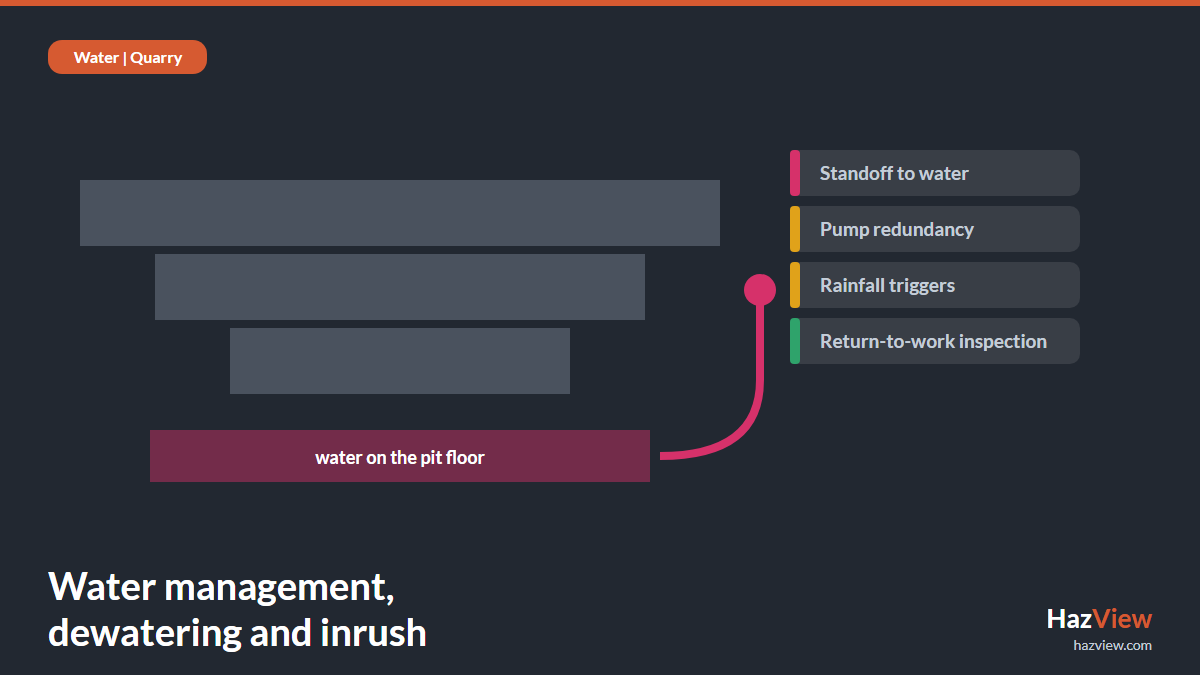
Quarry dewatering and inrush get treated as a production nuisance until the day they become a safety event. Water does more damage to a quarry than almost anything else: it destroys roads, saturates and destabilises faces, floods the pit floor, and in the worst case delivers a volume of water or saturated material into a working area faster than anyone can leave it.
This guide covers how to manage water as a hazard rather than as weather.
Inrush is a principal hazard
Uncontrolled inrush of substances is a listed principal mining hazard in WA and a principal hazard category in NSW. Quarry operators routinely skip it on the assumption that it is an underground problem.
It is not. A surface quarry has credible inrush exposure where it works below the water table, adjacent to a river, dam, farm dam or old workings, below a tailings or slimes storage, into ground that holds perched water, or beneath a stockpile of saturated fines that can flow.
If any of those apply, assess it properly and record the decision either way. See identifying principal mining hazards at a quarry.
Know what is around and above you
The starting point for inrush is a map of every water source that could reach your working areas, and the pathway it would take.
- Surface water. Creeks, rivers, dams and drainage lines, including ones that only run in a big event. Check the catchment upstream, not just the boundary.
- Groundwater. Depth to water table, and whether the pit is already below it.
- Old workings. Historic pits, quarries and shafts nearby that may hold water. Records are frequently poor and the risk is real.
- Stored water on site. Sediment dams, process water dams, sumps. Your own infrastructure is a source.
- Saturated material. Fines stockpiles, silt traps and slimes that can flow rather than slump.
The specific thing to establish is standoff: how much competent ground sits between your advancing face and the water source, and whether that distance is holding as the pit progresses.
Dewatering as a system
Most quarry dewatering is one pump in a sump with a hose over the edge, and it works until the day it does not.
- Size for the design event, not for the average week. What rainfall are you designing to hold, and where did that number come from.
- Redundancy. A single pump is a single point of failure during exactly the event that matters. A spare on site, or a documented arrangement to get one quickly.
- Power. If the pump runs on site power and the storm takes the power out, you have no dewatering during the storm.
- Sump position and access. Reachable to service without someone standing on a saturated edge in the rain.
- Discharge. Somewhere that does not erode your own roads, undercut a face, or create an environmental problem downstream.
- Monitoring. Water level in the pit tracked, not eyeballed occasionally.
Water and ground stability
Water is the main driver of quarry face failure, and inspection frequency almost never increases with rainfall.
Rain raises pore pressure in the ground, saturates weathered material, runs into tension cracks at the crest and washes out the toe. A face that has been stable through a dry six months can fail during or shortly after a heavy event.
Build the trigger into your ground control plan: rainfall above a defined amount triggers re-inspection of faces, batters, crests and tip heads before work resumes beneath them. Seepage from a face is a specific warning sign and warrants stopping work below it. See ground control at a quarry and tip head safety.
Water and roads
Water damages quarry roads faster than traffic does. No crossfall makes a road a pond, then a rutted trap, then a corrugated surface. Saturated ramps become the highest-risk part of the site for a loaded truck.
Drainage is a traffic control, not just a maintenance issue. Crossfall that sheds to a table drain, table drains that go somewhere, and a rule for closing ramps when surface conditions degrade. See quarry haul road design and conditional speed reduction.
A storm response plan
Decide before the season, not during the event.
- Forecast triggers. What warning level starts preparation, and who watches for it.
- Preparation actions. Move plant out of the pit floor, secure the tip head, check pumps and fuel, clear drains.
- Stop-work triggers. Rainfall intensity or accumulated amount that stops work in the pit and closes ramps.
- Evacuation. Route and muster if the pit floor is the exposure, and who calls it. See emergency response planning.
- Return to work. What must be inspected and by whom before anyone goes back in: faces, roads, tip heads, plant, electrical.
The return-to-work step is the one that gets compressed, because production pressure is highest immediately after a shutdown. That is exactly when the ground is least stable.
Recording conditions as they change
Water hazards are transient, which is what makes them hard to manage and hard to evidence. A ramp closed for two days after rain, a face excluded because of seepage, a sump that overtopped: all real controls, and all invisible a week later unless someone recorded them.
Marking closures and water hazards on a live map as they happen, with the time they went on and came off, gives the crews a current picture and gives you the record that the trigger was actually applied. See HazView or book a demo.
Related guides
- Noise and Hearing Conservation at a Quarry
- Blasting at a Quarry: Exclusion Zones, Flyrock and Clearance
- Misfires at a Quarry: Managing What Did Not Go Off
- All Quarry Operations guides
Frequently asked questions
Is inrush relevant to a surface quarry?
Yes, where the quarry works below the water table, near a river, dam or old workings, below stored water or tailings, or beneath saturated material that can flow. Assess it and record the reasoning either way rather than assuming it is an underground issue.
How much rain should trigger a face re-inspection?
Set the figure in your ground control plan based on your material and history. The important thing is that a defined rainfall trigger exists and is applied, rather than inspection frequency staying constant through the wet season.
Do we need a backup pump?
A single pump is a single point of failure during the event when dewatering matters most. Either hold a spare or document a reliable arrangement to obtain one quickly, and consider what happens if site power fails.
What are the warning signs of instability after rain?
Seepage from a face, fresh material at the toe, tension cracks at the crest, subsidence, and saturated or soft ground at edges and tip heads. Any of these should stop work below the feature until it is assessed.
When can work resume after a storm?
After a defined return-to-work inspection covering faces, roads, tip heads, plant and electrical, carried out by a competent person. Do not compress this step because of production pressure, which is highest at exactly the wrong moment.