Quarry noise exposure produces the most common permanent injury in the industry and generates the least urgency, because nobody is carried off site with it. Noise-induced hearing loss accumulates silently over years, is irreversible, and is entirely preventable. It also sits inside the same definition of a principal hazard as anything else that harms people through recurring exposure.
This guide covers the exposure standards, where the noise actually comes from at a quarry, and the controls that work in that order.
The exposure standards
Australian workplace noise exposure standards are expressed two ways, and both apply:
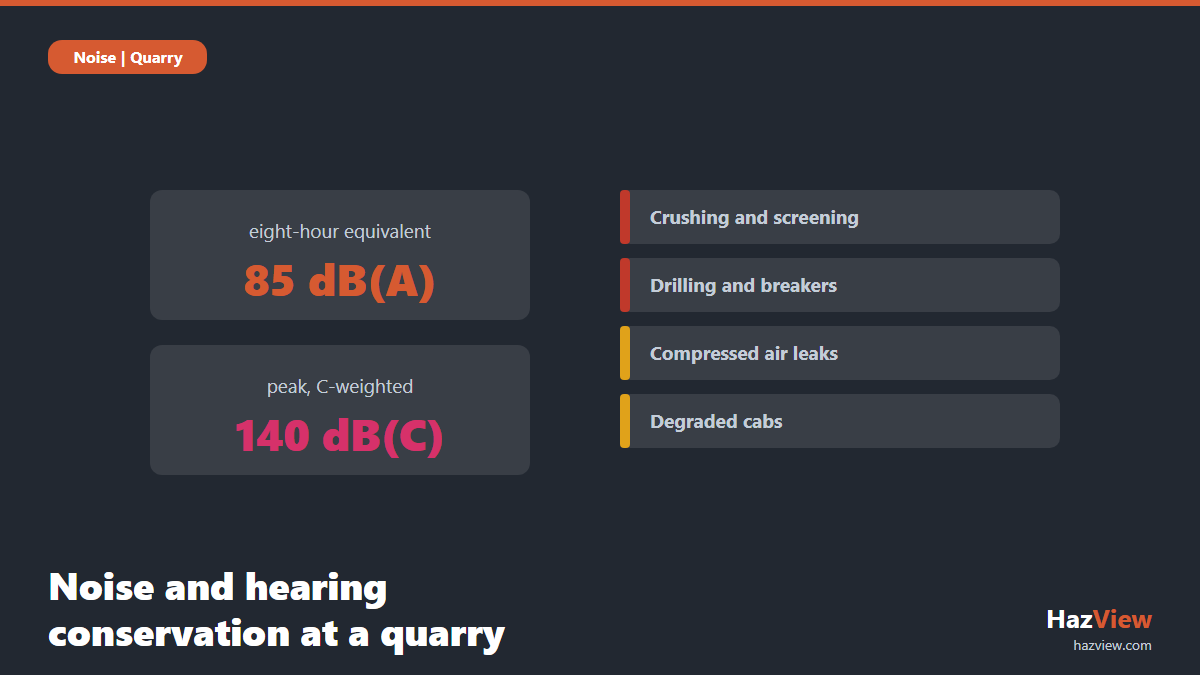
- An eight-hour equivalent continuous A-weighted sound pressure level of 85 dB(A). This is a dose, so it trades level against time.
- A peak C-weighted sound pressure level of 140 dB(C). This is an instantaneous limit for impact noise, and it is not a dose. One event can exceed it.
Two consequences quarry operators often miss. Because the eight-hour standard is a dose, a 12-hour shift has a lower allowable level than an eight-hour one. And because 3 dB represents a doubling of energy, 88 dB(A) for four hours is the same dose as 85 dB(A) for eight. Small numbers, large differences.
The peak limit is the one that catches quarries out, because impact noise from rock hitting steel routinely exceeds what people assume.
Where the noise comes from
- Crushing and screening. Continuous high levels, and the highest peaks where oversize rock hits a bin or grizzly.
- Drilling. Sustained high exposure, particularly for the driller and anyone nearby.
- Rock breakers and hydraulic hammers. High level and high impact.
- Mobile plant cabs. Usually fine when new and sealed, and progressively worse as door seals perish, glass cracks and air conditioning fails so people open windows.
- Compressed air. Blow guns, air tools and leaks. High frequency, extremely common and completely fixable.
- Workshop. Grinding, hammering and impact tools in a steel shed with hard surfaces.
- Blasting. Infrequent but high peak, and a specific check against the 140 dB(C) limit for anyone near the firing position.
The two that get missed are compressed air and degraded cabs, because neither feels like a noise source. A leaking air line running all shift beside a workshop bench is a genuine exposure.
Assess before you buy earplugs
Most quarries go straight to hearing protection, which is the bottom of the hierarchy and the least reliable control available.
A noise assessment by a competent person tells you which tasks and areas actually exceed the standard, and which people are in each exposure group. Without it, you are protecting everyone equally against a hazard that is not distributed equally, and you have no way of knowing whether your controls are working.
The assessment should cover personal exposure over a real shift rather than spot readings, include peak measurement for impact sources, and be repeated when plant or process changes.
Controls, in order
- Eliminate or substitute. Quieter plant at purchase is the highest-value decision you will ever make about noise, and it costs nothing extra if noise is a specification at procurement rather than a discovery afterwards.
- Engineering. Enclosures and acoustic panels on crushers and screens, rubber lining in chutes and bins to kill impact noise, damping on steel structures, silencers on air exhausts, and fixing air leaks.
- Isolation. Distance and barriers between people and the source. Control rooms, and locating the crib room away from the plant.
- Administrative. Rotating time in high-exposure areas, restricting access, and scheduling noisy work when fewer people are exposed.
- Hearing protection. Last, correctly selected for the actual level, fitted, and maintained.
Rubber lining a bin or chute is the highest-return noise control most quarries have available. It removes the peak impact noise at the source, and it usually reduces wear at the same time.
Hearing protection actually working
Two failure modes make hearing protection deliver much less than the number on the packet.
Fit. Foam plugs inserted poorly deliver a fraction of their rated attenuation. Earmuffs over a hard hat brim or safety glasses arms break the seal. Fit testing exists and is worth doing for people in the highest exposure groups.
Over-protection. Genuine and counterintuitive. Protection rated far above the exposure isolates the wearer so much that they cannot hear reversing alarms, radio calls or a machine changing note. People then remove it, or wear it loose, and end up with less protection than a correctly matched class would have given. Match the class to the measured exposure rather than choosing the highest available.
Noise also interacts with your other controls. A worker who cannot hear a reversing alarm is exposed to the traffic hazard, which is why hearing protection selection belongs in the conversation about vehicle and pedestrian segregation.
Health monitoring
Audiometric testing on a defined cycle is standard practice where workers are exposed to noise at or above the standard, with a baseline test and periodic comparison.
Treat a measurable shift in someone’s audiogram as a control failure and investigate it, the same way you would investigate a dust exceedance. Audiometry is not a control. It detects harm that has already happened, and by the time it shows, the loss is permanent. See the same logic applied to silica dust.
Exposure records are long-lived documents. A hearing loss claim decades from now will be assessed on what you kept.
Making noise visible
Noise is invisible in a safety system until someone measures it. Recording high-noise areas and tasks where they physically are, alongside the assessment results and the state of the controls, turns an abstract exposure into something a supervisor can see and act on.
It also surfaces the pattern: the same transfer point generating the same complaint, the same cab with the failed seal. See HazView, or book a demo.
For the state frameworks, see Queensland, NSW and Western Australia.
Related guides
- Blasting at a Quarry: Exclusion Zones, Flyrock and Clearance
- Misfires at a Quarry: Managing What Did Not Go Off
- Conveyor Guarding at a Quarry: The Fatality Pattern That Keeps Repeating
- All Quarry Operations guides
Frequently asked questions
What is the noise exposure standard in Australia?
An eight-hour equivalent continuous A-weighted level of 85 dB(A), and a peak C-weighted level of 140 dB(C). The first is a dose that trades level against time; the second is an instantaneous limit.
Does a 12-hour shift change the limit?
Yes. Because the standard is an eight-hour equivalent dose, a longer shift means a lower allowable average level for the same dose. Extended shifts need the exposure recalculated, not assumed.
Are earplugs enough?
They are the last control in the hierarchy and depend entirely on correct selection and fit. Engineering controls such as rubber lining, enclosures and fixing air leaks deliver more reliable reduction and do not depend on the wearer.
Can hearing protection be too strong?
Yes. Over-protection isolates the wearer from reversing alarms, radio calls and machine sounds, so people remove or loosen it. Match the class to the measured exposure rather than choosing the highest rating available.
How often should audiometric testing be done?
Establish a baseline and repeat on a defined cycle set in your safety management system, for anyone exposed at or above the standard. Treat any measurable shift as a control failure to be investigated.