Quarry safety in NSW has one feature no other Australian jurisdiction shares: a three-tier system that decides who is allowed to manage your quarry based on a risk profile of the site itself. Get the tier wrong and you have the wrong person in the job, which is a compliance problem before it is anything else.
NSW quarries sit under the Work Health and Safety (Mines and Petroleum Sites) Act 2013 and the Work Health and Safety (Mines and Petroleum Sites) Regulation 2022, layered over the general WHS Act. This guide covers what that means for a working quarry.
On this page
- The three-tier system, in one paragraph
- What decides your tier
- Principal hazards and the PHMP
- Roads and vehicle operating areas
- The safety management system
- Where NSW quarries come unstuck
- How NSW compares
- Making the system visible
The three-tier system, in one paragraph
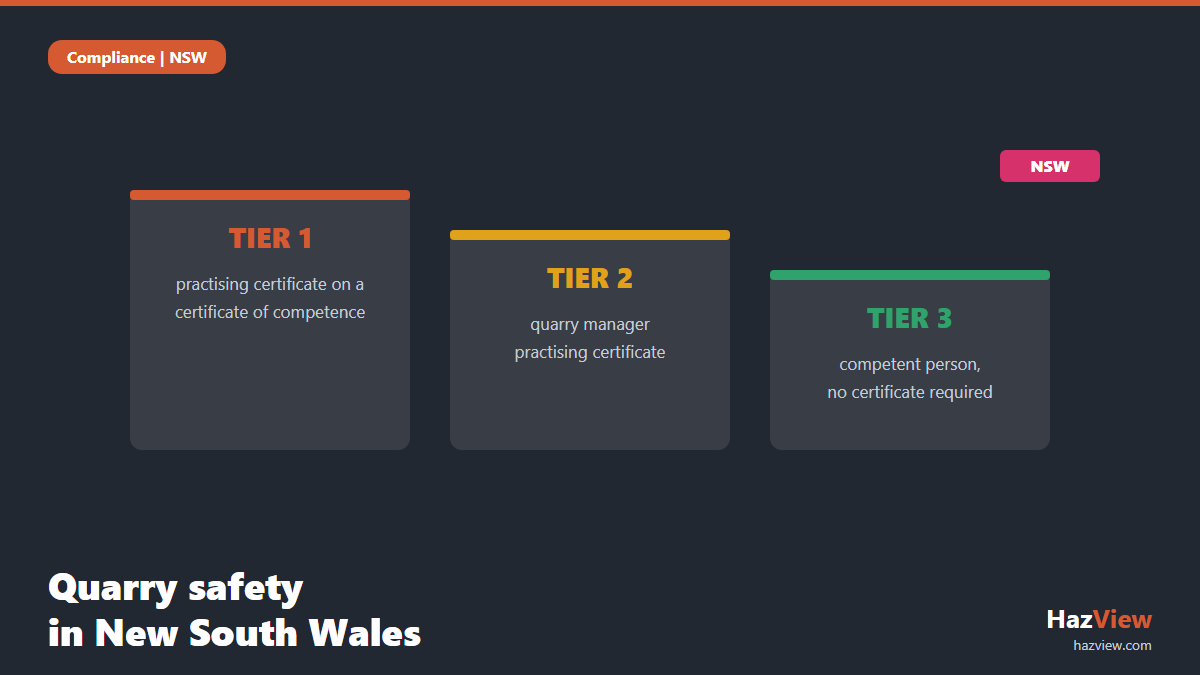
NSW quarries are divided into three categories. Tier 1 requires a quarry manager practising certificate attained on the basis of holding a certificate of competence. Tier 2 requires a quarry manager practising certificate. Tier 3 requires a competent person, with no practising certificate required.
The Resources Regulator determines which category a quarry falls into using a risk profiling tool. You do not self-assess your way into Tier 3 because the site feels small. See the practising certificate explained and how the risk profiling tool works.
What decides your tier
The risk profiling tool, developed by the Mining and Petroleum Competence Board, calculates a mine’s hazard burden. It assesses principal hazards, activity levels, mechanical and electrical complexity, staffing and output levels, and produces a numeric output.
Typical characteristics, as the regulator describes them:
- Tier 1: large operations with principal mining hazards such as multiple working benches, high walls, benching over 3 metres, drill and blast, complex vehicle operations and large fixed plant for crushing and processing, with sophisticated safety management systems.
- Tier 2: medium-sized operations where the principal mining hazards represent a medium risk.
- Tier 3: the remainder, managed by a competent person without a practising certificate.
Note “benching over 3 metres” and “drill and blast” in the Tier 1 description. Plenty of operators who think of themselves as a small quarry meet those descriptions comfortably.
Principal hazards and the PHMP
Alongside the competence regime, NSW runs principal hazards and principal hazard management plans. Where a principal hazard is identified at your quarry, you need a plan for it that sets out the controls, how they are implemented and how they are reviewed.
For a quarry, the recurring ones are ground or strata failure, roads and other vehicle operating areas, fire or explosion, and inrush. Our guide to principal hazard management plans covers the structure, and the same discipline applies as in the WA version.
Roads and vehicle operating areas
NSW published a Technical Reference Guide for roads or other vehicle operating areas in 2025, which is the most detailed NSW material on the subject and applies to quarries as much as to metalliferous mines. See the 2025 NSW vehicle interaction guide.
The practical content overlaps heavily with the WA code and with Queensland’s RS19, because the engineering does not change at a border. Our quarry-specific pieces on haul road design, segregation and the traffic management plan apply directly.
The safety management system
NSW requires a safety management system for the mine, and it is the frame that holds your principal hazard management plans, competence records, contractor arrangements and emergency planning together. See the safety management system for a NSW quarry.
Where NSW quarries come unstuck
- Assuming Tier 3. The regulator assigns the tier. Operators who assume they are Tier 3 and are not have an uncertificated person in a certificated role.
- Letting the certificate lapse. 60 hours of recognised learning over five years sounds generous and disappears if nobody logs it. See maintaining a certificate.
- Leaving the application too late. Applications go through the NSW Resources Portal and take between two and six weeks. If your quarry manager is leaving in a fortnight, you are already behind.
- Tier drift. The site that got a Tier 3 profile three years ago has since started blasting and gone to two benches. The profile no longer describes it.
- PHMPs written and shelved. The same failure as everywhere else.
How NSW compares
WA has statutory positions with certificates of competency and a threshold based on how many people carry out quarry operations. See quarry safety in Western Australia. Queensland leans on the site senior executive and the acceptable level of risk test, with no quarry-specific certificate. See quarry safety in Queensland.
NSW is the only one that profiles the site to decide the qualification. It is more work up front and, arguably, the most proportionate of the three.
Making the system visible
Whichever state you are in, the same thing separates a compliant quarry from an exposed one: whether the controls described in the plans are demonstrably in place on the day. Principal hazard management plans, road standards and inspection regimes all resolve to that.
Recording hazards, exclusion zones and inspections where they physically are, with the time and the person attached, gives you a live picture and an evidence trail at the same time. That is what HazView does. Book a demo to see it on your site.
Guides in this series
Each guide below covers one part of this topic in depth.
- The NSW Quarry Manager Practising Certificate: Three Tiers Explained
- Which Tier Is Your Quarry? The NSW Risk Profiling Tool Explained
- The Safety Management System for a NSW Quarry
HazView keeps this detail live on a site map rather than in a folder. Book a demo to see it against your own site.
Frequently asked questions
Does my NSW quarry need a certificated quarry manager?
It depends on your tier. Tier 1 requires a practising certificate attained on the basis of a certificate of competence, Tier 2 requires a practising certificate, and Tier 3 requires a competent person with no practising certificate. The Resources Regulator assigns the tier.
How do I find out my quarry’s tier?
The Resources Regulator determines it using the risk profiling tool, which calculates hazard burden from principal hazards, activity levels, mechanical and electrical complexity, staffing and output.
What legislation covers NSW quarries?
The Work Health and Safety (Mines and Petroleum Sites) Act 2013 and Regulation 2022, sitting over the general NSW WHS legislation.
Does a small sand or gravel pit count?
Extractive operations are covered. The scale of your obligations follows the risk profile of the site rather than a simple size cut-off, which is exactly what the tier system is for.
How long does a practising certificate application take?
Applications are submitted through the Mining Worker’s section of the NSW Resources Portal and can take between two and six weeks to process. Plan succession well ahead of that window.