The NSW quarry manager practising certificate is unlike any other quarry qualification in Australia, because what you need depends on the quarry rather than on you. NSW quarries are divided into three tiers, and the tier decides whether the person exercising the quarry manager function needs a practising certificate, a practising certificate backed by a certificate of competence, or no certificate at all.
This guide covers what each tier requires, how to apply, how long it takes, and what keeps the certificate alive.
The three tiers
- Tier 1: a quarry manager practising certificate attained on the basis of holding a certificate of competence.
- Tier 2: a quarry manager practising certificate.
- Tier 3: a competent person. No practising certificate required.
The distinction between Tier 1 and Tier 2 is the certificate of competence underneath. A Tier 1 certificate is not simply a Tier 2 certificate with more experience; it rests on a formal competence qualification.
Tier 3 is not an exemption from competence. It is an exemption from the certificate. The person still has to be a competent person, and if something goes wrong, that competence will be examined.
Which tier is your quarry?
You do not choose. The Resources Regulator determines which category a quarry falls into by assessing the hazards at the site using the risk profiling tool.
The typical characteristics the regulator describes:
- Tier 1 quarries will typically be large operations with principal mining hazards such as multiple working benches, high walls, benching over 3 metres, drill and blast, complex vehicle operations and large fixed plant for crushing and processing, together with sophisticated safety management systems.
- Tier 2 quarries are typically medium-sized operations where the principal mining hazards represent a medium risk.
Read the Tier 1 list carefully if you think you are small. Benching over 3 metres and drill and blast are both in there, and a great many operations that describe themselves as small quarries do both. See how the risk profiling tool works.
Who needs one
Mine operators of quarries and individuals exercising the quarry manager statutory function are the parties the requirement bites on. That is two different obligations pointing at the same appointment: the operator has to nominate someone appropriately certificated for the tier, and the individual has to hold and maintain the certificate.
An operator who nominates an uncertificated person to a Tier 1 or Tier 2 quarry has a compliance problem regardless of how capable that person is.
Applying
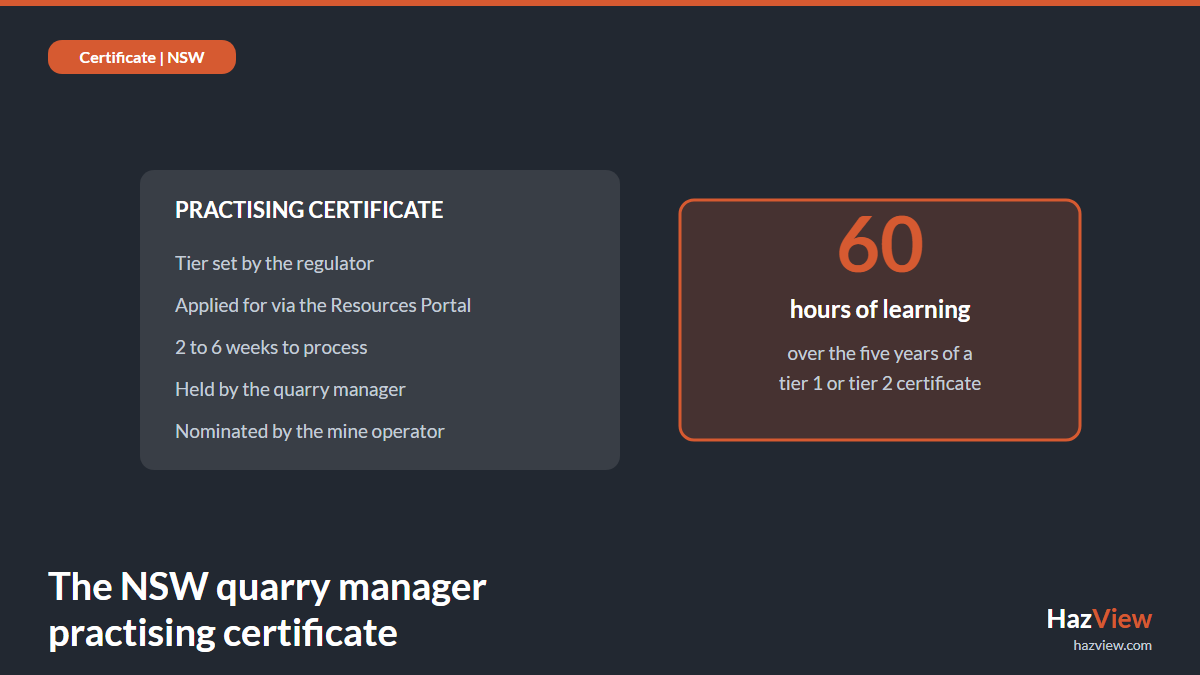
Applications are submitted via the Mining Worker’s section of the NSW Resources Portal, and can take between two and six weeks to process.
Two to six weeks is the single most useful number in this article, because it is a succession planning constraint. If your quarry manager resigns with four weeks’ notice and their replacement has not started an application, you will have a period with nobody appropriately certificated in the role. Start applications before you need them, and keep a second certificated person on the books where the operation can justify it.
Keeping the certificate current
A total of 60 hours of recognised learning must be completed over the five years of the certificate.
Twelve hours a year sounds easy and is the requirement people most often fall short on, for a predictable reason: it is not urgent until year five, and by then it is 60 hours. The regulator recommends keeping a logbook to record hours completed over the five years of tier 1 and tier 2 certificates.
Practical advice: log it as you go, in one place, and count the things that genuinely qualify rather than scrambling for a course in the final year. Industry seminars, technical training, regulator briefings and structured site learning all tend to count. Reading a safety alert over a coffee does not.
There have also been transitional requirements over time, including requirements for some holders to obtain qualifications by 1 October 2024. If your certificate predates recent changes, confirm the current conditions on it rather than assuming.
What the certificate does not do
Holding a practising certificate qualifies you for the role. It does not discharge the role. Once appointed, the quarry manager function carries real obligations for the operation of the quarry, the safety management system and the principal hazards on the site.
The mistake to avoid is treating the certificate as the compliance outcome. The certificate is the entry ticket. What you do afterwards, and whether you can show it, is the actual obligation. See the safety management system for a NSW quarry.
If the site changes, revisit the tier
Tier drift is the quiet risk. A quarry profiled years ago as low hazard burden starts drilling and blasting, adds a second bench, brings in a larger crushing plant or doubles output. The hazard burden that produced the original tier no longer describes the operation.
Treat a material change in benching, blasting, plant, staffing or output as a trigger to check the profile again, the same way you would trigger a review of a principal hazard management plan.
Evidencing the role
Whichever tier you are in, the quarry manager’s day-to-day judgement is the control that matters most and the one that leaves the least trace. Face inspections, road closures, decisions to stand work down: all real safety work, none of it evidence unless it is recorded.
Capturing those calls in the field, located and timestamped and attributed, means your competence is demonstrable rather than assumed. It also builds the record that supports future applications and CPD claims. See HazView’s hazard management tools or book a demo.
For the wider NSW picture, see quarry safety in NSW. For the WA equivalent, see the WA quarry manager’s certificate.
Related guides
- Quarry Safety in NSW: A Compliance Guide for Small Mines and Quarries
- Which Tier Is Your Quarry? The NSW Risk Profiling Tool Explained
- The Safety Management System for a NSW Quarry
- All NSW Quarries & Mines guides
Frequently asked questions
What is the difference between Tier 1 and Tier 2?
Tier 1 requires a quarry manager practising certificate attained on the basis of holding a certificate of competence. Tier 2 requires a quarry manager practising certificate without that underlying certificate of competence.
Does a Tier 3 quarry need a certificated manager?
No practising certificate is required, but the person must still be a competent person. Competence without a certificate still has to be real and demonstrable.
How many CPD hours does a NSW quarry manager need?
60 hours of recognised learning over the five years of the certificate. The regulator recommends using the guide and recommended logbook to record hours as you go.
How long does an application take?
Between two and six weeks, through the Mining Worker’s section of the NSW Resources Portal. Build that into succession planning.
Does my WA or QLD ticket transfer to NSW?
NSW runs its own practising certificate regime. Interstate qualifications and experience may support an application, but confirm recognition with the Resources Regulator rather than assuming a ticket carries across.