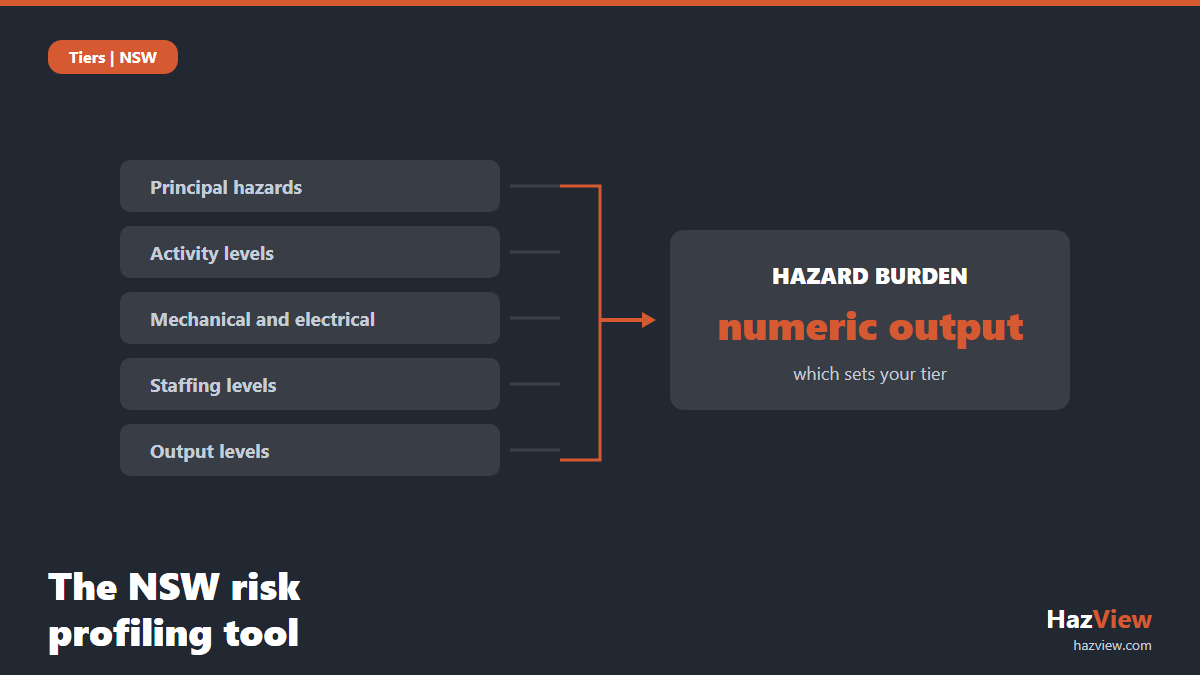
The quarry risk profiling tool in NSW is the mechanism that decides what qualification your quarry manager needs. Developed by the Mining and Petroleum Competence Board, it calculates a mine’s hazard burden and helps determine the certificate requirements for nomination as the quarry manager. It is not a self-assessment you fill in to justify a decision you have already made.
This guide covers what the tool measures, what pushes a site up a tier, and the change triggers that should send you back to it.
What the tool measures
The tool assesses the mine’s principal hazards, activity levels, mechanical and electrical complexities, staffing and output levels, and generates a numeric output.
Five inputs, one number. Worth taking each in turn, because operators consistently underestimate two of them.
Principal hazards
The heaviest input. Ground or strata failure, roads and other vehicle operating areas, fire or explosion, inrush. A quarry with high walls and drill and blast carries more hazard burden than one scraping sand off a flat lease, regardless of how many people work there.
Activity levels
How much is actually happening. A site working one face intermittently is a different proposition from one running two shifts across multiple benches.
Mechanical and electrical complexity
The input most often underestimated. A fixed crushing and screening plant with conveyors, high voltage supply, control systems and isolation requirements is a substantial complexity contribution on its own, and it exists even at sites with a small pit. See isolation and lockout on quarry plant.
Staffing levels
How many people are exposed, and the supervision structure around them. Contractors count as exposure even when they are not on your payroll.
Output levels
Production scale, as a proxy for movement, traffic, plant hours and pressure. The second most underestimated input, because output creeps up gradually and nobody re-examines what it implies.
From number to tier
When the numeric output for the mine is above the pre-determined measure, the mine operator must nominate a person with a practising certificate. If the numeric output is below that measure, the operator can nominate a quarry manager with a practising certificate or a practising certificate with conditions.
The regulator does not publish the threshold values, and there is no useful purpose in trying to reverse-engineer them. The tier assignment is made by the Resources Regulator, not by you. See the practising certificate requirements.
What pushes a quarry up a tier
From the regulator’s own description of Tier 1 characteristics, these are the features that carry the most weight:
- Multiple working benches. Going from one bench to two is a step change in ground control complexity, not an incremental one.
- High walls, and benching over 3 metres. A specific and low threshold. Many operators clear it without registering that they have.
- Drill and blast. Introducing blasting brings explosives, flyrock, misfires and exclusion zones in one move. See blasting exclusion zones.
- Complex vehicle operations. Multiple vehicle classes, customer trucks, pedestrians, shared routes.
- Large fixed plant for crushing and processing. Guarding, isolation, working at height, electrical.
Notice how little of that is about how many people you employ. A twelve-person quarry with two benches, blasting and a fixed plant carries a serious hazard burden.
When to go back to the tool
Treat these as triggers to revisit the profile, in the same way you would trigger a principal hazard management plan review:
- Adding a bench, or increasing bench height.
- Starting or significantly changing drill and blast.
- Installing or substantially upgrading fixed plant.
- A material increase in output or shift pattern.
- A change in staffing or contractor model.
- Identifying a new principal hazard.
The exposure here is specific and worth stating plainly: if the site has grown past its profile and the appointed quarry manager is not certificated for the tier the site now warrants, you have a compliance gap that predates any incident, and it will be found in the first serious investigation.
Use it as a planning tool, not just a compliance one
The most useful thing about the profiling approach is that it forces a conversation the industry does not otherwise have: what actually makes this operation dangerous, independent of its size.
If you are planning to add a bench or bring blasting in-house, run the question early. The competence requirement, the two-to-six-week certificate application, the additional principal hazard management plans and the extra controls are all consequences of that decision, and they are far cheaper to plan for than to retrofit.
Knowing your own hazard burden
Every input the tool uses is something you should be able to describe accurately about your own site at any moment: which hazards are live, what plant is running, who is exposed, what the operation is doing.
Sites where that information lives in one place, on a current map, answer regulator questions in minutes. Sites where it is spread across a spreadsheet, a whiteboard and three people’s memories spend a week assembling it. See why visual maps outperform text-based systems, or book a demo.
For the wider picture, see quarry safety in NSW.
Related guides
- Quarry Safety in NSW: A Compliance Guide for Small Mines and Quarries
- The Safety Management System for a NSW Quarry
- The NSW Quarry Manager Practising Certificate: Three Tiers Explained
- All NSW Quarries & Mines guides
Frequently asked questions
Who runs the risk profiling tool?
The tool was developed by the Mining and Petroleum Competence Board, and the Resources Regulator determines the quarry’s tier by assessing the hazards at the site using it.
What does the tool assess?
The mine’s principal hazards, activity levels, mechanical and electrical complexities, staffing and output levels. It generates a numeric output representing hazard burden.
Can I self-assess my tier?
You can and should understand your own hazard burden, but the tier determination is made by the Resources Regulator. Assuming a lower tier than the regulator would assign is a real compliance risk.
Does adding blasting change my tier?
It can. Drill and blast is listed among the typical Tier 1 characteristics, and it introduces principal hazards that feed directly into the profile. Check before you start, not after.
Is 3 metres of benching really a threshold?
Benching over 3 metres appears in the regulator’s description of typical Tier 1 characteristics. It is a characteristic rather than a single decisive cut-off, but it is a low bar and worth knowing where you sit against it.