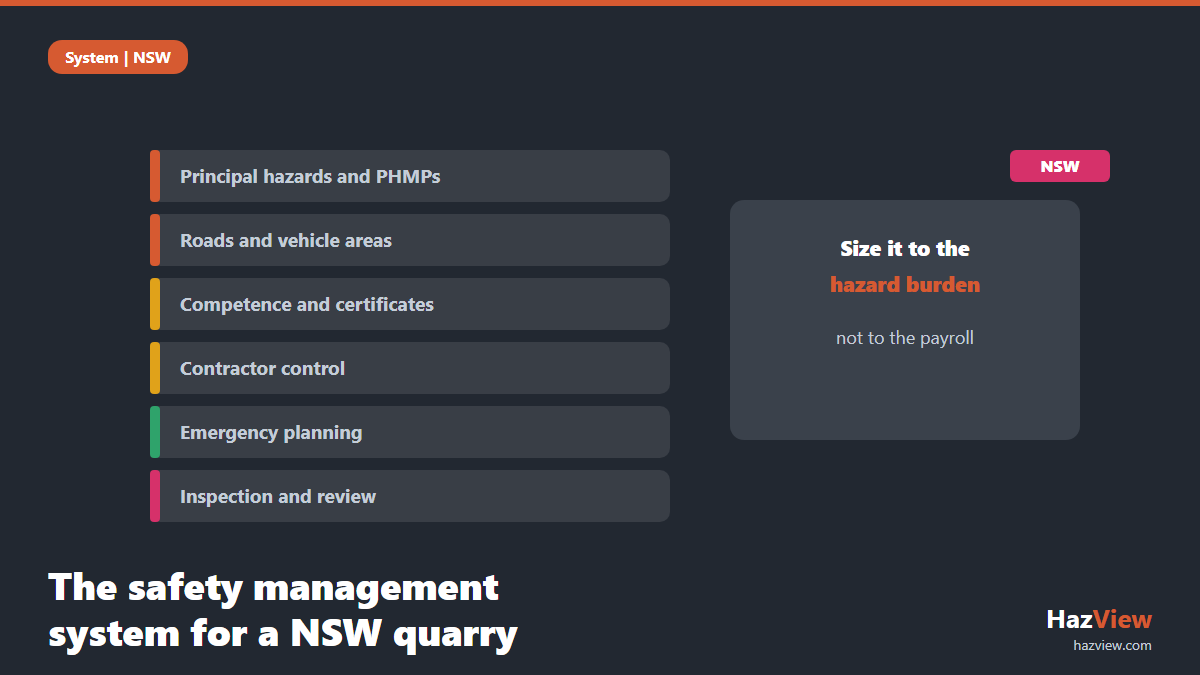
A NSW quarry safety management system is the frame that holds everything else together: your principal hazard management plans, competence and certificate records, contractor arrangements, emergency planning and the evidence that controls are working. It sits under the Work Health and Safety (Mines and Petroleum Sites) Act 2013 and Regulation 2022, layered over the general WHS Act.
This guide covers what belongs in it, how to size it to your tier, and where NSW quarries most often get caught.
Size it to the hazard burden, not to the payroll
NSW does something the other states do not: it profiles the site to work out how much competence the operation needs. That same logic should drive your safety management system.
A Tier 1 quarry with multiple benches, blasting and a large fixed plant needs a system that reflects that complexity. A Tier 3 operation does not need the same document, and building one is a waste that makes the system less likely to be used. Understand your hazard burden first: see the risk profiling tool explained.
What the system needs to hold
Principal hazards and their management plans
The substance of the system. Identify the principal hazards at your quarry and prepare a management plan for each. For a quarry that usually means ground or strata failure, roads and other vehicle operating areas, fire or explosion, and inrush where the site works near water or below the water table.
Structure and content are covered in principal hazard management plans explained, and the same discipline applies as in the WA version: hazard described as it exists here, risk assessed with worker input, controls with performance standards, and review triggers.
Roads and vehicle operating areas
NSW published a Technical Reference Guide for roads or other vehicle operating areas in 2025. It is the benchmark NSW material and applies to quarries. See the 2025 guide, and for the practical quarry version, the quarry traffic management plan, segregation and haul road design.
Competence and certificates
Who holds which role, what certificate they hold, when it expires, and how the maintenance of competence hours are tracking. In NSW that specifically includes the quarry manager practising certificate for your tier, and the 60 hours of recognised learning over five years for Tier 1 and Tier 2 holders. See the practising certificate.
Include succession. An application takes between two and six weeks, so a system that does not plan for the quarry manager leaving is a system with a known hole in it.
Contractor control
Drill and blast, crushing, maintenance and haulage contractors are often the majority of the exposure at a quarry. How they are engaged, inducted, supervised and verified belongs in the system. See contractor management at a quarry.
Emergency planning
Response arrangements proportionate to the site and its isolation. A quarry an hour from the nearest ambulance has a different emergency plan from one on the edge of a regional town. See emergency response planning at a quarry.
Inspection, monitoring and review
How controls are verified, how often, by whom, recorded where, and what triggers review of the system itself. See quarry inspections that stand up.
Where NSW quarries get caught
- The system and the tier disagree. A Tier 1 site running a Tier 3 system, usually because the operation grew and the paperwork did not.
- PHMPs that are hazard descriptions, not plans. No performance standards, no verification, no trigger for review.
- Certificates tracked in someone’s head. Expiry dates and CPD hours belong in the system, not in a memory.
- Contractors outside the system. Especially drill and blast crews who arrive with their own documentation and leave before anyone checks it against yours.
- No evidence of implementation. The universal one. The plan says the control exists, and nothing shows it was there on the day.
The implementation test
An inspector will not read your system cover to cover. They will pick one principal hazard and follow it: is it identified, is there a plan, does the plan name controls, is there a performance standard, is there a record that someone verified it, was the finding closed out.
Then they will walk the site and see whether it matches. Almost every serious finding in Australian quarry regulation comes from that second step rather than the first.
Closing the gap between plan and pit
The gap opens because the system is a document and the quarry is a moving object. Faces advance, roads change, plant goes in and out of service, contractors come and go. A document written in March describes a site that stopped existing in April.
Anchoring the system to a live picture, with hazards, exclusion zones, road status and inspection records held where they physically are, keeps the plan and the pit in step and produces the verification evidence at the same time. That is what HazView was built to do, and why critical controls fail without real-time visibility. Book a demo.
For the wider picture, see quarry safety in NSW.
Related guides
- Quarry Safety in NSW: A Compliance Guide for Small Mines and Quarries
- The NSW Quarry Manager Practising Certificate: Three Tiers Explained
- Which Tier Is Your Quarry? The NSW Risk Profiling Tool Explained
- All NSW Quarries & Mines guides
Frequently asked questions
Does a small NSW quarry need a safety management system?
Yes. What scales with the operation is the depth of the system, not whether you have one. The tier assigned to your quarry is a good guide to how much complexity it needs to carry.
What principal hazards apply to a quarry in NSW?
Most commonly ground or strata failure, roads and other vehicle operating areas, and fire or explosion, with inrush where the site works near or below water. You must identify any others that apply to your operation.
Do contractors work under our system?
Contractors must be integrated into the site’s arrangements, with competence verified and work supervised. WHS law requires duty holders with shared responsibilities to consult, cooperate and coordinate rather than run parallel systems.
How often should the system be reviewed?
On a defined cycle and on trigger: an incident, an audit finding, a change in the operation, or anything that would alter your risk profile such as adding a bench, starting blasting or installing major plant.
Is the NSW system the same as a WA MSMS?
The concepts are close and the documents cover similar ground, but the terminology, the hazard categories and the competence regime differ. Do not lift a WA mine safety management system into a NSW quarry without reworking it.