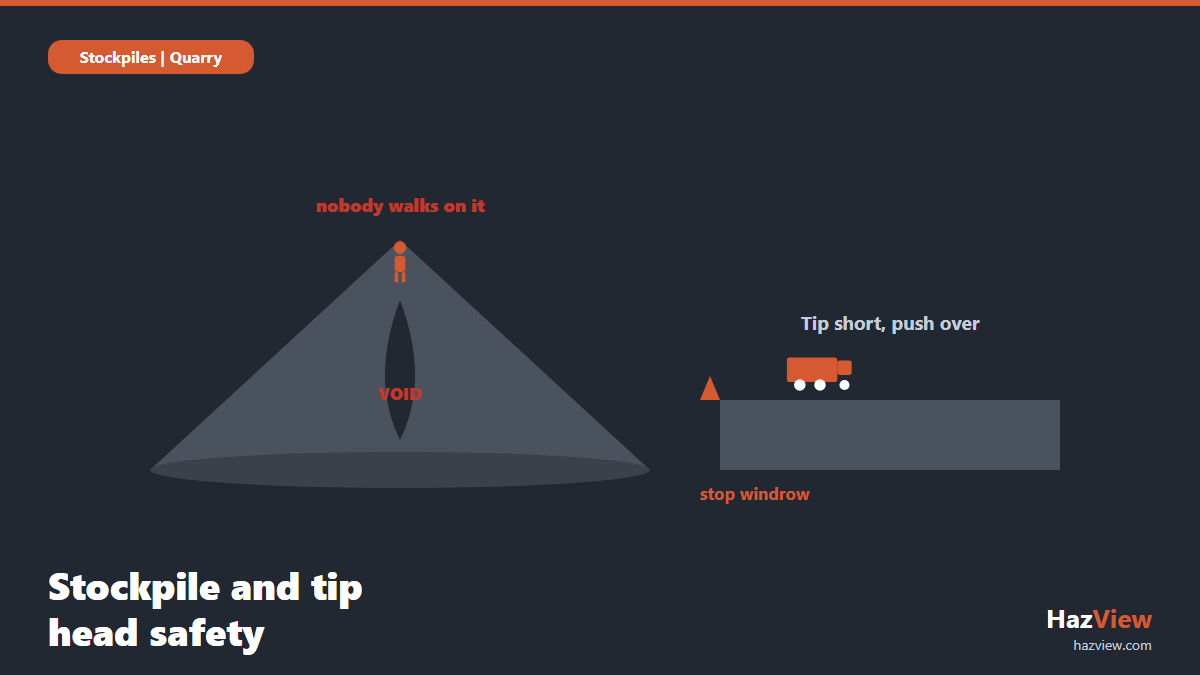
Stockpile safety at a quarry covers two hazards that look mundane and kill people regularly: engulfment in stored material, and failure of a tip head under a truck. Both share a characteristic that makes them dangerous. The material looks solid right up until it is not, and by the time it moves there is no time to react.
This guide covers what actually causes each, and the controls that hold.
Why stockpiles are more dangerous than they look
A stockpile is not a solid heap. Three mechanisms turn it into a trap.
Reclaim voids. Where material is drawn from underneath by a reclaim tunnel or feeder, a cavity forms inside the pile while the surface stays intact. Someone walks onto what looks like solid ground and falls into a void that then collapses on top of them. This is the classic engulfment mechanism and it is invisible from outside.
Undercutting. A loader digging into the toe of a pile creates a steep face above it. The face stands for a while and then comes down as a mass. Same mechanism as an undercut quarry face, at a smaller scale and with less warning. See ground control at a quarry.
Bridging and hang-ups. In bins, hoppers and chutes, material arches over the outlet and stops flowing. Someone goes in or reaches in to free it, and the arch releases at once. Fine, wet or cohesive material bridges most readily, which means the problem is worse in the wet season.
Controls that work for stockpiles
- Nobody walks on a stockpile. The simplest and most effective rule. Make it absolute rather than conditional, because a conditional rule requires a judgement about something invisible.
- Treat any pile with reclaim underneath as a no-go area. Barricade and sign it, and keep the barricade maintained.
- Never dig the toe. Work stockpiles from the top or from the face in a controlled sequence, and set the rule in the operating procedure rather than leaving it to the operator chasing the last of the material.
- Clear blockages from outside. Air cannons, vibrators, hydraulic hammers, poke holes and designed access. Entry into a bin or hopper should be a confined space entry with all that entails, not a routine task.
- Isolate before any work on or near a reclaim system. See isolation and lockout on quarry plant.
- Do not let people work alone near stored material. Engulfment is silent and fast, and a lone worker will not be found in time.
Tip heads
A tip head is where a truck reverses to an edge and discharges over it. The failure mode is the ground giving way under the rear wheels while the body is up, when the truck is at its least stable and the driver has the least control.
What causes it:
- Edge material that has not consolidated. Recently placed spoil at the crest is loose and will not carry a loaded truck.
- Water. Rain saturating the edge, or water ponding at the tip head, is behind a large share of failures.
- Reversing too far. Distance judgement in a mirror, at night, in dust, with a body up.
- No stop point, or a windrow that has been flattened over time and is now a marker rather than a stop.
- Tipping over the edge instead of short. Tipping short and dozing over removes the exposure almost entirely.
Controls that work for tip heads
- Tip short and push over. The single most effective control. The truck never approaches the edge.
- A competent stop windrow, sized as a stop rather than as a marker, continuous, and inspected. This is the same discipline as road windrows: see quarry haul road design.
- Inspect the tip head before each shift and after rain. Cracking parallel to the edge is the warning sign and it precedes failure.
- Grade the tip head away from the edge so water does not run to the crest.
- Lights, delineation and a spotter where conditions warrant, particularly at night.
- Do not lower a raised body while moving, and do not travel with the body up.
Tip head condition changes constantly, so it belongs on the shift inspection with a defined trigger for closing it. Condition triggers work well as a TARP: see building a TARP.
Where this fits in your system
Stockpile and tip head failure usually sit inside geotechnical instability as a principal hazard, and tip head operation also sits inside roads and areas where mobile plant operate. Both should appear explicitly in the relevant management plan rather than being assumed to be covered by a general ground control section.
See identifying principal mining hazards and writing the management plan. Engulfment also needs to be a scenario in your emergency response plan, because the rescue is time-critical and difficult.
Making the no-go areas real
Both hazards depend on people knowing where not to go, and both boundaries move: a stockpile becomes a reclaim hazard when the feeder starts, a tip head becomes unsafe after rain.
Physical barricades and signs handle the permanent cases. The changing ones need something faster, which is where marking closed areas on a shared live map that every operator and contractor can see earns its place. It also timestamps when the area was closed, which is the evidence that the control was in place. See HazView or book a demo.
Related guides
- Water Management, Dewatering and Inrush at a Quarry
- Noise and Hearing Conservation at a Quarry
- Blasting at a Quarry: Exclusion Zones, Flyrock and Clearance
- All Quarry Operations guides
Frequently asked questions
Why can you not walk on a stockpile?
Because voids form inside piles that are drawn from underneath, and the surface stays intact over them. There is no reliable way to tell from the top, so the only workable rule is not to walk on stored material.
How do we clear a bridged bin safely?
From outside, using designed methods: air cannons, vibrators, hydraulic hammers or poke holes, with the plant isolated. Entry should be treated as a confined space entry, not as routine work.
How high should a tip head stop windrow be?
Size it as a stop for the largest vehicle using it, in line with the same principles as road windrows, and keep it continuous and competent. A knocked-down windrow is a marker, not a control.
Is tipping short and dozing over better?
Generally yes. It removes the truck from the edge entirely, which eliminates the exposure rather than managing it. It costs a dozer pass and it is the most effective control available.
What are the warning signs of tip head failure?
Cracking parallel to the edge, subsidence, soft or saturated ground, ponding at the crest, and recently placed unconsolidated material. Inspect before each shift and again after rain.