The site senior executive at a quarry is not a job title the business hands out. It is a statutory position under the Mining and Quarrying Safety and Health Act 1999, and the obligations attach to the person, not to the company. If you are the SSE at a Queensland quarry, the safety and health management system is legally yours to develop and implement.
This guide covers what that means in practice, how it splits from the mine operator’s obligations, and what evidence actually discharges the duty.
The core obligation
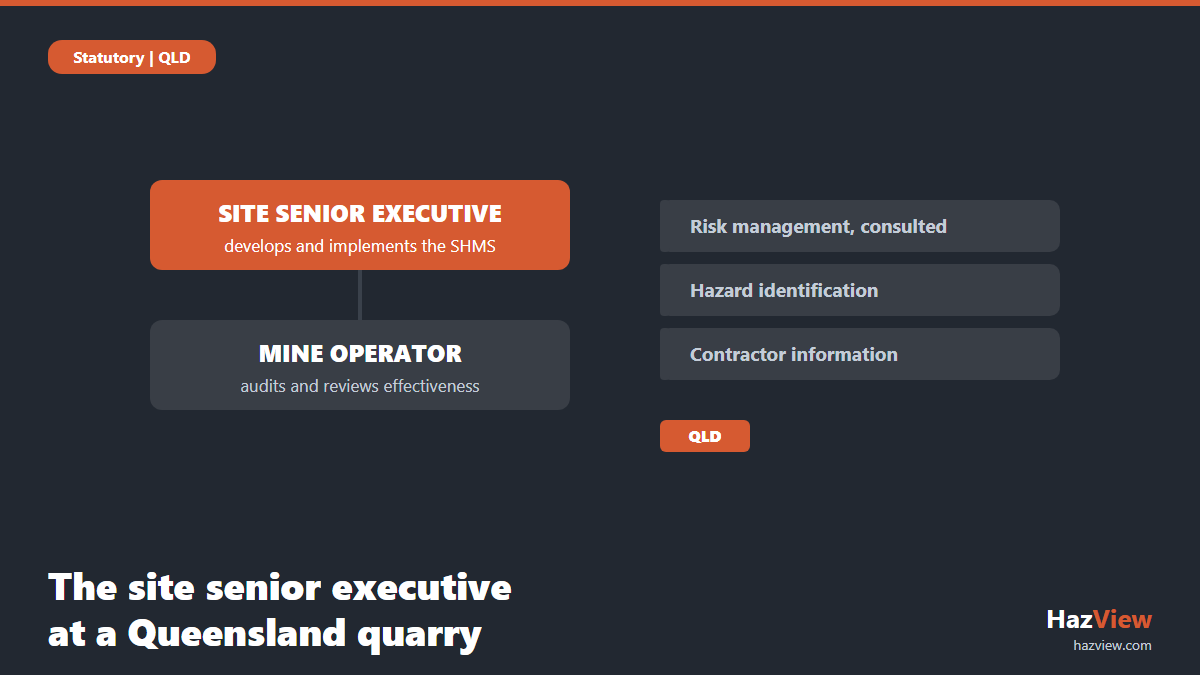
The SSE has the obligation to develop and implement the safety and health management system for the mine. The mine operator has the obligation to audit and review the effectiveness of that system.
That split is the architecture of Queensland quarry safety. It puts the person closest to the operation in charge of the system that governs it, and puts an independent check above them. It also means an SSE cannot deflect a system failure upward, and a mine operator cannot deflect an audit failure downward.
The SHMS must be intended to ensure the risks to persons from operations at the mine are at an acceptable level. See building an SHMS for a Queensland quarry.
What “develop and implement” actually requires
Develop is the easy half. Implement is where SSEs get caught, because implementation is a continuing act rather than a completed one.
- The system reaches the people it governs. An operator who cannot find the control for the hazard they are working next to is evidence of a system that was developed and not implemented.
- Controls are verified, not assumed. Inspection and verification records are how implementation is demonstrated. See quarry inspections that stand up.
- The system tracks the site. Faces advance, plant changes, contractors come and go. A system that describes last year’s quarry is not implemented at this year’s.
- Departures are noticed and dealt with. Consistently, and on the record.
Risk management, done in consultation
The SSE must ensure the mine’s risk management practices and procedures are established in consultation with the mine workers, and are compatible with and coordinated throughout the mine for all operations at the mine.
Consultation is a legal requirement with an evidence trail attached. In practice that means attendance, contributions and what changed as a result. A risk assessment where the operators listed as present said nothing that altered the outcome is a weak document, because the obvious inference is that they were there to sign it.
Coordination is the second half and it is the one quarries fail. Drill and blast, crushing and haulage are often three different organisations. If each runs its own risk process and they meet only at the induction desk, the practices are not coordinated throughout the mine.
Hazard identification obligations
Hazard identification is a recurring obligation, not a project you completed when the quarry opened. Some intervals are specified: hazard identification for hazards caused by hazardous chemicals or dangerous goods must be done at intervals not longer than five years.
At a quarry that reaches further than people expect. Diesel and fuel storage, explosives and their precursors, workshop solvents, oxy-acetylene, and any bulk chemical used in processing all sit inside that obligation.
The SSE also must ensure that a hazardous chemical or dangerous goods selected for use at the mine does not create an unacceptable level of risk to a person when used, handled or stored under standard work instructions. That is a selection duty as well as a handling duty: choosing a cheaper product with a worse hazard profile is an SSE decision.
Contractors are your obligation too
There can only be one safety and health management system on a Queensland site. Contractors come under the principal operator’s system, and the SSE is required to give a contractor information about all relevant components of the SHMS that the contractor must adhere to.
“Give information about” is a low bar to meet and a common one to fail. Handing over a USB stick at induction is not the same as making sure the drill and blast crew know your exclusion zone protocol and your traffic rules. See contractor management at a quarry.
Can one person be SSE at more than one quarry?
It happens, particularly with operators running several small pits across a region. The Act does not make it impossible, but it does not dilute the obligations either. An SSE across four sites carries the full develop-and-implement obligation at all four.
The practical question is whether you can genuinely discharge the duty at each. If you visit a site fortnightly and rely on a supervisor’s phone call for everything else, ask yourself what your evidence looks like the day something goes wrong there. Visibility across sites, rather than more travel, is usually the answer.
Evidencing the role
SSEs generate an enormous amount of safety work that leaves no trace: the call to stand a job down, the instruction to batter a face back, the decision to close a ramp after rain. None of that exists as evidence unless it is recorded, and the absence of a record after an incident reads as an absence of management.
The fix is not more paperwork at the end of a long day. It is capturing the decision where it is made, attributed and timestamped, so the record is a by-product of running the site rather than a second job. That is what HazView does, and why managers use it to see across sites. Book a demo.
For the wider Queensland framework, start at quarry safety in Queensland.
Related guides
- Quarry Safety in Queensland: An MQSHA Guide for Quarry Operators
- Building a Safety and Health Management System for a Queensland Quarry
- Acceptable Level of Risk at a Quarry: What Queensland Actually Requires
- Recognised Standards, Guidelines and Guidance Notes: Which Apply to a Quarry
- All QLD Quarries & Mines guides
Frequently asked questions
What does the SSE actually have to do?
Develop and implement the safety and health management system for the mine, ensure risk management practices are established in consultation with workers and coordinated across the operation, ensure hazard identification is carried out, and give contractors the relevant components of the SHMS they must adhere to.
What is the difference between the SSE and the mine operator?
The SSE develops and implements the SHMS. The mine operator audits and reviews its effectiveness. The obligations are separate and neither absorbs the other.
Is the SSE personally liable?
The obligations under the MQSHA attach to the person holding the position. That is the point of a statutory position, and it is why the appointment and the evidence of how you discharged the role both matter.
How often must hazard identification be done?
Periodically, and for hazards caused by hazardous chemicals or dangerous goods at intervals not longer than five years. Change at the site should trigger it as well, rather than waiting for the interval.
Can a supervisor act as SSE while the SSE is on leave?
Cover needs to be planned and documented rather than assumed. Whoever holds the position holds the obligations while they hold it, so the acting arrangement should be explicit and the person should be capable of discharging the duty.