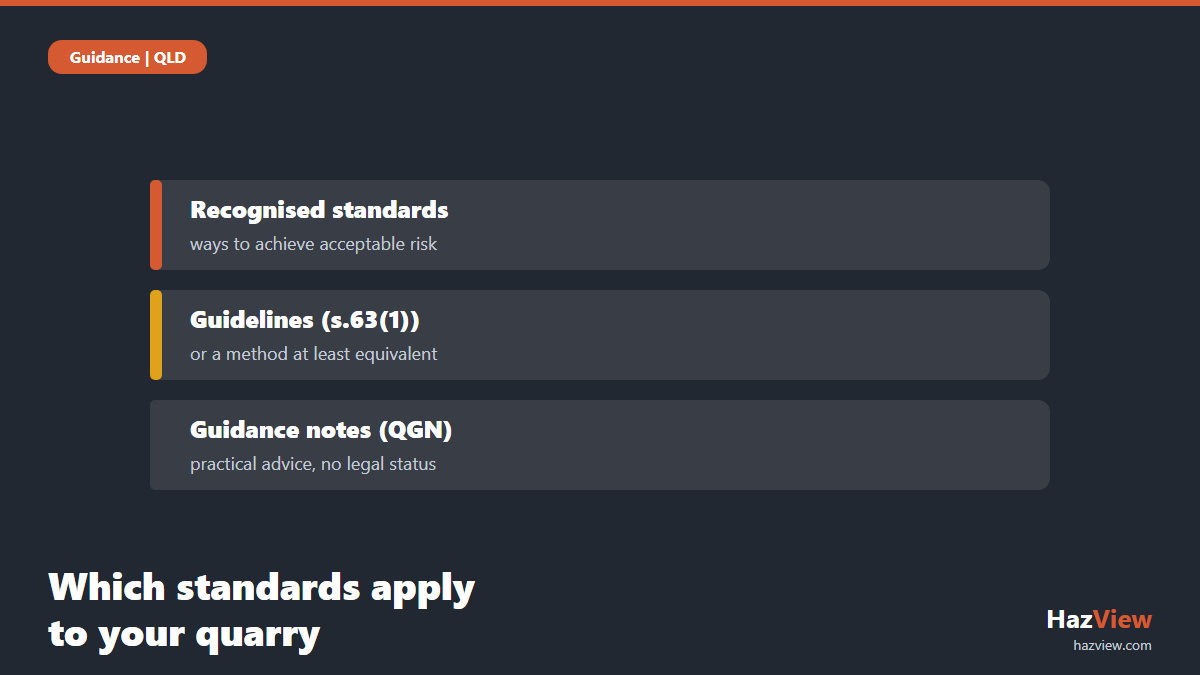
Recognised standards for quarries in QLD are a source of constant confusion, because Queensland publishes three different kinds of document with three different legal weights, and most of the well-known ones were written for coal mines. A quarry operator who treats them all as equally binding will over-build. One who treats them all as optional will get caught.
This guide sorts them out: what each type is, how much weight it carries, and how to work out what applies to a quarry.
The three tiers
Recognised standards
These state ways to achieve an acceptable level of risk. They carry the most weight of the three, and the well-known examples such as Recognised Standard 19 on mine roads sit under the coal legislation.
That last point matters and is routinely missed. A recognised standard made under the coal Act is not automatically a recognised standard for your quarry. It can still be excellent engineering guidance, and a court would take a dim view of you ignoring a well-known standard on a hazard you share, but the legal mechanism is different.
Guidelines
Under section 63(1) of the Mining and Quarrying Safety and Health Act 1999, the Minister may make guidelines that provide ways of achieving an acceptable standard of risk for people working in mineral mines and quarries. This is the quarry-side mechanism.
Guidelines are not mandatory in the sense a regulation is. An operator may manage the risk in a different way, but must be able to show the method used is at least equivalent to the method in the guideline. See acceptable level of risk at a quarry.
Guidance notes
The QGN series. These are practical advice with no formal legal status. They are often the most useful documents of the three for a working quarry, because they are written to be applied rather than to be complied with.
Examples that matter at a quarry include QGN 09 on reviewing the effectiveness of safety and health management systems, and QGN 16 on fatigue risk management. No legal status does not mean no evidentiary value: if a guidance note describes a sensible control for a hazard that then harmed someone at your site, you will be asked why you did not apply it.
How to work out what applies to you
- Check which Act the document sits under. Coal Mining Safety and Health Act, or Mining and Quarrying Safety and Health Act. This is the first filter and it removes a lot of noise.
- Check whether the hazard is shared. Haul roads, mobile plant, ground control and dust behave the same way regardless of what you are digging. Documents written for coal on shared hazards are highly relevant even where they are not legally binding on you.
- Check the scale assumption. Guidance written for a large operation may assume resources a 15-person quarry does not have. That is where the “at least equivalent” route earns its keep.
- Record the decision. For each significant hazard, note which document you are working to, or that you are managing it differently and why the method is equivalent. This single habit is the difference between a considered position and an apparent gap.
The coal documents worth reading anyway
Being pragmatic: on shared hazards, the coal-side documents are frequently the best written material available in Australia, and no inspector will criticise you for using them. The ones that transfer well to a quarry:
- Mine road design and construction. Geometry, grades, berms and intersections do not change with the commodity. See intersection design, safety berms and grades and ramps.
- Trigger action response plans. The structure is universal. See building a TARP.
- Fatigue risk management. QGN 16, and the general principles apply to any roster. See fatigue management at a quarry.
- Reviewing SHMS effectiveness. QGN 09, directly useful to the mine operator’s audit and review obligation.
Looking outside Queensland
Nothing stops you using another jurisdiction’s material as the basis for a control, and on some hazards it is simply better. Two worth knowing about:
- WA’s road and traffic management code of practice, published 4 August 2026, is the most current and comprehensive Australian document on mine traffic. See what it requires.
- WA’s ground control code of practice is expressly written to cover small sandpits and quarries as well as large operations. See ground control at a quarry.
If you adopt an interstate document, say so in your safety and health management system and explain why it achieves an acceptable level of risk here. Silently working to another state’s standard looks like confusion. Deliberately adopting it, documented, looks like judgement.
Keep a register
The most useful half-day a quarry SSE can spend is building a simple register: hazard, the document you are working to, its status, and where the corresponding control sits in your system. Review it annually.
It makes the “at least equivalent” argument straightforward, it makes audits fast, and it exposes the hazards where you are currently working to nothing at all, which is usually the point at which someone finds a gap worth closing.
For the wider framework, see quarry safety in Queensland. To make control verification produce its own evidence, book a demo of HazView.
Related guides
- Quarry Safety in Queensland: An MQSHA Guide for Quarry Operators
- The Site Senior Executive at a Queensland Quarry: Obligations Explained
- Building a Safety and Health Management System for a Queensland Quarry
- Acceptable Level of Risk at a Quarry: What Queensland Actually Requires
- All QLD Quarries & Mines guides
Frequently asked questions
Are recognised standards mandatory?
They state ways to achieve an acceptable level of risk rather than operating as regulations. You can use a different method, but you have to be able to show it is at least equivalent.
Does RS19 apply to a quarry?
RS19 sits under the coal legislation, so it is not a recognised standard for a quarry in the strict legal sense. The engineering in it applies to any haul road, and using it as your basis is a defensible choice you should record.
What is the difference between a guideline and a guidance note?
A guideline is made under section 63(1) of the MQSHA and provides a way of achieving an acceptable standard of risk. A guidance note is practical advice with no formal legal status, though it still carries evidentiary weight.
Can we use a WA or NSW document at a Queensland quarry?
Yes, provided the control achieves an acceptable level of risk. Document the choice and the reasoning inside your safety and health management system rather than adopting it informally.
Where do I find the current list?
Resources Safety and Health Queensland and the Business Queensland legislation and standards pages publish the current recognised standards, guidelines and guidance notes. Check the date on anything you rely on, because the lists change.